Jammu & Kashmir House Arrests: Opposition Leaders Detained Ahead of Student Quota Protests, Escalating Political Tensions
By: Javid Amin | 28 December 2025
House Arrests and Heightened Tensions in Jammu & Kashmir: Political Leaders Detained Ahead of Student Quota Protests
In a dramatic escalation of political tensions in the Union Territory of Jammu & Kashmir (J&K), authorities on Sunday placed several prominent opposition leaders under house arrest, days before a scheduled student protest over the reservation policy. The preventive action has drawn criticism from political figures and civil rights observers as a move to suppress dissent ahead of a peaceful sit-in planned by students demanding rationalisation of quotas in government jobs and educational institutions.
Among those confined to their homes were – Peoples Democratic Party (PDP) president Mehbooba Mufti, her daughter Iltija Mufti, National Conference (NC) MP Aga Syed Ruhullah Mehdi, PDP leader and Pulwama MLA Waheed ur Rehman Para, and former Srinagar mayor Junaid Azim Mattu. Sources describe the detentions as a pre-emptive measure by security forces aimed at keeping these senior voices from joining the student movement and giving it wider political resonance.
This episode underscores the intensely sensitive interplay in J&K between youth activism, reservation policy debates, and political governance—and highlights broader questions about the space for democratic dissent in the region.
A Crucial Flashpoint: Students, Quotas, and Rising Frustration
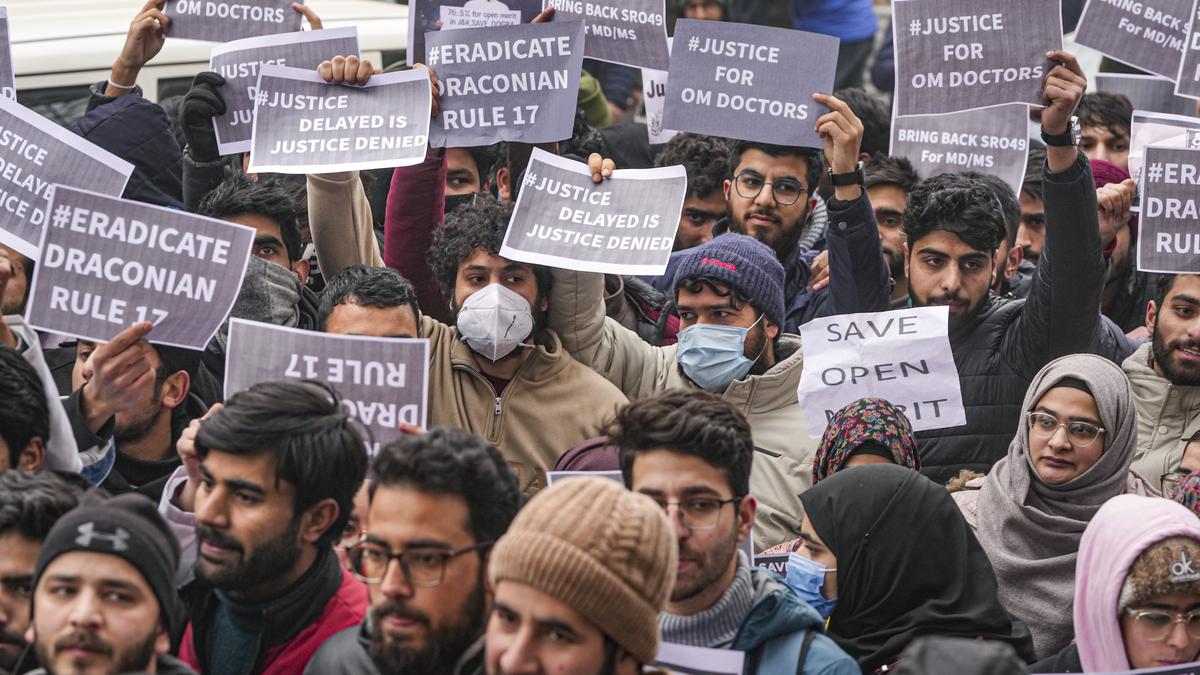
For more than a year, students in J&K have been pressing the government for rationalisation of the reservation policy, which they argue disproportionately disadvantages open merit candidates. The dispute began as youth agitation and over time gained political backing from leaders across party lines who share concerns over perceived inequities in the quota regime.
Why Quotas Matter
The reservation policy in J&K expanded significantly in recent years, with reserved categories receiving a substantial portion of seats in government jobs and educational admissions. Critics say this has reduced opportunities for general category (open merit) aspirants. The students’ group – the Open Merit Students Association of J&K – has called for:
-
A rationalised quota system
-
Transparency in policy formulation
-
A halt to further reservation until a review
The group planned a peaceful sit-in protest on Gupkar Road and Polo View Market in Srinagar for Sunday, December 28, 2025, aimed at spotlighting their demands and accelerating government action.
Political Leaders Under House Arrest: Details and Individual Profiles
Mehbooba Mufti: A Senior Opposition Stalwart
Former J&K Chief Minister and PDP president Mehbooba Mufti was among the first detained. Alongside her daughter, Iltija Mufti, she was kept at her residence with security forces stationed outside. The decision follows her public expression of solidarity with students and her vocal criticism of the government’s handling of the reservation issue.
Mehbooba’s confinement was swiftly met with reactions from supporters and party members, who described the action as an attempt to stifle dissent rather than address substantive policy concerns.
Aga Syed Ruhullah Mehdi: MP and Vocal Critic
National Conference MP Aga Syed Ruhullah Mehdi, representing Srinagar in the Lok Sabha, has been a leading voice opposing the current reservation structure. His repeated calls for rationalisation have put him at odds with the policy decisions of his own party’s government led by Chief Minister Omar Abdullah.
Security forces allegedly deployed armed personnel outside Mehdi’s residence prior to the protest, preventing him from leaving home to join the sit-in. The MP’s office described the move as “a pre-emptive crackdown to silence a peaceful, pro-student demonstration.”
Waheed ur Rehman Para: Youth Advocate and PDP Leader
PDP MLA Waheed ur Rehman Para, representing Pulwama, was also detained under house arrest. In a social media post, Para described the house arrest as “unfortunate” and accused the government of using security measures to suppress democratic expression. He said the reservation issue has become “an existential” concern for the youth of J&K, threatening their future prospects.
Junaid Azim Mattu: Former Mayor and Restriction
Former Srinagar mayor Junaid Azim Mattu, who has allied with student groups on this issue, also found his movement restricted by a heavy police and paramilitary deployment outside his residence. Mattu used social media to denounce the restrictions as excessive, alleging they were intended to curb voices seeking justice.
Iltija Mufti: Youth Leader and Confinement
Iltija Mufti, a PDP leader and daughter of Mehbooba Mufti, reported that she too had been placed under house arrest. She described the situation as symptomatic of a broader inability to engage in public life freely, particularly regarding peaceful protest and advocacy for students.
Government’s Stated Rationale and Official Silence
Authorities in J&K have characterised the detentions as preventive measures to manage tensions and avert uncontrolled gatherings. Officials said that this action was taken following assurances from leaders that they intended to join the protest, and it was aimed at maintaining public peace.
However, there has been no formal government statement detailing the legal mechanisms or explicit orders that authorised these detentions. Critics argue that detaining leaders in advance of a peaceful protest erodes trust and suggests a strategy of containment rather than engagement.
Historical Context: Protests and Detentions in J&K
The employment of house arrests and movement restrictions of political leaders is not without precedent in Jammu & Kashmir.
In August 2019, following the abrogation of Article 370 and reorganisation of the state, hundreds of political figures—including Mehbooba Mufti—were placed under preventive detention amid sweeping security measures. These detentions were intended to forestall unrest after a significant constitutional change but were widely criticised for stifling democratic participation.
The recurrence of such measures during the quota protests highlights a pattern of administrative responses to political dissent in the Union Territory.
The Student Movement: Scope, Structure, and Leadership
The reservation protests are largely led by the Open Merit Students Association of J&K, a collective representing aspirants from general categories who feel marginalized by the current quota regime.
The association’s demands include:
-
Rationalising reservation allocations in line with population proportions
-
Ensuring merit is adequately represented
-
Making the Cabinet sub-committee’s findings public
Despite the Constitutional protections related to reservations, students say the present framework—developed through multiple revisions—has resulted in open merit seats shrinking to levels that disadvantage a substantial segment of the population.
Reservation Policy in J&K: What’s at Stake
Since 2019, the reservation policy in J&K has been a bone of contention. The government expanded quotas across several categories including Scheduled Castes (SC), Scheduled Tribes (ST), Residents of Backward Areas (RBA), Other Backward Classes (OBC), and Economically Weaker Sections (EWS), as well as vertical and horizontal classifications for special groups such as ex-servicemen and persons with disabilities.
As per the current framework:
-
Open Merit has been reduced significantly, with reserved categories collectively receiving more than half of the seats in many spheres.
-
Students argue this has limited merit-based opportunities, especially for groups that do not fall under any reserved category.
-
Aspirants want a review that restores an equitable balance between reservation support and open merit, without reversing affirmative action goals.
The cabinet sub-committee formed by Chief Minister Omar Abdullah was tasked with reviewing the reservation policy, but its report has not been placed in the public domain. This lack of transparency has only intensified uncertainties and suspicion among students and political critics alike.
Political Fallout and Public Reactions
The house arrests have triggered varied reactions across the political spectrum and the public.
Opposition Voices
Opposition figures have characterised the detentions as unjust and undemocratic, arguing that preventing leaders from engaging with students undermines the right to peaceful protest. Waheed Para’s assertion that the issue has become existential for the youth reflects broader frustration within political circles.
Public Sentiment
Among broader public opinion, many Kashmiris express concern over the government’s approach. Students and families of aspirants voiced feelings that the state’s preventive tactics may exacerbate mistrust rather than quell tensions.
Social media reactions, local discussions, and community conversations echo the sentiment that the government should engage substantively with student demands, rather than relying on restrictions.
Risks, Challenges, and Future Trajectories
This situation presents several critical risks and challenges:
1. Suppression of Dissent
Preventing political leaders from joining peaceful protests signals a tightening of civic space, which could fuel more intense public anger and alienation.
2. Policy Uncertainty
With the cabinet sub-committee’s report not yet public, mistrust persists about whether government intentions align with student demands. Lack of clarity and transparency remains a central grievance.
3. Potential Escalation
While the protest planned for Sunday was intended to be peaceful, detentions could motivate more assertive forms of resistance, both among students and political activists.
What This Means for Jammu & Kashmir’s Political Landscape
The house arrests reflect a broader tension in J&K’s political landscape: the challenge of managing youth aspirations, governance responsiveness, and democratic dissent. What started as dissatisfaction with reservation allocations has morphed into an emblem of deeper institutional tensions and a perceived gap between citizen expectations and administrative action.
In this environment, political actors must navigate carefully:
-
Balancing security concerns with democratic freedoms
-
Restoring trust through transparent engagement
-
Addressing policy grievances without polarising communities
Conclusion: A Maturing Political Confrontation
The detention of Mehbooba Mufti, Ruhullah Mehdi, Waheed Para, Junaid Mattu, and others ahead of student quota protests is not merely a restrictive measure—it is a signpost of enduring political dynamics in Jammu & Kashmir. Amid demands for quota rationalisation, election platforms, and long-standing debates over governance post-Article 370, this episode reinforces the fact that citizenship, merit, representation, and political voice continue to be central to Kashmir’s public discourse.
The coming weeks will determine whether the government chooses dialogue and transparency or continues with tactics that many see as containment. Either path will shape how youth movements and political dissidents engage with governance in the Valley in the years to come.

