J&K Cabinet Greenlights Open-Merit Hike: What the 2025 Reservation Overhaul Means for Jobs, Youth & Regional Politics
By: Javid Amin | 03 December 2025
The Fork in the Road for J&K’s Youth and Communities
On December 3, 2025, a decisive move by the Jammu & Kashmir Cabinet — led by Omar Abdullah — altered the contours of reservation policy in the Union Territory. In a historic reshuffling, authorities approved increasing the Open Merit (OM) quota from roughly 30 % to 40–50 %, drawing down allocations for Residents of Backward Areas (RBA) and Economically Weaker Sections (EWS) by about 10 percentage points each, while leaving quotas for Scheduled Castes (SC), Scheduled Tribes (ST), Other Backward Classes (OBC), and border-area categories untouched.
The decision signals a clear attempt by the government to respond to growing discontent among general-category youth, who have long complained about limited opportunities. Yet, it also triggers alarm among rural and disadvantaged communities that depend on quotas for access to education and employment — and sets the stage for a volatile political and social reckoning.
In a region still wrestling with the aftermath of constitutional changes, rising unemployment, and deep regional disparities, the stakes of this overhaul extend far beyond numbers. This is a moment that could redefine youth aspirations, reshape social equity, and alter political alignments.
A Short History: How J&K’s Reservation System Evolved Post-2019
01. The Post-370 Reset and the Restructured Reservation Matrix
After the revocation of special status in 2019, the J&K administration undertook a sweeping rework of the reservation framework. New categories were added, quotas redistributed, and special protections for remote and disadvantaged areas expanded. The result: a quota-heavy system that many argue shrank the scope of merit-based competition dramatically.
Traditional categories such as SC/ST remained, but additional allocations for RBA, EWS, ALC/IB (border/line-of-control/International-Border residents), Pahari tribes, and others substantially increased the share of “reserved” seats and jobs. The open-merit pool — once considered the default — found itself squeezed.
02. Growing Discontent Among Open-Merit Aspirants
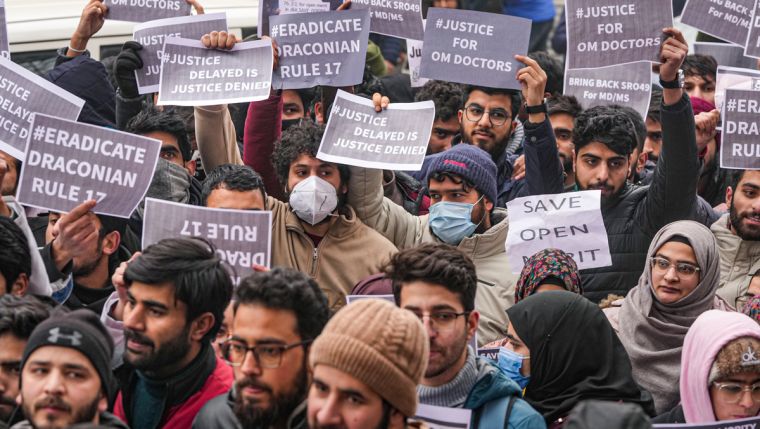
By 2024–2025, frustration among general-category youth — especially those who did not belong to any reserved group — had escalated sharply. Reports from job-seekers and candidates applying to professional courses showed recurring patterns where even high-scoring applicants found themselves edged out by category-based allocations.
One recent instance — for 600 Accounts Assistant posts — saw only 40 % (240) allotted to OM aspirants, while the remainder were distributed across reserved categories. This triggered renewed demand for quota rationalisation.
Historically, many Kashmir-based youth have argued that the massive quota framework post-2019 has led to a “merit freeze,” where even hard-earned academic scores and competitive exam results offer little assurance of success.
03. The Case for Reform: Calls for Rationalisation Intensify
Amid growing protests, public debate, and mounting disappointment, calls for a rationalisation of the quota system gained traction by early 2025. Critics — including youth groups, some civil-society voices, and general-category aspirants — argued that the current policy disproportionately disadvantages the majority, undermines meritocracy, and aggravates regional imbalance.
In response, the government constituted a Cabinet Sub-Committee (CSC), tasked with revisiting the reservation framework, assessing demographic and employment data, and proposing reforms to align with fairness.
The December 3, 2025 Cabinet Decision: What Changed, What Remains
01. The Core Changes Approved
The Cabinet’s green light to the CSC’s recommendations resulted in:
-
OM quota raised by 10 percentage points (from approx. 30 % to 40–50 %, depending on interpretation by different reports)
-
RBA and EWS quotas cut: roughly 7 % reduction in EWS, 3 % in RBA, contributing to the OM boost.
-
No change in quotas for SC, ST, OBC, border/ALC categories — categories protected on constitutional or administrative grounds.
The overall objective, according to government sources, is “rationalisation,” not rollback — i.e., recalibrating the quota matrix to ensure fairer division without removing protections for historically marginalized groups.
02. Administrative Follow-up: Sending File to the Lieutenant Governor
Post Cabinet approval, the revised quota structure has been forwarded to the Manoj Sinha-led Raj Bhawan for final consent and formal notification. Until the Lieutenant Governor signs off, the decision remains a proposal, albeit a strongly backed one.
Chief Minister Omar Abdullah has emphasised that the rationalisation is an effort to balance aspirations and equity, though detailed implementation guidelines — especially for certificate-issuance, backlog resolution, and ongoing recruitments — are yet to be clarified.
Reactions & Repercussions: From Euphoria to Angst
01. Relief and Hope Among OM Aspirants & Urban Youth
For many general-category job seekers and students, the decision sparked relief — and renewed optimism.
-
A leading youth aspirant from Srinagar told reporters that the OM hike “revives hope of a fair fight,” especially for those who have prepared hard without belonging to any reserved category.
-
Several social-media groups and student forums have already lifted celebrations, seeing the decision as vindication of their long protest against what they called “systematic exclusion.”
Pro-merit voices argue this shift is necessary to prevent the “flattening of aspirations” and to restore faith in competitive exams and job recruitments.
02. Outrage and Fear Among RBA / Rural / Economically Weaker Sections
On the other side, leaders and activists representing remote-area dwellers, rural Kashmir, and economically disadvantaged communities expressed deep concern — some even called it “political betrayal.”
One senior community leader from South Kashmir’s Pulwama district warned that “reducing RBA will silence entire villages — families that depended on quota-based access to education and stable employment.”
Student protests have been threatened, especially from districts such as Kupwara, Bandipora, Pulwama, and others where RBA certificates formed lifelines for many first-generation college-goers.
03. Regional Imbalance and Perceived Jammu-Kashmir Divide
A particularly sensitive flashpoint: recent data show a disproportionate issuance of category certificates heavily favouring Jammu region — reportedly around 72% in 2025 — while Kashmir lagged at 28%.
Critics in the Valley argue that the quota reshuffle may be used to further erode Kashmir’s representation, especially if RBA reductions disproportionately affect rural and remote Valley districts.
On the other hand, many in Jammu — where general-category aspirants are numerically stronger — welcome the move as a push towards merit-based fairness.
04. Political Fallout: Opposition Outcry & Civil Society Alarm
Opposition parties wasted no time in critiquing the decision. Several political formations accused the government of “politically engineering” the quota structure to favour general-category aspirants, ignoring ground realities of backward areas and economic inequality.
Civil society, student unions, and activists have issued statements demanding transparent implementation, data on past certificate distributions, and assurances that vulnerable communities will not be sidelined.
Educational institutions, recruitment bodies, and job-seekers await detailed administrative guidelines. The lack of clarity in implementation has already triggered a protest deadline from some student groups — demanding the state publish category-wise vacancy details, reservation-category certificate lists, and a fixed timeline for applications under the new policy.
The Socio-Economic Stakes: Who Gains, Who Risks
01. For General-Category Youth: Renewed Opportunity
-
Increased Chances: Higher OM quota improves prospects for high-scoring aspirants — especially in competitive exams and professional courses.
-
Restoring Meritocracy: For many, the decision reflects a return of the merit principle — where performance, not identity, becomes decisive.
-
Boost to Confidence: In a region plagued by unemployment and limited opportunities, the move may restore faith in systemic fairness.
Yet, these gains come with intense pressure: more OM aspirants will compete for available posts; competition may intensify; and expectations will soar.
02. For Rural & Economically Vulnerable Populations: Risk of Marginalisation
-
Shrinking Access: Lower RBA/EWS quotas could significantly curtail access to jobs and higher education for backward-area and economically weak families.
-
Regional Disparity Widening: Remote regions, especially in Kashmir’s hinterlands, may face deeper exclusion, while urban areas benefit more.
-
Loss of Safety Net: Many beneficiaries — first-generation students, compartmentalised communities — may lose upward mobility.
A social leader from rural Kupwara summarised the fear:
“For families like ours, RBA was more than reservation — it was hope. Cut that, and you erase their future.”
03. For Institutions & Governance: A Complex Implementation Challenge
-
Restructuring Recruitment & Admission Lists: All upcoming job adverts, college admissions, and certificates will need recalibration.
-
Monitoring Horizontal & Special Reservations: Categories like persons with disabilities, ex-servicemen, border-area residents, etc., need guarantees that their share isn’t squeezed out.
-
Ensuring Regional Equity: Without robust data tracking, the policy may inadvertently deepen regional or ethnic disparities.
-
Managing Legal Risk: The overhaul may invite court challenges — especially from communities arguing deprivation of historically guaranteed rights.
Legal, Ethical & Constitutional Dimensions
01. Reservation, Affirmative Action and the Merit Principle in India
India’s reservation system was originally designed as an affirmative mechanism — to uplift historically marginalized castes, tribes, and regions. Over decades, it has focused on social justice, inclusion, and leveling the field.
However, critics argue that excessive or poorly targeted quotas distort meritocracy, breed resentment, and erode standards — especially in sensitive sectors like education and administration.
J&K’s 2025 reform sits at this ethical fault line — attempting to recalibrate between fairness to majority youth and safeguarding vulnerable communities.
02. Constitutional & Policy Challenges in J&K’s Context
-
The 2019 reorganisation and subsequent quota expansion created a complex matrix of vertical and horizontal reservations. Reassessing that matrix demands careful balancing, legal clarity, and stakeholder consultation.
-
Reduced quotas for backward-area or economically weaker sections may be challenged as retrogressive unless alternate welfare or support systems are offered.
-
Authorities must ensure transparency in certificate-issuance and avoid overlap, misuse or duplication — especially in a context where political trust is fragile.
What’s Next? Implementation, Monitoring & the Road Ahead
For the decision to be effective — and socially sustainable — the following steps are critical:
01. Transparent Roll-Out & Clear Timelines
The government must publish a clear implementation schedule: notification timelines, vacancy-lists, certificate-verification windows, transitional arrangements for pending recruitments and admissions.
02. Stakeholder Engagement & Social Dialogue
Meaningful consultations with students, backward communities, rural stakeholders, civil society groups, and economic-class advocates can ease tensions, build consensus, and prevent unrest.
03. Data-Driven Monitoring & Periodic Review
A transparent, publicly accessible dashboard tracking recruitment, admissions, region-wise representation, and category-wise allocations will help audit equity and prevent misuse.
04. Complementary Welfare & Upliftment Measures
Reducing quotas for backward or economically weak groups must be accompanied by enhanced social welfare — scholarships, economic support, skill training, rural development — to preserve inclusivity.
Broader Significance: What This Means for J&K’s Future
This quota overhaul is more than a technical adjustment. It represents a sociopolitical pivot — a recalibration of who gets opportunity, whose aspirations are prioritized, and how justice is defined in a region still struggling with political uncertainty, economic stagnation, and identity fissures.
-
For youth and merit-seekers, it offers renewed hope.
-
For rural and vulnerable communities, it raises fear of marginalisation.
-
For political parties, it becomes a battlefield for voter support.
-
For civil society, it underscores the challenge of balancing equity and fairness.
-
For governance, it is a test of policy design, transparency, and delivery.
The decisions taken today — and how they are implemented — may well shape the next decade of Jammu & Kashmir’s social, economic, and political trajectory.
Conclusion — A Gamble on Fairness, Identity, and Justice
By raising the Open Merit quota and cutting RBA/EWS slots, the J&K government has thrown down the gauntlet — challenging long-standing, quota-heavy structures, while asking citizens to reimagine representation and opportunity.
If handled with transparency, fairness, and inclusive safeguards, this could restore faith among general-category aspirants and ease youth frustration. But if rushed or executed without sensitive social balancing, it risks disenfranchisement, regional alienation, and renewed unrest.
For a region where identity, opportunity, and dignity remain fragile, the 2025 reservation overhaul stands as one of the most consequential social experiments. Its success — or failure — will be measured not just in numbers, but in lives, hopes, and the future of a generation.


