JKNC’s Promise Deficit: One Year of Omar Abdullah & Jammu & Kashmir National Conference — Why Key Pledges Remain Unfulfilled
By: Javid Amin | 10 December 2025
The Hopes That Met the Cold Reality
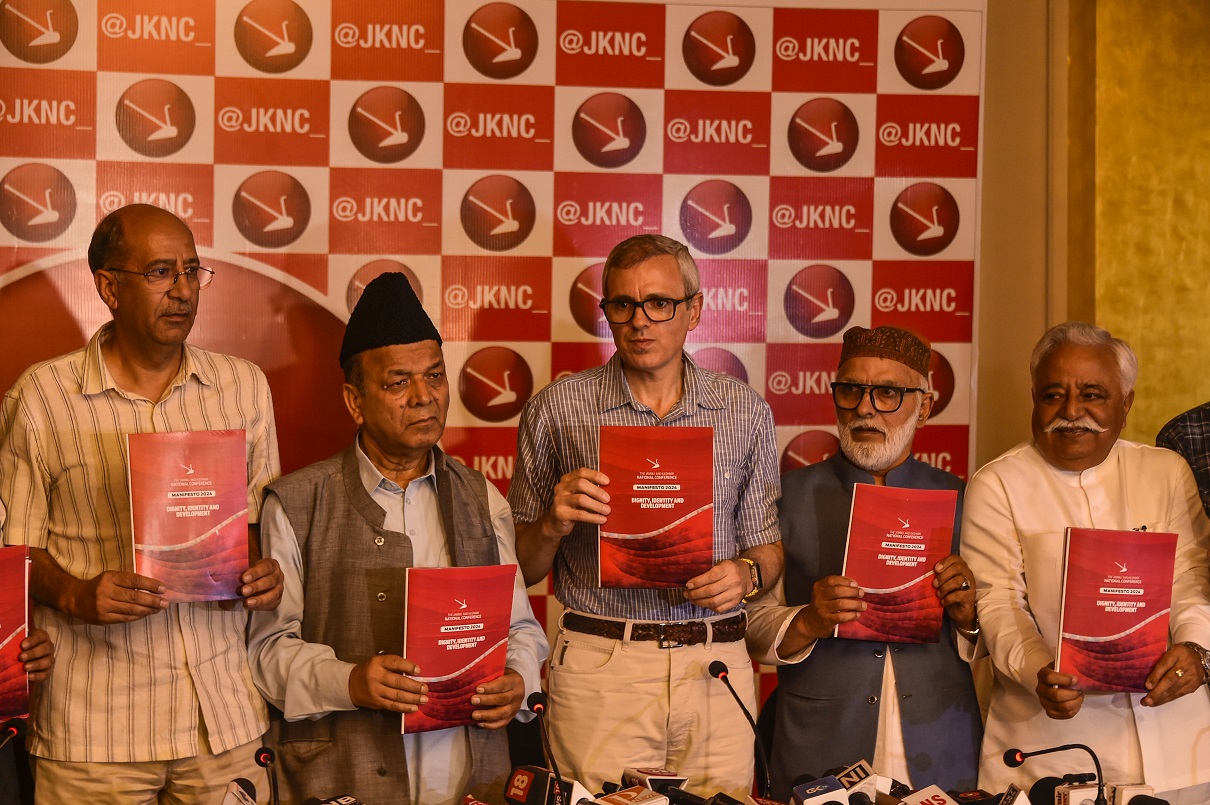
When Jammu & Kashmir National Conference (JKNC), under the leadership of Omar Abdullah, swept to power in the 2024 Assembly elections, there was a palpable sense of hope across the region. For many Kashmiris, it seemed like a second chance at restoring rights, dignity—and meaningful governance. Within months, the party’s manifesto, unveiled in August 2024, had raised expectations through sweeping promises: restoration of full statehood and constitutional safeguards, protection of Kashmiri identity, mass job creation, free electricity for households, reservation reforms, return of displaced communities and more.
But today, nearly a year into JKNC’s rule, the mood across the Valley is markedly different. Many of those promises remain unfulfilled. Institutional roadblocks, political compromises, and electoral setbacks have combined to erode trust — and left ordinary citizens questioning whether the hope once offered was realistic.
This article examines, promise by promise, what JKNC has delivered so far — and where it has fallen short. It draws on recent reporting, ground-level perspectives, and political developments to offer a comprehensive, up-to-date assessment of JKNC’s first year back in power.
The Promise — And the Pause: Statehood Restoration & “Dual Power Centre”
Statehood: Central Pledge, Central Delay
One of JKNC’s flagship promises for 2024 was the restoration of full statehood to Jammu & Kashmir. The move would presumably restore many of the powers and privileges that were curtailed after the 2019 reorganization.
Upon assuming office, Omar Abdullah reaffirmed this demand publicly. In early 2025, he expressed optimism, stating that the government was committed to restoring J&K’s statehood.
Yet, as of now, no concrete timetable has emerged. The process appears stalled, with little visible progress. Officials in the JKNC frequently attribute the delay to “structural constraints” — namely, the division of authority between the democratically elected government of JKNC and the centrally appointed Manoj Sinha, the Lieutenant Governor (LG). This dual-power arrangement, critics argue, severely limits the elected government’s ability to act autonomously.
The result: for ordinary citizens — many of whom voted on the promise of statehood — the wait continues. Uncertainty over the region’s political future remains high, and frustration has begun to seep in.
Institutional Friction: Governance Paralysis
The conflict between the Chief Minister’s office and the LG’s office has emerged as a significant stumbling block for governance. According to JKNC legislators, the LG retains control over police, transfers and promotions of IAS officers, and other critical aspects of the administration — effectively undercutting the elected government’s authority.
This institutional friction has translated into paralysis on many welfare and development fronts. Decisions that require coordination across administrative departments — ranging from power distribution to employment to reservation policy — are delayed, diluted or indefinitely deferred.
In effect, the promise of restored statehood has morphed into a broader demand for an end to the “dual power centre” system — a demand JKNC continues to press, but with limited leverage.
The Mirage of Autonomy: Article 370, Identity, and Political Credibility
Campaign Rhetoric vs. Post-Election Reality
Another core plank in JKNC’s 2024 manifesto was the restoration of constitutional safeguards under Article 370 (and Article 35A). The party pledged to fight for the reinstatement of these provisions, which had been revoked by the central government in 2019.
On the campaign trail, Omar Abdullah framed the abrogation as an “existential challenge” to the people of Jammu & Kashmir — threatening land rights, identity, and employment protections.
However, after coming to power, JKNC’s approach shifted: rather than push for immediate restoration of Article 370, the government recalibrated its demand to focus on statehood first — a shift that many saw as a retreat from core constitutional demands.
In recent months, despite occasional affirmations that the “special status issue remains alive,” the government has taken no substantive step toward restoring Article 370 or 35A.
Internal Criticism & Eroding Party Credibility
That shift has fomented discontent — not only among opposition parties, but within JKNC itself. Prominent party figures, including Aga Ruhullah Mehdi, have publicly voiced disappointment at what they view as a climb-down from pre-election commitments.
Once widely seen as the champion of Kashmiri identity and rights, JKNC’s credibility on constitutional safeguards now seems weakened. Opposition parties and disappointed supporters accuse the party of substituting real pressure on Delhi with symbolic resolutions and rhetoric.
In a region where identity, land, and jobs remain deeply entwined with constitutional protection, such backtracking has significant political costs — and raises serious questions about whether JKNC can deliver on its original vision.
Socio-Economic Promises Left Unfulfilled: Jobs, Electricity, Reservation Reform
Employment Promise: Largely a Mirage
Perhaps the most concrete socio-economic promise made by JKNC in 2024 was job creation. The 2024 manifesto pledged one lakh (100,000) jobs for the youth of Jammu & Kashmir.
A year on, however — according to critics — there has been no major recruitment drive, no new “Youth Employment Generation Act,” and no structural reform aimed at absorbing educated youth into stable, long-term employment.
Unemployment remains a pressing challenge. According to recent estimates, youth unemployment in J&K stands significantly above the national average.
For many youngsters, hopes of stable government employment remain distant. The gap between the promise and the outcome fuels growing frustration — especially among the region’s educated youth, who feel their aspirations have been sidelined.
Free Electricity: No Relief for Households
Another high-visibility promise was the provision of 200 free electricity units per household per month — a populist welfare measure aimed at easing the financial burden on ordinary citizens.
However, ground reports and media investigations paint a far different picture. Frequent power outages, erratic supply, inflated bills, and collapsing infrastructure continue to plague households across both Kashmir and Jammu divisions. In many places, the free electricity scheme remains a non-starter.
According to a widely shared post from a Srinagar resident on social media:
“@OmarAbdullah promised 200 units of free electricity, but we’re lucky to get 200 minutes of power a day! #JKBetrayed”
Such widespread disillusionment suggests that the free electricity pledge, which had once energized voters, now stands as a symbol of unfulfilled promises — undermining the government’s welfare-oriented image.
Reservation Policy & Social Equity: Partial and Murky
JKNC’s election platform also included assurances of rationalized reservation policies — promising better opportunities for local youth and historically marginalized communities.
Recently, the party has claimed to have “delivered” on this promise via a rationalization of the reservation system.
But the details remain opaque. No transparent data has been released. Critics — including some within JKNC — argue that the reform is cosmetic, lacking clarity or fairness. Some allege that the new policy still disadvantages merit-based applicants and fails to address structural issues.
In short: while the party may claim a partial “success,” for many Kashmiris, the reform lacks substance and trust.
Political Fallout: By-Elections, Internal Dissent & Eroding Leverage
By-Poll Defeats Signal Waning Faith
JKNC’s political capital has taken a significant hit in recent months. In the recent by-elections, the party suffered setbacks — notably losing the seat in Budgam (a seat held by the party almost continuously since 1957) and performing poorly in Nagrota.
These losses are more than symbolic: they reflect diminishing voter confidence, waning party morale, and weakening political leverage. Given that JKNC had once portrayed itself as the only credible safeguard against perceived central overreach, this shift sends a strong message to both the public and New Delhi: the honeymoon may be over.
Internal Fractures: From Unity to Critique
Behind the scenes, discontent within JKNC has become more prominent. Senior figures like Aga Ruhullah Mehdi have publicly criticized the leadership for abandoning constitutional promises like Article 370 and for failing to implement social and economic reforms.
This internal dissent is significant. When even party stalwarts feel compelled to raise their voice, it suggests deeper structural disillusionment — not just among supporters, but within the party’s own framework.
Such fractures weaken JKNC’s negotiating position vis-à-vis both the central government and rival regional outfits. For a party that once claimed moral and political ascendancy, this internal turbulence may ultimately undermine its ability to push for statehood or autonomy effectively.
Governance Disconnect: Welfare, Development, and Public Sentiment
Welfare Promises, Real World Discontent
Promises of welfare — from free electricity to improved reservation and jobs — were central to JKNC’s electoral pitch. But with those largely unfulfilled, public sentiment has begun to shift from hope to skepticism.
Local media and civil society reports describe widespread anger over power cuts, poor water supply, lack of employment opportunities, and a general sense of neglect.
As one resident reportedly wrote:
“The NC-led government exists only on paper. On the ground, life goes on as before.”
This sentiment underscores a fundamental reality: rhetoric — however lofty — means little when basic public services remain failing, and social promises remain unmet.
Symbolic Politics vs. Substantive Action
Analysts argue that JKNC’s strategy has shifted toward symbolic assertions rather than substantive reform. For example: passing resolutions demanding statehood; reiterating support for Article 370; publicly blaming the central government or LG office for delays — while few concrete initiatives are launched on the ground.
For many ordinary citizens, that distinction matters less than real impact. In a region where daily life remains fraught, symbolic politics may no longer satisfy electoral hopes.
Why It Matters: Public Trust, Identity, and the Future of J&K
Erosion of Public Trust — and Political Capital
Repeated delays, vague assurances, and symbolic posturing have begun to erode public trust. Many who voted for JKNC expecting relief, dignity, and stability now feel disappointed — perhaps betrayed.
This erosion of trust is not merely a political cost — it threatens the very legitimacy of the regional government. If JKNC cannot deliver, what assurance do voters have that it will fight for their core rights in future?
Institutional Impasse & Governance Risks
The continuing “dual power centre” arrangement — elected government vs. centrally appointed LG — has emerged as a structural obstacle to meaningful reform. Unless this institutional impasse is resolved, even the best-intentioned pledges may remain unfulfilled.
Moreover, prolonged delays and broken promises risk pushing ordinary citizens toward disenchantment, apathy, or radical alternatives — with serious implications for political stability in a region already vulnerable to unrest.
Opportunity for Rivals — BJP, PDP, Others
From a strategic viewpoint, JKNC’s failures create an opening for rival parties. The Bharatiya Janata Party (BJP), the Peoples Democratic Party (PDP), and other regional outfits may exploit public frustration — positioning themselves as more responsive, decisive, or even “realistic”.
Given the bypoll losses and internal dissent within JKNC, such a shift could reshape J&K’s political landscape in the years ahead.
The Identity Gap: Between Rhetoric and Reality
Perhaps most poignantly: the dissonance between JKNC’s campaign rhetoric — about restoring Kashmiri identity, preserving autonomy, protecting jobs and land — and the reality on the ground has left many feeling disillusioned. In a region where identity matters deeply, that gap may have long-term consequences for faith in democratic politics itself.
What JKNC Needs to Do — To Salvage Credibility
Given the gravity of the unfulfilled promises, there are limited yet concrete steps JKNC could take to rebuild trust and regain political capital:
-
Transparent Action on Reservations & Employment — Publish full data on reservation policy revision, new recruitments, and job creation efforts. Make recruitment transparent, merit-based, and fair.
-
Initiate Free Electricity Pilot Projects — Start with realistic, small-scale rollouts — in selected rural areas or for identified low-income households — to demonstrate commitment, then scale up.
-
Engage with the LG and Centre for Institutional Reform — Open dialogue for clarifying powers, reducing friction, and providing the elected government more administrative leeway.
-
Concrete Roadmap for Statehood, Not Just Rhetoric — Frame a timeline or step-by-step plan with defined milestones; involve civil society, legal experts; mobilise public opinion — rather than rely solely on political resolutions.
-
Communicate Progress Transparently — Regular public reporting on what has been done, what is pending, why — instead of vague promises or blame-shifting.
Absent such concrete, transparent, and accountable steps, JKNC risks cementing its image as a party of unfulfilled promises — and losing the very public trust that brought it to power.
Bottom-Line: From Hope to Disillusionment — A Critical Juncture for J&K
The first year of JKNC’s return to power under Omar Abdullah has been a study in contrasts — between hope and frustration, rhetoric and reality. The party promised sweeping reforms, constitutional restoration, socio-economic upliftment, and welfare — and voters responded, giving JKNC a decisive mandate.
Yet, as this analysis shows, many of those promises remain unfulfilled. Institutional obstacles, political compromises, and internal dissent have combined to stall progress. As a result, public trust is eroding; political capital is depleting; and the region’s future — once painted in optimistic strokes — now looks uncertain.
For JKNC, the coming months will be critical. How the party responds — whether with action, transparency, and accountability — will determine whether it regains the confidence of the people, or becomes yet another entry in the long list of broken promises. For the people of Jammu & Kashmir, the wait continues — but so does frustration.


