Kashmir’s Vanishing Winters | Reduced Snowfall, Dry Rivers & Climate Crisis in the Valley
By: Javid Amin | 16 December 2025
For centuries, winter has defined Kashmir.
It shaped its rivers, its crops, its forests, its festivals, and its folklore. Snowfall was never merely weather—it was the Valley’s life-support system.
Today, that system is faltering.
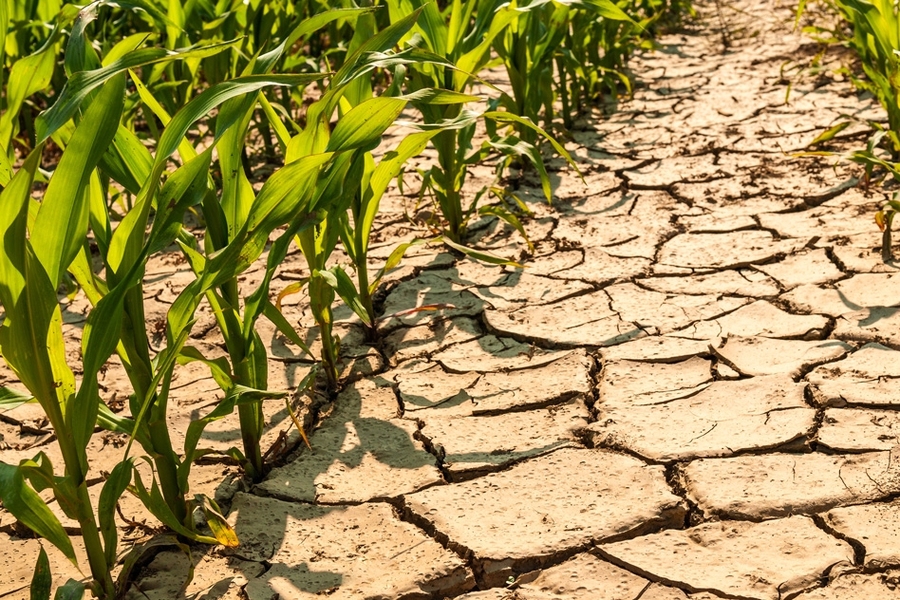
Across Kashmir, winters are becoming shorter, warmer, and alarmingly dry. Snow that once arrived reliably during Chillai Kalan—the harshest 40-day winter phase—is now irregular, delayed, or absent altogether. Hills that should be buried under thick white blankets remain exposed and brown. Rivers that depend on slow snowmelt are shrinking. Springs that sustained villages for generations are drying up.
What was once whispered as “an unusual season” is now acknowledged by scientists, farmers, wildlife officials, and residents alike as a structural shift driven by climate change.
This is not a distant future scenario.
It is unfolding now.
The Silent Collapse of Snowfall: Chillai Kalan Without the Chill
Traditionally, Chillai Kalan marked Kashmir’s deepest winter. Snowfall during this period replenished glaciers, fed rivers, insulated soil, and sustained ecosystems through spring and summer.
That cycle is breaking.
What’s Changing
-
Snowfall events are fewer and weaker
-
Precipitation increasingly falls as rain instead of snow
-
Long dry spells now interrupt peak winter months
-
Snow accumulation at mid-altitudes has sharply declined
Tourist hubs like Gulmarg, once synonymous with deep snow and winter sports, have witnessed prolonged snowless stretches even in peak season. Locals describe slopes that look “bald” well into January—a phenomenon unheard of two decades ago.
Why Snowfall Matters More Than Rain
Snow acts as natural water storage. Unlike rain, which runs off quickly, snow melts slowly, releasing water steadily into rivers and aquifers. Reduced snowfall means:
-
Sudden winter rain causes runoff and erosion
-
Less water is stored for summer months
-
Rivers experience extreme seasonal variability
Experts warn that rainfall cannot compensate for lost snowpack. The hydrological rhythm of the Himalayas is snow-driven, not rain-driven.
Jhelum in Distress: A River Running Out of Time
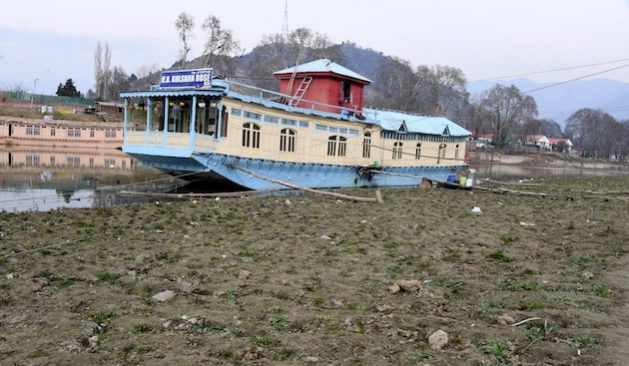
The Jhelum River, Kashmir’s lifeline, tells the climate story in stark numbers.
Monitoring stations at Sangam and Pampore have recorded water levels hovering around 0.65 metres, among the lowest observed during recent winter seasons. This decline is not isolated—it reflects reduced snowmelt, drying tributaries, and shrinking groundwater recharge.
Consequences of a Weak Jhelum
-
Drinking water stress in urban and rural areas
-
Reduced irrigation capacity for agriculture
-
Ecological stress on fish and riverine biodiversity
-
Increased vulnerability to floods during sudden rainfall
Ironically, climate change is creating both drought-like conditions and flood risks. When snow is replaced by rain, water arrives too fast and leaves too quickly.
Hydrologists caution that without consistent winter snow, the Jhelum’s summer flow will continue to weaken, affecting millions who depend on it downstream.
Springs and Streams Are Disappearing—Village by Village
Kashmir’s rural water security has always depended on natural springs (nagas), fed by groundwater recharge from snowmelt.
Today, those springs are vanishing.
Ground Reports from South and North Kashmir
-
Pulwama and Shopian: Dozens of perennial springs now seasonal
-
Bandipora: Mountain streams running dry earlier than usual
-
Baramulla foothills: Villages relying on tanker water during winter
Hydrogeological surveys show groundwater table declines between 0.5 and 3 metres across multiple monitoring wells in the Valley.
Why Groundwater Is Not Recovering
-
Reduced snow infiltration
-
Increased extraction through borewells
-
Urban expansion sealing natural recharge zones
-
Loss of wetlands that acted as natural sponges
Once a spring dries, revival becomes extremely difficult without large-scale recharge interventions.
Wetlands on the Brink: Losing Kashmir’s Natural Climate Buffers
Wetlands such as Hokersar, Wular, Hygam, and Mirgund are critical ecological regulators. They store floodwater, recharge aquifers, support fisheries, and host migratory birds from Central Asia and Europe.
Climate change is pushing them toward collapse.
Observed Changes
-
Shrinking water spread during winter
-
Siltation accelerated by erratic rainfall
-
Reduced inflow from feeder streams
-
Invasive vegetation overtaking open water
For migratory birds, wetlands are not optional—they are survival stations. Declining wetland health means:
-
Reduced bird populations
-
Altered migration timings
-
Loss of biodiversity
Environmentalists warn that wetlands are being lost quietly, without the dramatic visuals of glaciers melting, but their disappearance may prove equally devastating.
Agriculture Under Stress: Farming Without Winter Water
Kashmir’s agriculture—especially horticulture and paddy cultivation—is intricately linked to winter snowfall.
Snowmelt ensures:
-
Moist soil during spring sowing
-
Adequate irrigation during dry spells
-
Nutrient retention in farmlands
With declining snowfall, farmers now face:
-
Delayed sowing seasons
-
Increased dependence on groundwater
-
Reduced crop yields
-
Higher input costs
Apple growers, the backbone of Kashmir’s rural economy, report irregular chilling hours affecting flowering cycles. Without sufficient winter cold, fruit quality and yield suffer.
Climate-resilient agriculture is no longer a choice—it is an urgent necessity.
Wildlife Losing Its Rhythm: Bears That No Longer Hibernate
Perhaps the most visible—and dangerous—signal of climate disruption is unfolding in Kashmir’s forests.
Himalayan Black Bears Are Not Hibernating
Wildlife officials report increasing incidents of bears:
-
Remaining active throughout winter
-
Entering villages and towns
-
Damaging property and crops
-
Triggering human-wildlife conflicts
Hibernation is triggered by prolonged cold and snow cover. Warmer winters confuse biological clocks, forcing animals to forage when food is scarce.
This has resulted in:
-
Injured humans and animals
-
Increased stress on wildlife departments
-
Growing fear among rural communities
Experts caution that such disruptions ripple across entire ecosystems.
Comparative Snapshot: Kashmir’s Climate Stress Indicators
| Impact Area | Observed Change | Consequences |
|---|---|---|
| Snowfall | Sharp decline | Tourism loss, water stress |
| Jhelum River | Lowest winter levels | Drinking & irrigation shortages |
| Springs | Drying rapidly | Rural water insecurity |
| Groundwater | 0.5–3m depletion | Long-term scarcity |
| Wetlands | Shrinking habitats | Biodiversity loss |
| Wildlife | Disrupted hibernation | Human-animal conflict |
| Agriculture | Reduced irrigation | Lower yields |
Communities Adapting: Resilience from the Ground Up
Despite mounting challenges, Kashmir’s communities are not passive victims.
Nomadic Innovation
Pastoralists in alpine regions are reviving traditional practices:
-
Constructing small rainwater and snowmelt ponds
-
Restoring degraded grazing meadows
-
Adjusting migration routes based on water availability
Civil Society Action
Local NGOs, educators, and journalists are:
-
Raising climate awareness
-
Documenting disappearing water sources
-
Advocating sustainable land use
These grassroots responses demonstrate resilience—but they cannot replace systemic action.
Policy Gaps: Why Kashmir Needs Integrated Climate Planning
Experts consistently highlight a lack of:
-
Integrated water resource management
-
Climate-resilient agricultural planning
-
Wetland protection enforcement
-
Long-term groundwater regulation
Fragmented policies treat symptoms, not causes.
What Kashmir needs is:
-
Basin-level river management
-
Wetland restoration as climate infrastructure
-
Climate-smart farming incentives
-
Scientific monitoring linked to policy action
Without this, adaptation efforts remain scattered and insufficient.
Why This Matters More Than Ever
Kashmir’s identity—cultural, ecological, and economic—is inseparable from its winters.
If snowfall continues to decline:
-
Tourism will become unreliable
-
Agriculture will face chronic instability
-
Water conflicts will intensify
-
Ecosystems may cross irreversible thresholds
Climate change is not only reshaping Kashmir’s landscape—it is reshaping daily life.
The Valley is not losing a season.
It is losing a stabilising force that sustained it for generations.
Bottom-Line: A Vanishing Winter Is a Warning
Kashmir’s changing winters are not an isolated anomaly. They are part of a broader Himalayan climate crisis with implications far beyond the Valley.
The snow may still fall—but no longer enough, no longer on time, and no longer as before.
What remains is a narrowing window to act.
Protecting Kashmir’s winters now means protecting its water, food, wildlife, and future.
The question is no longer whether the climate is changing.
It is whether response will arrive before the snow disappears for good.