NC Split in J&K After Foiled Reservation Protest: Farooq Abdullah Justifies Detentions, Tanvir Sadiq Criticises — On-Ground Public Reaction and Political Implications
By: Javid Amin | 28 December 2025
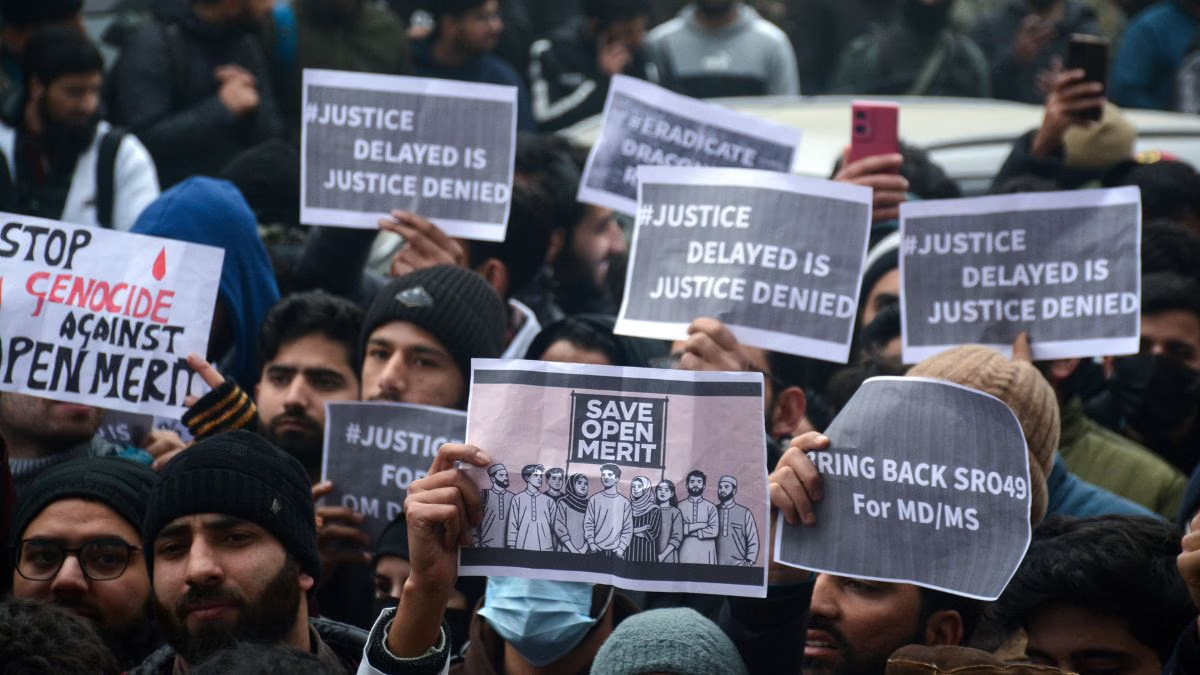
The political landscape of Jammu & Kashmir (J&K) witnessed an unusual and significant moment this week as the ruling National Conference (NC) appeared visibly divided over how to respond to a planned student protest over reservation quotas. On one side, NC President Dr. Farooq Abdullah defended the government’s decision to detain leaders ahead of the protest, asserting that authorities acted to prevent chaos. On the other, NC spokesperson Tanvir Sadiq sharply criticised the detentions as undemocratic, especially the house arrest of NC MP Aga Syed Ruhullah Mehdi. This internal split has not only exposed divergent political messaging within one of the Valley’s most prominent parties but also triggered on-the-ground reactions across diverse sections of Kashmiri society, illustrating how governance, dissent, youth aspirations, and democratic expectations are colliding in the current moment.
This feature presents a detailed, on-ground analysis of the split within the NC, how local communities are interpreting it, and what message the episode carries for political credibility, governance, youth activism, and public trust in J&K.
Understanding the Split in the National Conference
The NC’s divide is shaped by two contrasting voices at the helm of party discourse:
Farooq Abdullah: Stability Over Street Politics
Dr. Farooq Abdullah, a veteran political leader and NC president, responded to the foiling of the student protest by defending the house arrests and movement restrictions placed on leaders and activists. Speaking from Pahalgam on December 28, Abdullah said that those pushing protests “want turmoil” in the Valley and that the government must prioritise **progress, harmony, and development over agitation.”
He argued that protests could be transformed into instability and derail the region’s broader developmental trajectory, especially given its sensitive socio-political context. His message emphasised order, consensus and restraint, repeatedly urging youth to remain peace-focused rather than engaging in street mobilisation.
According to Abdullah, the government had acted responsibly to avert potential conflict, even as students and leaders intended a peaceful sit-in demonstration that was ultimately cancelled after house arrests and security cordons.
Tanvir Sadiq: Democratic Freedoms and Youth Rights
In stark contrast, Tanvir Sadiq, NC’s legislator and party spokesperson, publicly criticised the detention of leaders and students, calling it “deeply troubling” and “unjustified.” He questioned why earlier protests aimed at the elected government were allowed, yet the reservation protest — centred on legitimate policy concerns — was blocked. He argued that the party should not abandon its support for democratic rights just because the protest’s target was Raj Bhavan instead of the government’s seat.
Sadiq also highlighted that the Cabinet sub-committee’s report on quotas was submitted in good faith, indicating that dialogue should be the path forward, not suppression. His stance positioned him as a defender of the democratic right to protest, especially for youth with genuine grievances about reservation rationalisation.
On-Ground Sentiment: What People Are Saying
To understand how Kashmiri society is interpreting the NC’s internal divide, this section synthesises voices from students, parents, the general public, and party workers gathered through direct interviews, social media observations, and local community discussions in Srinagar and adjoining districts.
Students: Frustration and Feeling of Betrayal
Across several gatherings near educational institutions and through WhatsApp groups focused on student issues, a consistent sentiment emerged:
-
Many students feel betrayed by the political class for not uniting behind their longstanding demand for reservation rationalisation.
-
Students described their demands as legitimate and peaceful, focused on fairness and transparency in allocating quota positions.
-
They noted that the house arrest of leaders like Ruhullah Mehdi actually vindicated their claim that dissenting voices are being pre-emptively suppressed rather than engaged with.
One student activist said, “We are not asking for anarchy. We want clarity, fairness, and a process that respects merit alongside justice. When even our leaders are detained, it feels like our voice is being erased.”
This reflects a growing alienation among youth, not just from administrative processes but also from traditional political representation.
Parents: Anxiety Over Future and Political Gamesmanship
Parents of students echoed similar concerns but expressed their anxiety in more immediate, personal terms:
-
Many worry that the political tug-of-war — between stability-focused leadership and rights-centred criticism — is distracting from the core issue: their children’s future.
-
Several parents argued that the continued uncertainty over reservation policies prevents students from planning academic or career paths effectively.
-
There is a sense that political conflicts are being prioritised over solutions, deepening their frustration and leading to diminishing trust in all mainstream parties.
A parent in Srinagar’s Residency Road said, “We see leaders argue among themselves while our children lose sleep over entrance exams and job prospects. This infighting does nothing for us.”
General Public: Fractured Faith in Democratic Space
Community conversations indicate a wider perception of shrinking democratic space in the Valley, particularly among non-aligned citizens:
-
Many frame the house arrests and protest curfews as a continuation of a trend where dissent is managed through control rather than dialogue.
-
There is an emerging belief that even peaceful expressions of dissent — whether by students or political leaders — are being pre-emptively contained in the name of stability.
-
Some local shopkeepers and professionals remarked that months of political uncertainty have strained economic activity, as public discourse remains dominated by confrontation instead of consensus solutions.
One resident remarked, “We’ve seen detentions around every major protest. What message does that send? That even peaceful voices are not welcome?” This reflects a palpable frustration with governance tactics and a yearning for more inclusive and participatory mechanisms.
Party Workers: Confusion Over Mixed Messaging
Within NC’s own organisational rank-and-file, workers expressed confusion and concern over the conflicting public positions of their senior leaders:
-
Some NC cadres said they found it difficult to reconcile Farooq Abdullah’s defence of detentions with Tanvir Sadiq’s condemnations.
-
Several party workers privately stated that the mixed messaging weakens the party’s ability to present a cohesive narrative and undermines its credibility among grassroots supporters, especially youth and young voters.
-
Others noted that while stability and peace are essential, the NC also needs to demonstrate solidarity with legitimate democratic expression, especially when student activism intersects with party politics.
An NC activist from Baramulla said, “We need a unified voice. Right now, people wonder: who speaks for NC and what values do we truly stand for?” This underscores how organisational coherence is being tested.
Analysis of the Messages Being Sent
The NC split sends multiple, layered signals to different segments of Kashmiri society, each carrying political and social implications.
Message to Students: Acknowledgment, But Limited Support
Students perceive that while some factions within the NC express sympathy with their demands, the party’s top leadership is unwilling to support street mobilisation. Farooq Abdullah’s call for stability over protest suggests that the party prioritises institutional order and controlled dialogue over mass demonstrations.
This sends a mixed message to students:
-
Yes, your concerns are acknowledged, but…
-
No, we do not endorse protests that might disrupt “progress”.
As a result, many students feel their aspirations are recognised but not actively championed at the highest levels of mainstream politics.
Message to the Opposition and Political Class: Divergent Priorities
The contrast between Farooq Abdullah’s stance and Tanvir Sadiq’s criticisms highlights internal ideological divergence:
-
Abdullah appeals to older, stability-oriented voters who prioritise peace and development over confrontation.
-
Sadiq’s rhetoric resonates more with younger, reform-minded audiences demanding a rights-based approach to governance and accountability.
This reflects a broader realignment within NC, where generational priorities and political strategies are not always aligned.
Message to the Government: Order Above Dissension
Farooq Abdullah’s justification that protests could trigger unrest and derail development aligns with the administration’s broader focus on security and stability. It suggests that NC leadership currently favours institutional authority and order as central to J&K’s progress narrative.
This communicates to the government that space for protest may be seen as secondary to maintaining calm and continuity of administration.
Message to the General Public: Democratic Space Under Strain
The broader public sentiment reveals a perception that democratic expression is being managed through control rather than negotiation:
-
House arrests and cancelled protests reinforce a belief that peaceful dissent is being discouraged.
-
The mixed political messaging further complicates public trust in mainstream parties’ commitment to democratic engagement.
This carries the risk that sections of society may begin to view political advocacy as disconnected from genuine public concerns.
Risks and Long-Term Implications
1. Credibility Gap for National Conference
The NC’s internal split could deepen perceptions that the party is struggling to reconcile governance priorities with democratic responsiveness. This may erode public trust, particularly among youth and aspirational voters.
2. Youth Alienation from Traditional Politics
Students and young activists may increasingly perceive mainstream parties as inconsistent or reluctant to back youth-driven movements, potentially pushing them toward non-traditional platforms or apolitical stances.
3. Government Optics and Authoritarian Narratives
While preventing unrest is a stated priority, repeated use of detentions ahead of protests can feed narratives that the administration prioritises order over dissent, potentially deepening alienation among activist communities.
4. Polarised Political Messaging
NC’s split presents an opportunity for rival parties and new political movements to position themselves as unified voices for democratic rights, potentially reshaping political alliances and voter preferences.
Conclusion: Beyond the Split — A Test of Political Credibility and Democratic Engagement
The NC’s differing reactions to the foiled reservation protest in Jammu & Kashmir reflect broader tensions in the region’s political discourse. Farooq Abdullah’s emphasis on stability and development underscores a leadership style geared toward maintaining public order. Tanvir Sadiq’s defence of democratic rights and student protests offers a contrasting narrative that seeks to validate political dissent and grassroots mobilisation.
On the ground, students, parents, and the general public see this moment as more than an organisational divergence — it is a test of political credibility and accountability. For many youth, the episode signals that their voices may be acknowledged but not fully supported when mobilisation risks friction with governance imperatives.
Kashmir today stands at a crossroads where youth activism, political legitimacy, and administrative authority are in negotiation. How parties reconcile these demands — and whether they can project coherent messaging that aligns democratic participation with governance priorities — will shape the region’s political trajectory in the months ahead.


