No Political Interference in Hydropower Projects, Says CM Omar Abdullah Amid Ratle BJP Pressure Row
By: Javid Amin | 15 December 2025
When Hydropower Meets Hard Politics
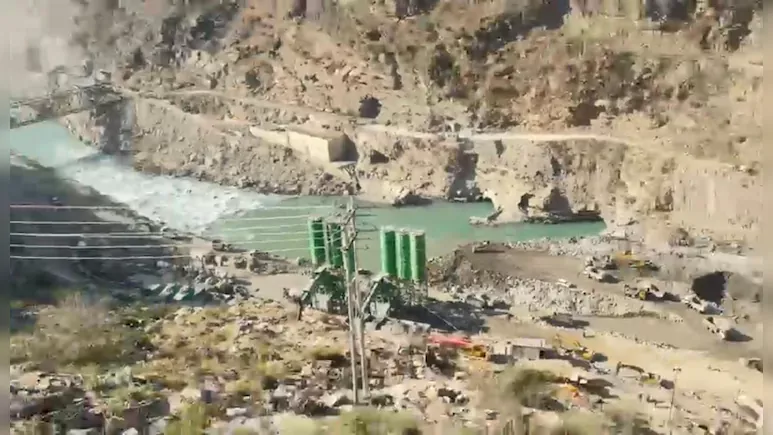
In Jammu & Kashmir, infrastructure projects rarely remain confined to engineering drawings and financial spreadsheets. They quickly acquire political meaning, social expectations, and ideological overtones. The latest controversy surrounding the Ratle Hydroelectric Power Project in Kishtwar has once again exposed this uneasy intersection—forcing the Union Territory’s political leadership, law‑enforcement agencies, and corporate developers into an uncomfortable public reckoning.
At the centre of the storm is an allegation by Megha Engineering and Infrastructure Limited (MEIL), the developer executing the 850‑MW Ratle project, that local leaders of the Bharatiya Janata Party (BJP), including a sitting MLA, pressured and allegedly threatened the company to hire specific local workers or risk surrendering the project. The BJP and the MLA named have categorically denied the charges. Yet the controversy escalated sharply after Chief Minister Omar Abdullah publicly intervened, declaring that no political interference should be tolerated in projects of national importance and urging law‑enforcement agencies to act without fear or favour.
What makes this episode particularly significant is not merely the accusation and denial, but the broader governance questions it raises: Who controls development in Jammu & Kashmir? How should local employment aspirations be balanced against transparent recruitment? And can large infrastructure projects survive sustained political pressure in a region still negotiating its post‑2019 administrative reality?
Explainer: The Ratle Hydroelectric Power Project at a Glance
- Location: Kishtwar district, Jammu region
- River: Chenab
- Installed Capacity: 850 MW
- Approved Cost: ₹5,281.94 crore (approved by the Cabinet Committee on Economic Affairs, January 2021)
- Developer: Megha Engineering and Infrastructure Limited (MEIL)
- Strategic Role: Strengthening J&K’s power self‑reliance and India’s hydropower footprint in the Chenab basin
Allegations That Triggered a Political Flashpoint
The controversy erupted after MEIL formally alleged that it was facing undue pressure from local BJP leaders in Kishtwar to recruit certain individuals as part of the Ratle project’s workforce. According to senior company officials, the demands went beyond routine representations for local employment and escalated into threats—warning that the company would be forced to surrender the project if it failed to comply.
A senior MEIL executive cautioned that continued disruption could compel the company to withdraw from the project altogether, resulting in massive financial losses. The company has already invested heavily in specialised machinery, construction material, and manpower. Any premature exit, officials said, would trigger penalties, including forfeiture of bank guarantees furnished to the National Hydroelectric Power Corporation (NHPC).
While such allegations are difficult to independently verify in real time, their seriousness lies in what they imply: an erosion of professional autonomy in a project deemed vital for national energy security.
BJP and the Named MLA Respond
The BJP reacted swiftly, rejecting the allegations as baseless and politically motivated. Party leaders maintained that the BJP does not interfere in recruitment or contractual decisions of infrastructure developers and accused MEIL of attempting to deflect attention from its own hiring practices.
BJP MLA Shagun Parihar, whose name surfaced prominently in the allegations, denied exerting any pressure on the company. Instead, she counter‑alleged that MEIL had employed individuals with questionable backgrounds, including surrendered militants—an assertion that reframed the debate around security vetting rather than political interference.
This exchange hardened positions on both sides and ensured that the dispute would not remain a quiet administrative matter.
CM Omar Abdullah Draws a Red Line
Chief Minister Omar Abdullah’s intervention marked a decisive moment in the controversy. Speaking to reporters in Srinagar, Abdullah asserted that any political interference in hydropower projects must be viewed with utmost seriousness.
“These projects are not only for Jammu and Kashmir; they are for the entire country. These are projects of national importance,” he said, making it clear that obstruction or coercion would not be tolerated.
In a pointed remark, Abdullah noted that had similar allegations been made against any minister in his government, the Anti‑Corruption Bureau (ACB) would have already initiated action. “You and I both know that if this accusation had been made against any of my ministers, the ACB would have conducted a raid by now,” he said, underscoring what he described as selective accountability.
The Chief Minister also urged law‑enforcing agencies to act independently and without political pressure, effectively throwing the matter into the institutional domain.
Allegations of Wider Interference in Kishtwar
Abdullah went further, suggesting that the issue extended beyond a single individual. According to him, two opposition MLAs were interfering in multiple projects in Kishtwar district, though only one name had surfaced publicly so far.
Such claims hint at a systemic pattern rather than an isolated incident, reinforcing concerns that large infrastructure projects in the region remain vulnerable to informal political mediation.
Governance Gaps and the Question of Control
The Ratle controversy has also highlighted unresolved governance issues in Jammu & Kashmir. Abdullah publicly flagged delays in the transfer of key departments to the elected government, pointing out that despite being the Power Minister, the Power Development Corporation had not yet been handed over.
This fragmented administrative control complicates accountability. When authority is divided between elected representatives and centrally controlled institutions, responsibility becomes diffused—creating space for disputes, allegations, and political posturing.
Local Employment Politics—A Persistent Fault Line
Demands for local employment have historically accompanied large projects in Jammu & Kashmir. Communities argue that projects exploiting local resources must prioritise local youth, particularly in districts with limited economic opportunities.
However, the absence of clear, codified local hiring frameworks often turns employment into a site of negotiation—and, at times, coercion. Developers insist on skill‑based recruitment and security clearances, while political representatives feel compelled to demonstrate results for their constituencies.
The Ratle episode exemplifies this tension, raising questions about where advocacy ends and interference begins.
Corporate Governance and Legal Pushback
Amid escalating tensions, MEIL lodged a formal complaint with the Deputy Commissioner of Kishtwar, seeking legal action against a local social media influencer, Asif Iqbal Naik. The company accused him of posting false, defamatory, and threatening content against its officials.
This move reflects a growing trend of corporations turning to legal remedies to counter reputational risks amplified by social media—a factor that increasingly shapes public perception of infrastructure projects.
Parliament, NHPC, and the Bigger Hydropower Debate
The controversy resonated beyond Jammu & Kashmir when jailed MP Engineer Rashid raised the issue in Parliament, demanding the return of hydropower projects from NHPC to the Union Territory. Accusing NHPC of behaving like the “East India Company,” Rashid alleged that J&K’s resources were being exploited without adequate local benefit.
Though rhetorically charged, his intervention reflects a long‑standing grievance in the region over control and revenue sharing in hydropower projects.
Energy Security and National Stakes
From a national perspective, the Ratle project is a key component of India’s renewable energy strategy. Delays or disruptions would not only affect Jammu & Kashmir’s power availability but also increase dependence on expensive power purchases.
Hydropower projects on the Chenab also carry strategic weight, intersecting with transboundary water considerations under the Indus Waters framework.
Perspectives Table: Stakeholders and Their Stakes
| Stakeholder | Position | What’s at Stake |
|---|---|---|
| MEIL | Alleges political pressure | Financial losses, project continuity |
| BJP leadership | Denies interference | Political credibility |
| BJP MLA | Counter‑alleges | Personal and political reputation |
| J&K Govt | Calls for action | Governance authority |
| Local communities | Seek jobs | Economic opportunity |
| Centre/NHPC | Oversight | Energy security |
Bottom-Line: Development Demands Freedom from Interference
The Ratle Hydroelectric Power Project controversy highlights a fundamental lesson for Jammu & Kashmir: sustainable infrastructure cannot thrive under the weight of political pressure, suspicion, or informal influence. For projects of such scale, success requires stability, institutional transparency, and the assurance that decisions are anchored in law and policy—not swayed by intimidation or partisan demands. Only when development is shielded from external pressures can it deliver lasting benefits to the region and its people.


