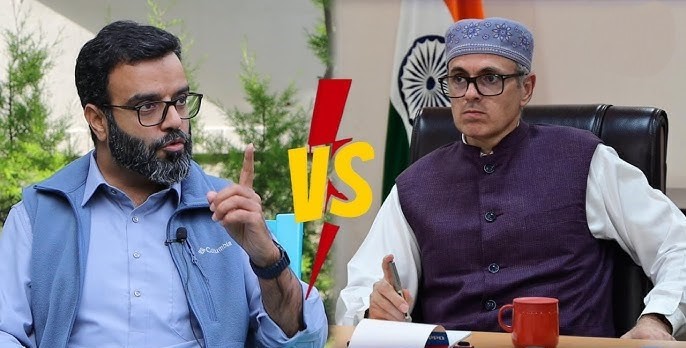
Omar Abdullah Rebukes Ruhullah Mehdi on J&K Reservation Policy, Rejects Pressure Politics
By: Javid Amin | 26 December 2025
A Public Rebuttal That Exposed a Deep Political Fault Line
National Conference vice-president Omar Abdullah has publicly and firmly pushed back against his party colleague and Lok Sabha MP Ruhullah Mehdi, declaring that he will not be influenced by “threats” or street pressure in deciding the future of Jammu & Kashmir’s reservation policy.
“I am not afraid of anyone’s threats, nor will I take any wrong decision under pressure,” Omar Abdullah said, underlining that reservation-related decisions must be resolved within constitutional and legal frameworks, not through protests or political brinkmanship.
The statement marks one of the sharpest public disagreements within the National Conference (NC) in recent years and highlights the growing sensitivity around reservation, merit, and access to opportunities in post-2019 Jammu & Kashmir.
What Triggered the Clash
The immediate trigger was a series of protests led by Ruhullah Mehdi, who has emerged as one of the most vocal critics of the current reservation framework in J&K.
On December 23, 2024, Mehdi led demonstrations outside Omar Abdullah’s residence in Srinagar, joined by leaders cutting across party lines. Protesters argued that the existing policy has pushed reservations beyond 60%, severely reducing opportunities for open merit candidates in government jobs and professional institutions.
Mehdi has repeatedly demanded:
-
Rationalisation of reservation quotas
-
Protection of open merit seats
-
Immediate political intervention to reverse what he calls an “imbalanced” policy
Omar Abdullah’s Position: Constitution Over Confrontation
Omar Abdullah has not rejected discussion on reservations outright. Instead, he has drawn a clear red line on method and process.
Key Elements of Omar’s Stand
-
Reservation policy cannot be altered through intimidation or street protests
-
Any changes must involve stakeholder consultation, legal vetting, and constitutional compliance
-
Decisions taken under pressure risk being struck down by courts
By doing so, Omar is positioning himself as a process-driven leader, wary of populist shortcuts in a legally sensitive domain.
Why Reservation Is a Legal Minefield in J&K
Reservation policies are not ordinary executive decisions. They intersect with:
-
Constitutional guarantees of equality
-
Supreme Court ceilings and jurisprudence
-
Social justice obligations
-
Regional and community-specific sensitivities
The current reservation framework in J&K was approved during Central rule, adding another layer of complexity. Any modification now would require:
-
Careful legal scrutiny
-
Alignment with constitutional provisions
-
Avoidance of retrospective harm to beneficiaries
Omar’s caution reflects these constraints, even as political pressure mounts.
Ruhullah Mehdi: Channeling Street-Level Anger
Ruhullah Mehdi’s approach represents a different political instinct.
His Core Argument
-
Over 60% reservation leaves too little room for merit-based selection
-
Open merit students, particularly in Kashmir, are being unfairly disadvantaged
-
Silence from leadership risks alienating an entire generation
By leading protests, Mehdi is positioning himself as a voice of aggrieved youth and middle-class aspirants, tapping into a growing sense of frustration.
However, his public challenge to party leadership has also raised questions about internal discipline and strategy within the NC.
Comparison of Positions
| Stakeholder | Position | Core Argument |
|---|---|---|
| Omar Abdullah | Process-first approach | Reservation must follow constitutional and legal procedures |
| Ruhullah Mehdi | Protest-driven opposition | Excessive quotas harm open merit students |
| Protesters & Opposition | Demand rationalisation | Current policy lacks balance and fairness |
Political Risks for the National Conference
1. Visible Infighting
Public disagreement between senior leaders risks projecting NC as internally divided at a time when it seeks to reassert itself as a stable alternative in J&K politics.
2. Mixed Messaging
While Omar speaks the language of constitutional caution, Mehdi speaks the language of street mobilisation—sending contradictory signals to voters.
3. Youth Alienation
Failure to address merit concerns substantively could deepen frustration among educated youth, a demographic already skeptical of mainstream politics.
A Larger Debate: Merit vs Social Justice
Beyond personalities, the controversy reflects a broader dilemma:
-
How to balance historical disadvantage with present-day competition
-
How to ensure social justice without eroding meritocracy
-
How to adapt reservation policies to evolving demographics
This debate is not unique to J&K, but the region’s fragile political and social fabric amplifies its intensity.
What This Episode Signals Politically
Omar Abdullah’s blunt rebuttal serves multiple purposes:
-
Asserting leadership authority within the party
-
Reassuring institutions that decisions will not be populist
-
Drawing a line between governance and agitation
For Ruhullah Mehdi, the protests consolidate his image as a grassroots mobiliser, even if they strain party unity.
What Comes Next
The likely next steps include:
-
Internal NC deliberations to manage the fallout
-
Possible stakeholder consultations on reservation concerns
-
Legal examination of the existing policy’s sustainability
Whether this translates into policy recalibration or prolonged political tension remains to be seen.
Conclusion: A Clash of Methods, Not Just Opinions
The Omar Abdullah–Ruhullah Mehdi confrontation is not merely a personal spat—it is a clash between constitutional restraint and populist pressure, between institutional caution and street politics.
By rejecting threats and protests as tools of decision-making, Omar Abdullah has chosen the path of legal process, even at the cost of internal discomfort. Whether that approach ultimately resolves public anger—or deepens it—will shape both the reservation debate and the National Conference’s political future in Jammu & Kashmir.


