PDP–BJP Alliance Explained: Who Suffered and Who Succeeded in J&K
By: Javid Amin | 23 December 2025
A Statement That Reopens an Unsettled Chapter
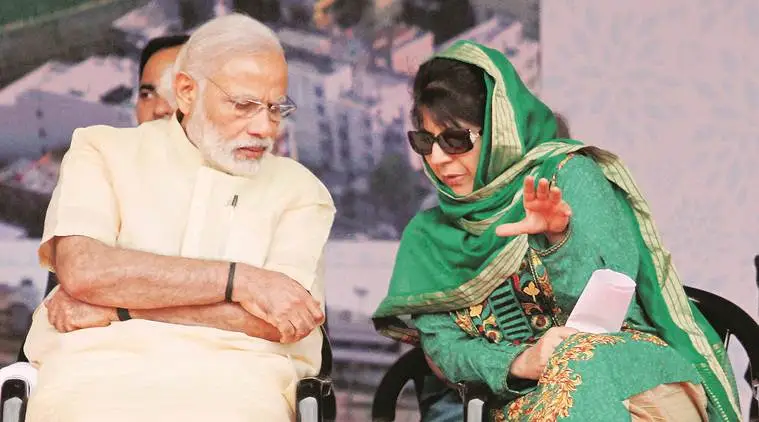
When Mehbooba Mufti says today that the PDP–BJP alliance of 2015 was “misunderstood” and undertaken “for the sake of Jammu & Kashmir,” she is not merely defending a political decision. She is attempting to reframe one of the most controversial experiments in Kashmir’s political history—an experiment whose consequences continue to define trust, alienation, and power in the region.
Nearly a decade later, the alliance remains a reference point for betrayal for some, pragmatism for others, and strategic success for a few. To assess the credibility of Mehbooba’s claim, one must move beyond rhetoric and examine ground realities:
Who suffered?
Who succeeded?
And who paid the long-term price?
The Context of 2015: A Coalition Born of Compulsion
A Fractured Mandate
The 2014 Assembly elections produced a politically split verdict:
-
PDP emerged as the largest party in the Valley
-
BJP swept Jammu
-
National Conference was weakened but intact
There was no natural ideological coalition possible. The PDP built its politics on “soft separatism,” dialogue, and regional autonomy. The BJP’s ideological anchor rested on nationalism, integration, and skepticism toward Article 370.
Mufti Mohammad Sayeed’s Calculation
Mufti Sayeed framed the coalition as a “bridge between Jammu and Kashmir”, formalized through an “Agenda of Alliance” promising:
-
Preservation of J&K’s special status
-
Dialogue with all stakeholders
-
Development without dilution of identity
At the time, the decision was presented as a necessary compromise, not an ideological convergence.
Who Suffered the Most: A Ground-Level Reality Check
1. The Kashmiri Street
The most immediate casualties were ordinary Kashmiris:
-
Protest fatigue increased
-
Trust in mainstream politics eroded
-
The sense of political representation weakened
The alliance created confusion: a party that had promised resistance to Delhi’s heavy hand was now sharing power with it.
2. PDP’s Core Support Base
PDP’s traditional voters—particularly youth and middle-class Kashmiris—felt politically orphaned.
Key impacts:
-
Cadre demoralization
-
Mass resignations at local levels
-
Loss of narrative credibility
By 2016, PDP was no longer seen as an alternative to NC—it was viewed as complicit.
3. Victims of 2016 Unrest
After Burhan Wani’s killing:
-
Over 100 civilians died
-
Thousands were injured, many by pellet guns
-
Public anger peaked
Despite being in power, Mehbooba Mufti was unable—or unwilling—to meaningfully restrain the security apparatus. The optics were devastating: a regional party presiding over unprecedented civilian suffering.
4. Institutional Autonomy of J&K
The alliance did not protect:
-
Article 370
-
Article 35A
-
Political autonomy
In hindsight, critics argue that the coalition normalized BJP’s presence, making later constitutional changes easier.
Who Succeeded: The Uneven Distribution of Power
1. The BJP
From a strategic standpoint, the BJP emerged as the single biggest beneficiary.
Key gains:
-
Legitimated its presence in J&K
-
Acquired administrative familiarity
-
Built political networks
-
Normalized central intervention
The BJP entered Kashmir as a junior coalition partner—and exited years later as the dominant decision-maker.
2. Jammu’s Political Consolidation
The alliance reinforced the perception that:
-
Jammu’s mandate mattered
-
BJP was the primary voice of the region
This consolidation reshaped J&K politics from a Valley-centric discourse to a regionally polarized one.
3. Security Establishment
The coalition allowed:
-
Hardline security policies without political pushback
-
Reduced scope for dissent within governance
Unlike earlier NC governments, PDP did not enjoy Delhi’s confidence to negotiate limits.
Who Lost Politically: The PDP’s Long Decline
Erosion of Credibility
The PDP’s greatest loss was trust.
Post-2018:
-
Electoral relevance shrank
-
Cadre weakened
-
Public skepticism hardened
The alliance blurred PDP’s ideological identity, leaving voters unsure what the party stood for.
Mufti Mohammad Sayeed’s Legacy
Mehbooba’s current defense is fundamentally about protecting her father’s historical standing.
Yet among many Kashmiris:
-
Mufti is remembered as well-intentioned
-
But politically naïve about BJP’s long game
The alliance is increasingly seen as a moral gamble that failed.
2018–2019: Collapse and Consequences
When the BJP withdrew support in 2018:
-
PDP was left exposed
-
Governor’s Rule followed
-
Delhi ruled directly
Less than a year later:
-
Article 370 was abrogated
-
J&K was bifurcated
-
Political leadership was detained
For critics, the sequence appears linear:
Alliance → Normalization → Withdrawal → Direct Rule → Constitutional Overhaul
Post-370 Reality: Who Bore the Cost?
Economic Fallout
-
Local businesses faced uncertainty
-
Outsourcing increased
-
Mining contracts went to outside firms
-
Unemployment worsened
These are the very grievances Mehbooba now raises—ironically, from outside power.
Political Marginalization
Mainstream parties, including PDP, lost:
-
Negotiating power
-
Constitutional leverage
-
Institutional relevance
The alliance did not prevent centralization; it arguably accelerated it.
Mehbooba’s 2025 Reframing: Strategy or Sincerity?
Her current narrative rests on three pillars:
-
Compulsion, not choice
-
Intent, not outcome
-
Legacy protection
Politically, this reframing serves survival:
-
PDP has limited space
-
Voters demand explanations
-
Silence is no longer viable
But narrative correction does not equal historical absolution.
Ground Sentiment Today: What People Actually Feel
Based on consistent ground reporting and public discourse:
-
Sympathy exists for Mehbooba personally
-
Skepticism persists toward PDP institutionally
-
The alliance remains emotionally unresolved
For many, the question is not why the alliance happened—but why no red lines were enforced.
Final Assessment: Who Really Suffered, Who Truly Succeeded
Suffered
-
Ordinary Kashmiris
-
PDP’s voter base
-
Political autonomy
-
Institutional trust
Succeeded
-
BJP strategically
-
Centralized governance
-
Jammu’s political consolidation
Lost the Most
-
PDP as a political force
-
Mufti Sayeed’s unblemished legacy
-
Faith in coalition politics as a safeguard
Conclusion: A Gamble That Reshaped Kashmir—But Not the Way It Was Promised
Mehbooba Mufti is right about one thing: the PDP–BJP alliance was born in a moment of uncertainty.
But history judges decisions by outcomes, not intentions.
For Jammu & Kashmir, the alliance did not deliver stability, protection, or reconciliation. It delivered transition—without consent and without safeguards.
The suffering was local.
The gains were strategic.
And the costs continue to be paid.