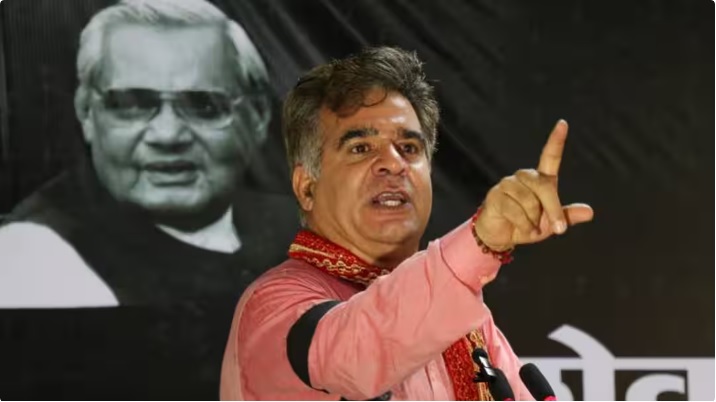
BJP leader acknowledges everyday hardships, pledges accountability role in J&K
By: Javid Amin | 14 December 2025
Senior BJP leader Ravinder Raina on Tuesday acknowledged that people in Kashmir continue to face multiple challenges in their daily lives and said his party would function as a vigilant and responsible opposition to hold the government accountable.
Raina’s remarks came during his visit to several areas in the Kashmir Valley, where he interacted with local residents and listened to grievances related to basic amenities, governance gaps, and persistent day-to-day hardships. His statement reflects an attempt by the BJP to recalibrate its political positioning in Jammu & Kashmir by foregrounding public welfare concerns while asserting its role as a watchdog.
“People Are Struggling With Everyday Issues”
Raina said that despite repeated claims of improvement, ordinary Kashmiris continue to face serious difficulties in accessing essential services.
“The people here are facing multiple problems. Issues related to basic amenities, governance, and daily life remain unresolved in many areas,” he said, adding that these concerns need urgent attention rather than political rhetoric.
His acknowledgment comes amid broader public debate in J&K over governance efficiency, delivery of welfare schemes, and administrative responsiveness—especially in the context of the Union Territory’s current power structure.
BJP Positions Itself as an Alert Opposition
With the BJP not part of the elected government in Jammu & Kashmir, Raina stressed that the party would actively perform its opposition role.
“We will remain alert and vigilant. Wherever there are shortcomings, we will raise them at appropriate forums and ensure that the government is held accountable,” he said.
This positioning is significant as opposition politics in J&K undergoes realignment. Raina’s remarks suggest that the BJP intends to scrutinize governance decisions, implementation delays, and service delivery failures rather than remain on the defensive over larger constitutional questions.
Engagement With Locals During Valley Visit
According to party sources, Raina interacted with residents across multiple localities, hearing complaints related to:
-
water and electricity supply
-
road connectivity and infrastructure gaps
-
unemployment and livelihood concerns
-
bureaucratic delays in welfare schemes
By publicly acknowledging these issues, the BJP leader sought to signal empathy with grassroots concerns, an approach aimed at rebuilding trust and political relevance in the Valley.
Observers note that such outreach reflects a tactical shift—placing humanitarian and governance issues at the center of political messaging rather than relying solely on ideological narratives.
Accountability as a Political Strategy
Raina underlined that the BJP would take up public grievances through democratic and institutional channels, including legislative platforms and public discourse.
“Our responsibility is to safeguard the interests of the common people. We will not shy away from questioning the government where it fails,” he said.
Political analysts view this as part of a broader strategy to frame the BJP as a constructive opposition—one that emphasizes accountability, service delivery, and governance outcomes rather than confrontation alone.
Why Raina’s Statement Matters
1. Humanitarian Emphasis
By highlighting everyday hardships, Raina acknowledged a reality that many residents feel is often glossed over by official narratives of normalcy.
2. Opposition Rebranding
The BJP’s attempt to project itself as a vigilant opposition reflects an effort to stay politically relevant amid shifting power dynamics in J&K.
3. Pressure on Governance
Such statements increase scrutiny on the administration and may amplify demands for improved public service delivery.
4. Grassroots Signaling
Direct engagement with locals helps the party communicate that it is listening, even while sitting outside power.
A Broader Political Context
Raina’s remarks come at a time when public discourse in J&K is dominated by concerns over governance efficiency, political accountability, and unmet expectations. Civil society groups have increasingly flagged administrative disconnects and public frustration, while opposition parties seek to align themselves with popular sentiment.
In this environment, acknowledging problems rather than denying them may resonate more strongly with citizens who are looking for tangible improvements rather than abstract political assurances.
Bottom-Line: Watchdog Politics in a Sensitive Landscape
Ravinder Raina’s statement blends humanitarian concern with political positioning. By openly admitting that Kashmiris face multiple problems and pledging a vigilant opposition role, he has framed the BJP as a party seeking to hold the government to account on issues that directly affect daily life.
Whether this approach translates into policy influence or electoral traction remains to be seen. What is clear, however, is that governance, accountability, and public welfare are increasingly becoming the central battlegrounds of Jammu & Kashmir’s evolving political landscape.

