SMVDIME Admission Row Explodes: Transporters, Traders & Jammu Bar Association Join Sangharsh Samiti Protest
By: Javid Amin | 10 December 2025
A Medical College Caught in the Crossfire of Merit, Identity, and Politics
The Shri Mata Vaishno Devi Institute of Medical Excellence (SMVDIME) was envisioned as a cutting-edge, merit-driven medical institution funded through the offerings of millions of pilgrims visiting the sacred Vaishno Devi shrine. But in December 2025, this institution found itself at the centre of Jammu’s most polarising controversy in recent years.
The trigger was the publication of the MBBS admission list, where 42 of 50 seats went to Muslim students through NEET-based merit selection. What should have been a moment of academic achievement turned into a loud, messy, emotionally charged political storm.
Overnight, the controversy gained social, religious, economic, and legal dimensions. The Sangharsh Samiti (SMVDSS) launched protests demanding a rollback of the list and the granting of minority status to the institution. Soon after, powerful community groups—transporters, traders, and the Jammu Bar Association—joined the agitation, significantly escalating public pressure and turning the issue into a region-wide political standoff.
The debate now sits at an explosive intersection of meritocracy versus religious representation, donor sentiment versus constitutional rules, and political narratives versus institutional autonomy.
This feature traces the origins, escalation, and implications of this fast-developing controversy—one that is shaping policy discussions, polarising communities, and redefining the conversation on education governance in Jammu & Kashmir.
The Trigger: How an MBBS Merit List Became a Political Flashpoint
A Merit List That Shocked Protest Groups
When SMVDIME published its first MBBS admission list under the NEET-UG framework, the figures were straightforward: 42 of 50 seats were secured by Muslim students based entirely on merit.
The backlash began almost immediately.
To the Sangharsh Samiti and several Jammu-based Hindu community organisations, the overwhelming number of Muslim candidates in a shrine-funded institution felt like an “imbalance” that did not reflect “community expectations.” Their argument rested on two sentimental pillars:
-
SMVDIME is funded through Hindu pilgrim donations.
Therefore, the community should have a “preference” or some form of representational guarantee. -
Pilgrim-funded institutions must preserve cultural identity.
They should not, in the view of protesters, become “ordinary” state institutions devoid of any community character.
These arguments quickly snowballed into a mass mobilisation campaign across Jammu.
Merit vs Representation: A Conflict of Principles
At the core lies a fundamental question:
Should a donor-funded institution have preferential representation for the donor community?
Or should it function purely on national-level meritocratic standards?
This is the tension that converted an admission list into a region-wide agitation.
Sangharsh Samiti Steps In: The Agitational Architecture Is Born
The Formation of SMVDSS’s Core Narrative
The Sangharsh Samiti (SMVDSS)—a coalition of shrine-linked activists, community leaders, and civil society groups—positioned the admission list as:
-
An “injustice” to Hindu students
-
A “misuse” of shrine donations
-
A “failure” of the institution to reflect local sentiment
-
A “signal” of demographic imbalance
This framing catalysed the protests.
The Samiti issued calls for:
-
Immediate cancellation of the admission list
-
Shrine-linked representation policy
-
Minority status for the college
-
Independent review of selection procedures
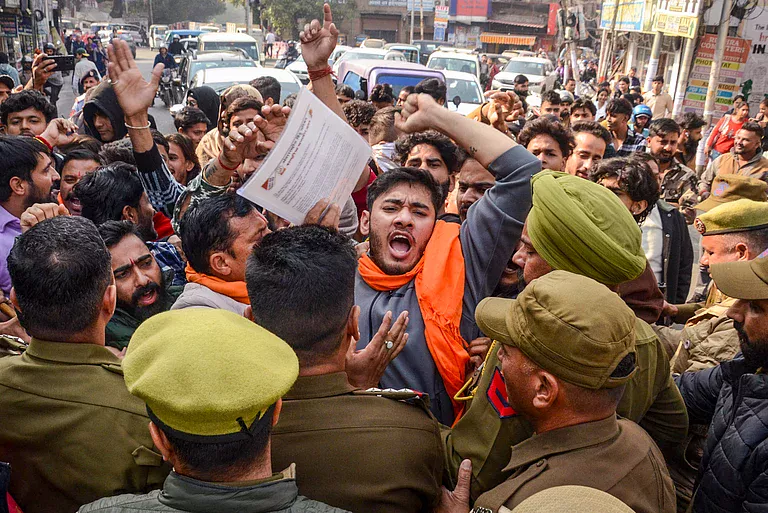
Within days, protest sites across Jammu drew hundreds of supporters.
The Escalation: When Transporters and Traders Joined the Streets
Economic Powerhouses Enter the Battle
The agitation took a decisive turn when two influential groups—transporters and traders—announced full support for SMVDSS.
These groups hold enormous leverage in Jammu’s civic fabric:
-
Transporters influence mobility, inter-district supply chains, and daily transportation networks.
-
Traders impact market operations, local business sentiment, and public mobilisation.
Their support implies:
-
Market shutdowns
-
Disruption of transportation routes
-
Daily life interruptions
-
Economic pressure on policymakers
Why They Joined
Interviews and statements from trade union leaders point to:
-
Community pressure and sentiment
-
Perception of donor rights
-
Fear of setting a “permanent precedent”
-
Symbolic obligation to a shrine-funded institution
Once these groups entered the protests, the agitation gained permanence and breadth.
A Turning Point: Jammu Bar Association Adds Legal Legitimacy
The Legal Fraternity Steps Into the Arena
The Jammu Bar Association—one of the region’s strongest civil society institutions—offered full support to the Sangharsh Samiti.
This changed the dynamics for four reasons:
-
Legal Validation
Lawyers framed the issue as a matter relating to minority rights and donor representation. -
Petition Preparedness
Lawyers indicated they are ready to challenge the admissions list in court if required. -
Public Mobilisation
The Bar’s involvement often influences public perception and political response. -
Administrative Pressure
When the legal community aligns with a movement, the government must approach the situation more cautiously.
The protests now had social, economic, and legal pillars behind them.
Political Battlelines: Omar Abdullah vs BJP and Sangharsh Samiti
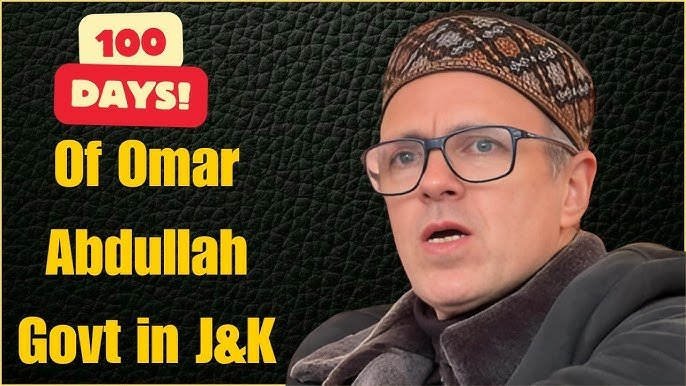
Omar Abdullah Defends Meritocracy
Chief Minister Omar Abdullah made it unequivocally clear:
-
The admission list is purely merit-based.
-
NEET rules leave no room for religious or donor-based quotas.
-
The controversy is artificially manufactured.
His stance presents him as the defender of meritocracy and institutional fairness.
Omar’s message also warns against allowing sentiment to override national-level exam norms.
BJP and Hindu Groups Push Back Hard
Contrarily, the BJP’s Jammu unit and several right-wing Hindu organisations have mounted a political counter-narrative:
-
The college must be granted minority status.
-
The admission list should be scrapped or reviewed.
-
Donor representation should be institutionalised.
For BJP, the controversy offers:
-
An opportunity to appeal to its core Hindu voter base
-
A narrative to question the CM’s decisions
-
A chance to reframe identity politics around educational governance
The friction between the government and these groups is now politically charged and increasingly polarised.
The Shrine Board Under Pressure: A Religious Institution in an Administrative Storm
Why the Shrine Board Is Being Targeted
The Shrine Board, which funds SMVDIME through pilgrim offerings, faces sharp questions:
-
Should a shrine-funded institution follow constitutional meritocracy only?
-
Or honor donor sentiment with representational guarantees?
This debate is internalised within the Board’s stakeholders too.
Many devotees believe:
-
Shrine funds should benefit the Hindu community primarily.
-
Admissions with an overwhelming majority from another faith undermine the “purpose” of the institution.
However, constitutional experts point out:
-
As long as SMVDIME is a publicly regulated educational institution, it must follow NEET.
-
Shrine-based donations cannot override national admission norms.
This legal-moral contradiction is at the heart of the crisis.
The Administrative Stakes: What Happens If Protests Continue
If the agitation sustains and expands, the government faces multiple operational challenges:
a) Market Disruptions
Traders’ involvement may lead to shutdowns, affecting supply chains and businesses.
b) Transportation Chaos
Transport strikes could disrupt intra-Jammu mobility, pilgrim travel, and essential services.
c) Legal Action
Bar-backed petitions could trigger prolonged court cases, complicating admissions.
d) Credibility Questions for SMVDIME
Controversies may impact:
-
Academic reputation
-
Attractiveness to future students
-
Faculty morale
-
Institutional autonomy
e) Political Polarisation
The issue could become a permanent electoral fault line between parties.
The Bigger Story: Meritocracy vs Identity Politics in J&K’s Education Landscape
The SMVDIME row highlights a deep, unresolved tension in J&K’s education sector:
-
Meritocracy, as mandated by NEET, demands equal opportunity for all.
-
Identity politics, especially in pilgrimage-linked institutions, demands community representation.
This contradiction is not easy to reconcile.
Multiple institutions around India have faced similar conflicts:
-
Donor-funded colleges seeking autonomy
-
Minority-run institutions balancing representation with merit
-
Community expectations clashing with national exam norms
SMVDIME is now the latest and perhaps most visible case in this long-running national debate.
Stakeholder Positions: A Comprehensive Mapping
| Stakeholder | Position | Implication |
|---|---|---|
| Sangharsh Samiti (SMVDSS) | Demands cancellation of MBBS list and minority status | Driving mass protests |
| Transporters & Traders | Full support to agitation | Adds economic pressure |
| Jammu Bar Association | Backing the stir | Provides legal legitimacy |
| Omar Abdullah (CM) | Defends NEET merit list | Stands against identity-based demands |
| BJP & Hindu Groups | Demand shrine-linked representation | Fueling mobilisation |
| Shrine Board | Under scrutiny for donor expectations | Must balance sentiment with law |
| Students & Families | Caught in crossfire | Facing uncertainty over admissions |
The Possible Scenarios: What Happens Next?
Scenario 1: The Government Holds Ground
Merit list stays.
Protests continue but gradually lose steam.
Court intervention could validate the list.
Scenario 2: The Government Orders a Review
A middle path to calm public pressure.
Could trigger legal challenges over NEET compliance.
Scenario 3: Minority Status Granted
This would reshape the institution’s governance.
But would raise major constitutional questions.
Scenario 4: Court Intervenes
Judicial scrutiny could redefine admission policies across shrine-funded institutions.
Scenario 5: Political Negotiation
Behind-the-scenes talks could produce a formula balancing merit with sentiment.
Conclusion: A Test of Governance, Community Sensitivity, and Institutional Integrity
The SMVDIME admission row is no longer just about one merit list. It is a live referendum on how Jammu & Kashmir navigates:
-
competing community identities
-
constitutional meritocracy
-
political opportunism
-
sentiment linked to religious institutions
-
the credibility of national exams
-
pressure from civil society, traders, and legal bodies
It is also a test of the Abdullah government’s resolve—and the BJP’s strategy to reframe the issue as a cultural and political battle.
At the heart of the issue, however, lies a simpler question often buried under slogans and protests:
Can an institution funded by a devotional community remain purely merit-driven?
Or
Must it reflect the community’s ethnic, cultural, and religious demographics?
This debate is far from over.
The coming weeks will determine whether SMVDIME becomes a model of meritocratic resilience—or a precedent-setting case of identity shaping modern education policy in Jammu & Kashmir.