48% Srinagar Households Get 24×7 Power: RDSS Trial Success, Public Reaction & What’s Next
By: Javid Amin | 24 December 2025
A Quiet but Transformational Change
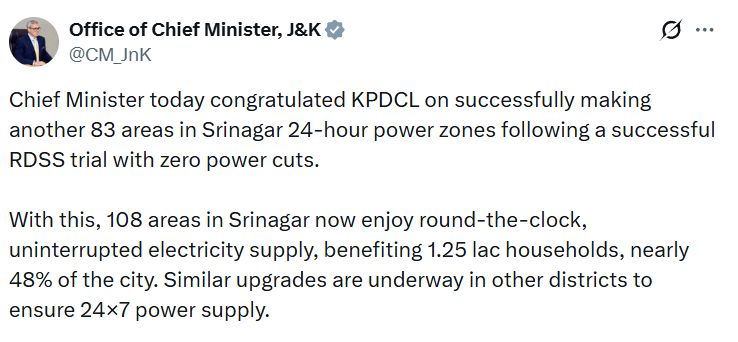
In a region where electricity shortages—especially during harsh winters—have long shaped daily routines, the announcement that 48% of Srinagar households now enjoy uninterrupted 24×7 power supply marks a significant moment in Jammu & Kashmir’s infrastructure journey.
Chief Minister Omar Abdullah, acknowledging the progress under the Revamped Distribution Sector Scheme (RDSS), congratulated the Kashmir Power Distribution Corporation Limited (KPDCL) for successfully converting 83 additional areas in Srinagar into zero-power-cut zones.
While the official numbers signal progress, the real test lies on the ground: How reliable is the supply? What do residents actually experience? And can this model be scaled citywide?
RDSS Explained: Why This Trial Matters
The Revamped Distribution Sector Scheme (RDSS) is a centrally backed reform initiative aimed at fixing long-standing issues in India’s power distribution system.
Core Objectives of RDSS
-
Reduce Aggregate Technical and Commercial (AT&C) losses
-
Modernize power infrastructure
-
Improve billing efficiency and metering
-
Ensure reliable and quality power supply
In Srinagar, RDSS trials focused on:
-
Feeder segregation
-
Smart metering and monitoring
-
Strengthening transformers and substations
-
Real-time fault detection
The result, according to the government: zero scheduled and unscheduled power cuts in trial zones.
What the Numbers Mean: 48% Is Not Just a Statistic
Nearly half of Srinagar’s households now experiencing uninterrupted electricity is not merely an administrative achievement—it represents a shift in everyday life.
Coverage Expansion
-
83 new areas added to 24-hour power zones
-
Multiple residential clusters across different constituencies
-
Mix of old city localities and newer residential layouts
Officials stress that these are functional zones, not experimental micro-pockets.
On the Ground: What Srinagar Residents Are Saying
Residential Areas: Cautious Optimism
In many newly added zones, residents confirm a noticeable improvement.
“Earlier, we planned everything around power cuts—charging phones, heating water, even cooking. For the last few weeks, power has been stable, even at night,”
— Resident, Bemina
However, residents are careful not to over-celebrate.
“It’s definitely better, but people are watching closely. Winters are the real test,”
— Senior citizen, Rajbagh
Winter Anxiety Still Lingers
Despite the improvement, many households remain wary:
-
Peak winter demand has historically strained grids
-
Fear of transformer overload during sub-zero temperatures
-
Past experiences of sudden breakdowns remain fresh
Business Community: A Clear Win
Traders and Small Businesses
For shopkeepers, workshops, and service providers, uninterrupted power is already showing results.
“We used to shut early or run generators. Now costs are down and work is smoother,”
— Electronics shop owner, Lal Chowk
Key benefits cited:
-
Reduced diesel generator expenses
-
Less wear and tear on inverters
-
Improved customer experience
Hospitality and Services
Hotels, clinics, and IT-enabled services particularly welcome the change:
-
Fewer service disruptions
-
Better reliability during peak hours
-
Lower operating costs
KPDCL’s Role: Quiet Execution Over Publicity
The Chief Minister’s Office specifically congratulated KPDCL, reflecting recognition of a department often criticized rather than praised.
Operational Improvements
Ground reports indicate:
-
Faster fault response times
-
Improved monitoring of feeders
-
Better coordination during load management
However, staff shortages and ageing infrastructure in some pockets still pose challenges.
Governance Signal: A Shift in Power Sector Narrative
For decades, electricity in Kashmir has been a politically sensitive and administratively difficult subject.
This milestone sends three key governance signals:
-
Infrastructure reform can deliver results
-
Data-driven pilots work better than blanket promises
-
Public trust improves when outcomes are visible
The RDSS trial provides a template for measurable governance success, something often missing in utility reforms.
The Other 52%: The Uneven Reality
While 48% coverage is significant, more than half of Srinagar still does not have 24×7 power.
Common Issues in Non-Covered Areas
-
Frequent outages
-
Voltage fluctuations
-
Transformer overloads
-
Longer repair times
Residents in these areas express frustration:
“When we hear ‘24×7 power’, it feels like two Srinagars exist—one with power, one without,”
— Resident, Downtown Srinagar
This disparity highlights the need for equitable rollout, not just selective success.
Challenges Ahead: Scaling Without Slipping
Infrastructure Load Management
Extending uninterrupted supply citywide will require:
-
Transformer capacity upgrades
-
Substation strengthening
-
Better peak-load forecasting
Sustainability of Zero-Cut Zones
Maintaining 24×7 power is harder than achieving it once. Risks include:
-
Sudden weather events
-
Seasonal demand spikes
-
Equipment fatigue
Consumer Behaviour
Officials quietly acknowledge that:
-
Power theft
-
Unregulated load usage
-
Resistance to metering
could undermine progress if not addressed sensitively.
Expert View: A Structural Turning Point, Not a Finish Line
Power sector analysts describe the RDSS trial as:
-
A structural improvement, not a temporary fix
-
Evidence that distribution reforms matter more than generation alone
However, they caution:
-
Success depends on continuous investment
-
Political consistency is essential
-
Public cooperation will determine long-term stability
What Needs to Happen Next
Immediate Priorities
-
Expand RDSS zones methodically
-
Ensure winter stress-testing
-
Strengthen complaint redressal systems
Medium-Term Reforms
-
Universal smart metering
-
Transparent billing and usage data
-
Incentives for energy efficiency
FAQs
Q1: Is 24×7 power guaranteed year-round?
In RDSS trial zones, yes—but winter demand will be the real test.
Q2: Will electricity tariffs increase due to RDSS?
No immediate tariff hike has been linked directly to the trial.
Q3: How can residents know if their area is included?
Updated zone lists are being shared by KPDCL and local administration.
Q4: What if power cuts still occur in trial areas?
Residents can lodge complaints with KPDCL; zero-cut performance is being actively monitored.
Bottom-Line: A Promising Start, Watched Closely by the Public
The announcement that 48% of Srinagar households now enjoy uninterrupted electricity represents one of the most tangible governance gains in recent years. On the ground, the response is largely positive—though tempered with caution shaped by past experience.
For residents, it brings comfort and predictability.
For businesses, it brings efficiency and savings.
For governance, it brings credibility.
The real success of the RDSS trial, however, will be judged not by press notes—but by whether 24×7 electricity becomes the norm rather than the exception across Srinagar and beyond.


