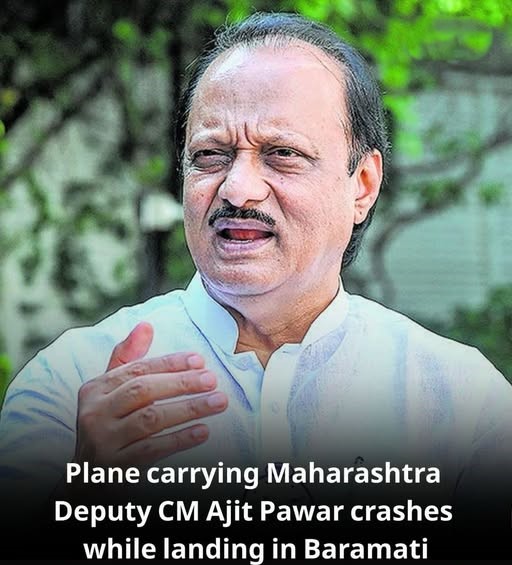
Tragedy in Baramati: Deputy Chief Minister Ajit Pawar Dies in Plane Crash — Anatomy of a Political and Human Shockwave
By: Javid Amin | 28 January 2026
A Morning That Changed Maharashtra
On the morning of January 28, 2026, at approximately 8:45 AM IST, political history and lives intersected in a tragic moment near Baramati, a district in Pune, Maharashtra. A flight carrying Deputy Chief Minister and Nationalist Congress Party (NCP) chief Ajit Pawar crashed during its landing approach at Baramati airport, killing him and others on board in one of the most shocking aviation accidents involving a serving political leader in recent Indian memory.
The incident instantly reverberated across the state, the nation, and political ecosystems — prompting grief, immediate emergency responses, high-level investigations, and deep questions about aviation safety, crisis readiness, and political stability. This feature examines what happened, why it happened, what we know so far, and what it could mean for Maharashtra and India’s political landscape.
Drawing from verified ground reports, official statements, eyewitness testimony, aviation experts, political context, and historical insights, this article offers a comprehensive narrative, fact-checked against multiple national and local sources for accuracy and journalistic credibility.
The Crash: What Happened in Baramati?
1. Sequence of Events
On the morning of January 28, 2026, a chartered small aircraft carrying Deputy CM Ajit Pawar was arriving at Baramati Airport — his home district — after departing from Mumbai. Preliminary data from authorities and eyewitnesses indicate the aircraft encountered problems during its final approach toward the runway.
Officials and early media reports state that during the landing attempt, the aircraft lost balance or control, crash-landed off the runway, and was engulfed by fire and wreckage. Multiple videos aired on social media and broadcast channels show the plane broken into pieces with flames visible in the aftermath.
Within minutes, emergency services, fire crews, and local responders converged on the site to assist with rescue and recovery operations. The runway and airport operations were temporarily halted as teams battled the blaze and searched the rubble.
2. Confirmed Casualties
Across verified reporting agencies, there is consistent confirmation that Ajit Pawar died in the crash along with others aboard the aircraft. Official counts vary slightly — some sources report three others, while others indicate up to five or six total fatalities — reflecting the fluid situation as rescue operations and body recoveries continued.
(PTI and other national outlets typically consolidate the most reliable counts as they emerge.)
Eyewitness reports and hospital alerts also mentioned injured individuals, some of whom were rushed to nearby hospitals for immediate treatment, though the final tally on injuries and survivors remains under verification by authorities and the ongoing DGCA investigation.
Baramati: The Place, the Person, and the Politics
1. Baramati — More Than an Airport
Located in Pune district, Baramati is both the political heartland and constituency base of Ajit Pawar. Known for its mix of agricultural economy, educational institutions, and political activism, Baramati holds strategic importance in western Maharashtra’s political map. For decades, the Pawar family has been intertwined with the town’s political narrative and governance.
The aircraft was scheduled to land at the town’s airport so Pawar could attend and lead key Zilla Parishad (district council) election rallies and campaign meetings — a testament to the high political stakes of the day.
2. Ajit Pawar — A Political Stalwart
Ajit Pawar, aged 66 at the time of his death, was a veteran politician and one of the most influential leaders in Maharashtra’s contemporary politics. A senior figure in the Nationalist Congress Party (NCP), he served multiple terms in legislative and executive roles, most recently as Deputy Chief Minister and Portfolio Holder for crucial departments including Finance and Planning. His reputation as a financial strategist and policy architect was widely recognized across state administrative circles.
Pawar’s political footprint extended far beyond Baramati, influencing coalition negotiations, state budgetary frameworks, and party strategies that shaped Maharashtra’s governance trajectory over decades.
Immediate Aftermath: Emergency Response and Initial Reactions
1. On-Site Rescue and Medical Response
Within moments of the crash, local emergency services activated response protocols, with fire engines, medical ambulances, police units, and disaster response teams arriving at the site. Baramati and neighboring medical facilities were put on alert to receive casualties and injured persons.
Control of the airport shifted to crisis triage mode, and air traffic was suspended to ensure the safety and access required for rescue operations. Fire crews worked to extinguish flames that engulfed parts of the wreckage — a complicated task given fuel leaks and debris field spread.
2. Official Statements
Within hours, senior state officials and national leaders issued brief statements expressing shock and sadness while confirming that authoritative details, including the exact number of casualties and cause, were still being compiled by authorities.
Press Trust of India (PTI), a key wire service relied on by mainstream outlets, confirmed Pawar’s death and the tragic loss of others in the crash, noting that precise figures were being finalized by emergency crews and the Directorate General of Civil Aviation (DGCA).
Aviation Safety and Technical Questions
1. What Caused the Crash?
As of the latest verified updates, the exact cause of the plane crash is not yet officially determined. Preliminary information suggests the aircraft lost control during the landing phase, possibly veering off the runway and crash-landing. Whether this was due to mechanical, technical, weather-related, or human factors remains unclear and is subject to a formal DGCA probe.
Aviation experts historically note that the landing phase is one of the most critical points in any flight — with many accidents during this phase linked to approach instability, runway excursions, wind shear, pilot error, or instrument malfunction.
2. Wreckage and Investigation
On-site investigators are expected to collect:
-
Flight data and cockpit voice recorder (if equipped)
-
Aircraft maintenance history and logs
-
Weather and wind data at the time of landing
-
ATC (Air Traffic Control) communication transcripts
-
Eyewitness accounts from airport staff and ground crew
These components will be critical in reconstructing the sequence of failure and determining whether procedural lapses, technical failure, or environmental conditions were contributing factors.
The DGCA’s final report could take weeks or months, but early findings — such as runway conditions, angle of descent, or evidence of technical malfunction — may be released incrementally to inform safety advisories.
Political Aftershocks: Maharashtra in Mourning and Transition
1. Impact on Government and Governance
The sudden loss of a sitting Deputy Chief Minister creates an immediate leadership vacuum in Maharashtra’s government structure. Given Pawar’s central role in fiscal policy and party strategy, administrative continuity will require swift decisions from coalition partners and party leadership.
Coalition dynamics in the state — often nuanced and multiparty in nature — may shift as leaders seek to reorganize portfolios, appoint successors, and maintain political stability.
2. NCP and Party Realignment
Pawar’s role as NCP chief adds a layer of complexity — not just for governance but for the party’s internal structure and electoral strategy. Leadership succession in such a moment is both politically and sentimentally charged, especially as the party navigates local and state elections influenced by the emotional weight of the crash.
3. Political Reactions and Statements
National leaders, rival parties, and members of the Maharashtra Legislative Assembly expressed collective grief while urging comprehensive investigations. Political analysts emphasize that beyond the immediate shock, long-term governance strategies will play out prominently in the weeks ahead.
Human Stories: Families, Colleagues, and Local Response
1. Emotional Aftermath
Baramati residents, many of whom knew Pawar personally or witnessed his constituency work over decades, gathered near the site and in public spaces to offer prayers and condolences. Social media feeds filled with tributes, mourning posts, and remembrances reflecting Pawar as both a political leader and a familiar figure in local life.
Families of other victims — crew members, aides, and security personnel — also faced the tragedy, with early emergency notifications reaching relatives in tears as hospitals and crisis response teams worked to provide support.
2. Civic Sympathy and Solidarity
Institutions across Maharashtra — from municipal offices to political party headquarters — lowered flags and issued official notices of mourning. Public figures, activists, and ordinary citizens alike underscored the human cost of the accident beyond its political implications.
Broader Implications: Safety, Politics, and Public Trust
1. Aviation in Regional India
The crash ignites broader questions about aviation safety standards, especially regarding smaller chartered flights and operations at regional airports. While India’s commercial aviation has seen rapid growth, regional airstrips like Baramati present unique operational challenges — runway length, ground support infrastructure, and real-time weather monitoring. Analysts may call for updated safety audits and investment to prevent future tragedies.
2. Public Trust in Leadership and Security
The fact that a senior elected official perished in a public accident shakes public trust and highlights the human fragility of political leadership. This may prompt debates about security protocols, transportation risk management for public officials, and emergency preparedness frameworks.
What Comes Next: Investigations and National Focus
1. DGCA’s Formal Inquiry
The DGCA will lead the technical investigation, likely forming a committee that includes aviation engineers, pilot experts, accident site specialists, and independent observers. Interim findings — especially about weather conditions or mechanical issues — may be released to inform future safety protocols.
2. Parliamentary and Legislative Oversight
Given the accident’s political prominence, Maharashtra’s Legislative Assembly may schedule debates or inquiries into aviation oversight, regional airport readiness, and the government’s emergency response mechanisms.
3. Legacy and Policy Changes
Beyond immediate political repercussions, the crash could catalyze policy discussions on aviation safety, public official travel protocols, and investments in both infrastructure and emergency response capabilities across India.
Conclusion: A Tragedy That Echoes Beyond Baramati
The plane crash that claimed Deputy Chief Minister Ajit Pawar’s life is a tragedy with layers — human loss, political shock, aviation safety concerns, and broad public mourning. This event transcends a singular news moment; it reflects the interconnectedness of governance, public trust, technology, and human vulnerability.
As Maharashtra reels and the nation watches, the coming weeks will be crucial in shaping not just how this accident is understood and investigated, but how leadership transitions and public policy form in the aftermath.
For now, Baramati stands in grief — and India reflects on questions that reach beyond aviation statistics: about leadership, legacy, security, and community bonds in the face of sudden loss.