Alienation in Kashmir Has Reached an Unprecedented Level: Mehbooba Mufti Accuses Omar Abdullah of Silence Amid Growing Public Discontent
By: Javid Amin | 07 January 2026
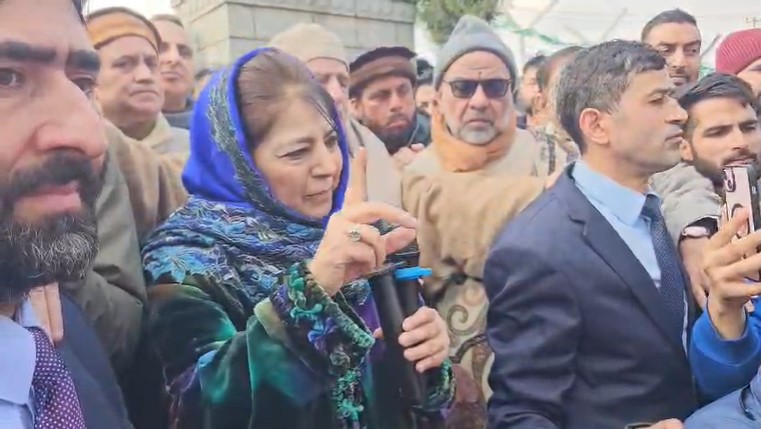
Standing before party workers and supporters on the 10th death anniversary of former Chief Minister Mufti Mohammad Sayeed, People’s Democratic Party (PDP) president Mehbooba Mufti delivered one of her most forceful speeches in recent years. Her message was unambiguous: alienation in Kashmir has deepened to an unprecedented level, and mainstream political leadership — particularly National Conference (NC) leader Omar Abdullah — has failed to speak up.
The emotionally-charged gathering in Bijbehara, Mufti Mohammad Sayeed’s hometown, served not only as a memorial but also as a sharp political intervention. Mehbooba framed the moment as both a warning and a plea — a call to return to dialogue-driven politics rooted in dignity, reconciliation, and outreach, values she credited to her father’s legacy.
At the heart of her address lay three intertwined themes:
-
rising youth despair and unemployment
-
a sharp decline in political trust
-
and what she called a troubling silence from those in power
This feature examines the political message, the underlying anxieties shaping the Valley’s mood, the symbolism of invoking Mufti Mohammad Sayeed’s legacy, and the growing rivalry between two of Kashmir’s most prominent political leaders.
A Valley at Unease: Mehbooba’s Warning of “Unprecedented Alienation”
Mehbooba Mufti did not temper her language. She said the present generation of Kashmiri youth faces a depth of alienation and hopelessness unseen in decades. Her remarks referenced persistent unemployment, tightening socio-political restrictions, and what she described as an atmosphere of silent suffocation.
She alluded to stories circulating in villages and towns across the Valley — qualified youth struggling without jobs, families facing insecurity over land and livelihoods, and social frustration that rarely finds institutional outlets. In her words, the result is not simply dissatisfaction, but systemic disillusionment with governance and representation.
This narrative echoes a growing sentiment that political channels — once seen as bridges between New Delhi and the Valley — are now failing to articulate public distress. Mehbooba positioned herself as a voice warning of the risks:
when society silently detaches, governance loses legitimacy.
Her argument was not framed in rhetoric alone — but in the lived anxieties of ordinary Kashmiris.
Targeting Omar Abdullah: Silence as Political Failure
A key section of Mehbooba’s speech directly targeted Omar Abdullah, the National Conference vice-president and former chief minister.
She accused him of choosing silence at a time when people expected leadership.
According to her, this silence is particularly glaring because:
-
The NC commands significant numerical strength in the Assembly.
-
The party holds representation in Parliament.
-
Public issues require active advocacy.
Mehbooba alleged that Omar Abdullah has avoided forcefully addressing matters such as:
-
job scarcity
-
land rights
-
the plight of Kashmiri detainees
-
growing socioeconomic pressure
In political messaging, silence can carry meaning. Mehbooba framed it as complicity through inaction — a refusal to confront the core anxieties of the Valley.
Her critique served two purposes:
-
Differentiate PDP’s political posture from NC’s.
-
Reframe the public conversation around accountability — not just policy.
In Kashmir’s post-2019 political arena, such positioning matters deeply.
Invoking Mufti Mohammad Sayeed: A Legacy of Dialogue and Dignity
The timing and venue of the criticism were deliberate.
The occasion marked ten years since Mufti Mohammad Sayeed’s passing, a leader remembered for advocating reconciliation, outreach, and de-escalation. Mehbooba reminded attendees that her father prioritised dignity and political inclusivity over partisan gain.
She emphasized themes central to his legacy:
-
dialogue with New Delhi
-
reducing distrust
-
protecting civil space
-
addressing grievance rather than denying it
She contrasted this with present-day caution, guarded speech, and strategic silence among political leaders.
Her underlying message was clear:
outreach is not weakness — it is political responsibility.
The legacy invocation also served an electoral function — reaffirming PDP’s ideological identity at a time when Kashmir’s political spectrum is undergoing recalibration.
Call for Outreach and Reconcilation: A Return to Political Bridge-Building
Mehbooba’s prescription for today’s crisis remains consistent with her political outlook:
-
revive dialogue mechanisms
-
prioritize civil dignity
-
rebuild emotional trust
-
acknowledge people’s pain
She argued that administrative efficiency alone cannot heal alienation unless political conversation reopens. This means both:
-
listening to the youth
-
and addressing structural anxieties
Her speech framed Kashmir’s political climate as quiet but tense — not explosive, but unsettled.
Comparative Political Postures
| Figure | Position | Tone |
|---|---|---|
| Mehbooba Mufti | Alienation at unprecedented level; demands public advocacy | Alarmed, confrontational |
| Omar Abdullah | Accused of silence, limited public confrontation | Reserved, tactical |
| Mufti Mohammad Sayeed (legacy) | Outreach, reconciliation, dignity | Conciliatory, bridge-building |
This contrast reflects two political models:
-
activist-advocacy politics (PDP)
-
institution-driven cautious politics (NC)
Both claim legitimacy. But Mehbooba argues that today requires voice, not restraint.
Why the Moment Matters: Political and Social Stakes
The speech carries implications beyond party rivalry.
1. Youth Sentiment
Young Kashmiris today face:
-
fewer job opportunities
-
rising examination competition
-
limited private-sector absorption
-
uncertainty about rights and expression
When political leaders disengage, Mehbooba warns, the emotional distance widens.
2. Mainstream Credibility
Mainstream parties historically served as institutional channels for grievance. If people begin to doubt that they speak honestly, trust erodes.
3. Power Dynamics
Her remarks sharpen Kashmir’s political divide:
-
PDP — framing itself as defender of dignity
-
NC — seen by critics as institutionally dominant but cautious
The stakes are high — public perception is currency.
Omar Abdullah’s Position: Measured Silence or Strategic Restraint?
As of the time of the remarks, there had been no direct rebuttal from Omar Abdullah.
Some analysts interpret his style as strategic moderation, intended to avoid confrontation that may limit institutional flexibility. Others believe greater moral clarity is expected from leaders with electoral mandate.
Either way, Mehbooba’s comments shifted political pressure onto him.
The Emotional Undercurrent: A Valley Still Searching for Voice
Beyond rhetoric and rivalry, the issue returns to one recurring theme:
Kashmiris want to be heard.
Not simply governed.
Not simply managed.
But meaningfully engaged.
Mehbooba Mufti’s speech — rooted in legacy, grievance, and political contest — tapped into that emotional undercurrent.
Conclusion: A Battle Over Voice, Responsibility, and Legacy
The Bijbehara address was not an isolated outburst — it was a strategic intervention at a psychologically fragile time for the Valley.
By warning that alienation has reached “unprecedented” levels and accusing Omar Abdullah of political silence, Mehbooba Mufti has:
-
reignited Kashmir’s mainstream debate
-
framed leadership as moral responsibility
-
called for renewed dialogue and outreach
Whether this rhetoric transforms into policy pressure or electoral repositioning remains to be seen. But one reality is difficult to ignore:
Kashmir continues to search for political voices willing — and able — to speak openly about its anxieties.
And Mehbooba Mufti clearly intends to be one of them.


