Depleting Springs and Shrinking Rivers in Kashmir: Climate Change Triggers Water Crisis
By: Javid Amin | 17 January 2025
Snow That Once Fell Now Refuses Kashmir
Kashmir, long romanticised as the “Paradise on Earth,” is today confronting a slow-moving ecological emergency. Beneath postcard images of snow-clad peaks and serene rivers lies a harsher reality: the Valley’s water systems are weakening. Springs that once flowed year-round are drying up. Rivers that defined Kashmir’s geography, economy, and culture are losing their pulse.
At the heart of this crisis is a bitter irony. Kashmir has contributed almost nothing to the greenhouse gas emissions driving global warming, yet it is paying an outsized price. The snow that once sustained its rivers now arrives erratically—or not at all. The cost of a warming planet is being extracted from a region that did not cause it.
Vanishing Snow: The Collapse of Kashmir’s Natural Water Bank
Winters Rewritten
For generations, Kashmir’s winters were defined by heavy, sustained snowfall. Snow accumulated across mountains, meadows, and forests, slowly melting through spring and summer to recharge aquifers and feed rivers. This natural storage system is now breaking down.
Ground reports and long-term observations indicate that snowfall has become:
- Delayed, often beginning weeks later than historical norms
- Fragmented into short, weak spells
- Concentrated at higher altitudes, leaving valleys largely snowless
The result is a dangerous phenomenon increasingly described as a “snow drought”—not the absence of winter cold, but the absence of winter snow.
Why Snow Matters More Than Rain
Unlike rain, which runs off quickly, snow melts gradually. This slow release ensures steady groundwater recharge and sustained river flow during dry months. When snow disappears, rivers swell briefly during erratic rain events but run dangerously low in summer, precisely when water demand peaks.
Shrinking Glaciers: The Silent Retreat
Himalayan Ice in Retreat
Glaciers across the Kashmir Himalaya—feeding the Jhelum, Lidder, Sindh, and Chenab river systems—are retreating at unprecedented rates. Rising average temperatures accelerate melting while reduced snowfall limits glacial regeneration.
What appears, in the short term, as increased meltwater is deceptive. As glaciers shrink, their long-term capacity to sustain rivers collapses. Scientists warn that many smaller glaciers may lose their functional role within decades.
Long-Term Hydrological Risk
The retreat of glaciers threatens:
- Summer river flows
- Hydropower reliability
- Drinking water security downstream
Once glaciers cross a critical threshold, recovery becomes nearly impossible.
Springs in Crisis: Drying Lifelines of Rural Kashmir
Disappearing Sources of Life
Natural springs are the backbone of rural water supply in Kashmir. Thousands of villages depend on them for drinking water, livestock, and irrigation. Today, many of these springs have either dried up completely or reduced to seasonal trickles.
The reasons are interconnected:
- Reduced snowmelt infiltration
- Degraded catchment forests
- Unregulated construction blocking recharge zones
For communities, the loss of a spring is not abstract—it means women walking farther for water, livestock losses, and rising conflict over access.
Rivers Losing Their Voice: Jhelum and Its Tributaries
A River Under Stress
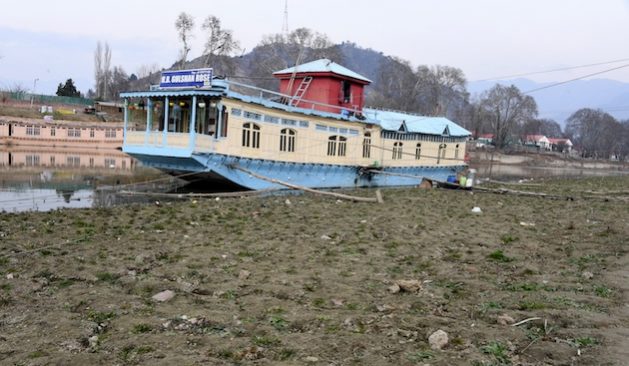
The Jhelum, Kashmir’s principal river, is showing clear signs of distress. Reduced flow during non-monsoon months affects everything from irrigation canals to wetlands and hydropower projects.
Tributaries such as the Lidder and Sindh, once robust with glacial and snow-fed flows, now fluctuate unpredictably. Low water levels disrupt fisheries, damage riverine ecosystems, and reduce agricultural reliability.
Wetlands at Risk
Wetlands like Hokersar and Wular—natural flood buffers and biodiversity hotspots—are shrinking as inflows decline. Their degradation amplifies flood risks during extreme rainfall while reducing water availability during dry periods.
Agriculture Under Strain: Livelihoods on the Brink
Fields Thirsting for Water
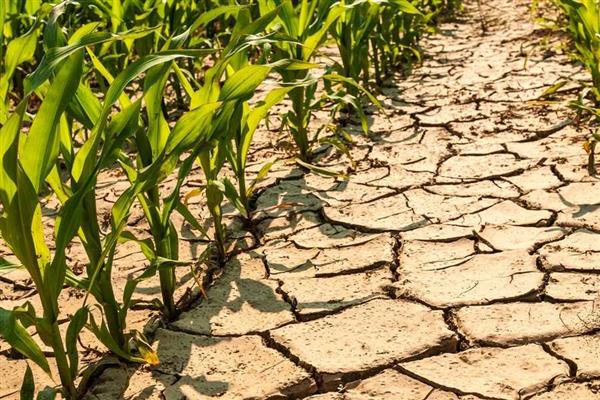
Kashmir’s economy remains deeply tied to agriculture. Rice paddies, apple orchards, and saffron fields all depend on predictable water availability. Reduced river flows and drying springs are creating acute stress.
Farmers report:
- Delayed sowing seasons
- Reduced yields
- Rising costs for alternative water sources
Traditional cropping calendars, refined over centuries, are becoming unreliable.
Climate Injustice: Paying for a Crisis Not of One’s Making
Negligible Emissions, Massive Impact
Kashmir’s carbon footprint is minimal compared to industrialised regions. Yet rising global temperatures—driven largely by historical emissions elsewhere—are rewriting its climate.
This imbalance lies at the heart of climate injustice: those least responsible suffer first and most severely.
Social Costs of Warming
The consequences extend beyond ecology:
- Water rationing in urban centres like Srinagar
- Economic insecurity in rural areas
- Growing migration pressures as traditional livelihoods collapse
Human and Ecological Consequences
Urban Water Stress
Srinagar and other towns increasingly face water shortages during summer. Aging infrastructure, combined with reduced source availability, forces authorities to ration supplies.
Biodiversity Loss
Cold-water fish species, alpine flora, and wetland birds are losing habitat. As water temperatures rise and volumes fall, entire ecosystems face disruption.
Cultural Displacement
For pastoralists and small farmers, water scarcity undermines not just income but identity. Traditional knowledge systems struggle to adapt to rapidly changing conditions.
Possible Solutions: Repairing What Can Still Be Saved
Reviving Springs
Community-led spring rejuvenation—through catchment protection, rainwater harvesting, and recharge trenching—has shown promise in pilot areas.
Policy and Planning
Urgent priorities include:
- Integrated watershed management
- Climate-resilient agriculture
- Regulated groundwater extraction
- Sustainable hydropower practices
Global Responsibility
Climate finance, technology transfer, and adaptation funding from industrialised nations are not charity—they are accountability.
An Anthemic Wake-Up Call
“Snow that once fell now refuses Kashmir” is more than poetic grief. It is a warning etched into drying riverbeds and silent springs. Kashmir’s water crisis is not local—it is global in cause and moral in consequence.
The question is no longer whether the climate is changing. It is whether the world will accept responsibility for who pays the price.