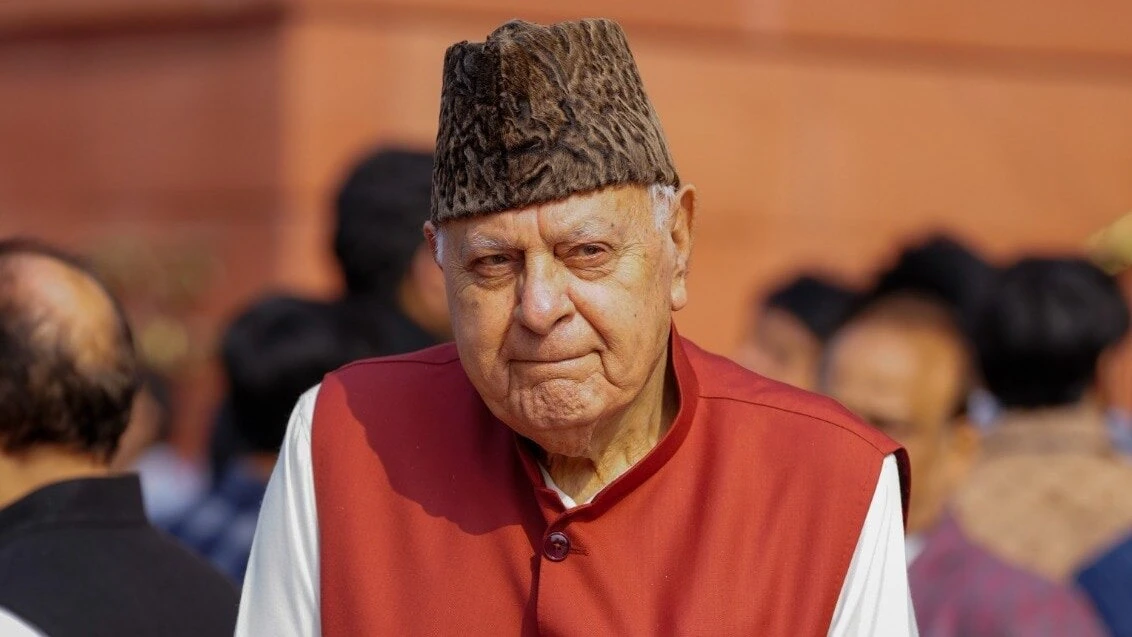
Farooq Abdullah Draws Firm Lines at NC Convention: Kashmir’s Unity, India-Pakistan Dialogue, and a Sharpening Rift with Mehbooba Mufti
By: Javid Amin |20 January 2026
At a crucial National Conference convention, Farooq Abdullah reasserts his party’s pro-India legacy, rejects further division of Jammu & Kashmir, calls for talks with Pakistan, and ignites a fresh political clash with Mehbooba Mufti over history, governance, and the future of the region.
A Convention That Reopened Old Fault Lines
Political conventions in Kashmir are rarely routine affairs. They are often moments when history, memory, grievance, and aspiration collide. The recent National Conference (NC) convention, addressed by party president Farooq Abdullah, was one such moment.
What might have been a conventional organisational gathering turned into a forceful political statement — not only against the Bharatiya Janata Party (BJP) and its narrative on Kashmir, but also against a familiar rival within the Valley’s mainstream politics: Mehbooba Mufti and the Peoples Democratic Party (PDP).
Abdullah’s speech traversed multiple fault lines:
-
The National Conference’s relationship with India
-
The future territorial and administrative shape of Jammu & Kashmir
-
The need for India-Pakistan dialogue
-
And the legacy wars that continue to define Kashmiri politics
In doing so, it revealed the persistent fragility of consensus among Kashmir’s regional parties — even as they face a dominant central government.
“We Took Bullets for India”: Farooq Abdullah Defends NC’s Pro-India Legacy
One of the most emphatic moments of Farooq Abdullah’s address came when he rejected accusations — often voiced by the BJP and its supporters — that the National Conference has historically thrived on instability or ambiguity about India.
“We have taken bullets for India, and we are ready to take them again,” Abdullah said, invoking decades of political struggle, electoral participation, and sacrifice by NC workers.
01. A Response to BJP’s Narrative
Since the abrogation of Article 370 in 2019, the BJP has repeatedly accused Kashmir’s mainstream parties of:
-
Encouraging separatism
-
Benefiting politically from unrest
-
Maintaining a deliberately ambiguous stance on India
Abdullah’s remarks were a direct rebuttal to this framing. By invoking the party’s sacrifices — particularly during the insurgency years of the 1990s when NC leaders and workers were frequently targeted by militants — he sought to reclaim moral and political legitimacy.
02. NC’s Historical Position
The National Conference has long projected itself as:
-
A constitutional party
-
A participant in electoral politics
-
A stakeholder within the Indian Union, albeit with demands for autonomy
By emphasising this legacy, Abdullah aimed to remind both Delhi and Kashmir that mainstream politics in the Valley has paid a heavy price for rejecting armed separatism.
Rejecting Further Bifurcation: “Foolish and Ignorant” Demands
Perhaps the most politically charged part of Abdullah’s speech was his outright rejection of any proposal for further division of Jammu & Kashmir.
He described such demands as “foolish” and “ignorant”, warning that carving the region into more political or administrative units would only deepen alienation.
01. Post-2019 Sensitivities
The statement must be read against the backdrop of:
-
The 2019 bifurcation of the erstwhile state into the Union Territories of Jammu & Kashmir and Ladakh
-
Ongoing debates about regional representation, development, and identity
For Abdullah, the trauma of 2019 remains unresolved. His assertion that he hopes Ladakh will one day be reunited with J&K reflects a continued rejection of the Centre’s reorganisation.
02. Fear of Endless Fragmentation
Abdullah’s argument is rooted in a concern shared by many in Kashmir:
-
That repeated territorial reconfigurations weaken political cohesion
-
That identity-based divisions may replace democratic governance
-
That further bifurcation risks institutionalising mistrust between regions
His remarks signal that, for NC, territorial integrity — even within a reimagined constitutional framework — remains non-negotiable.
India-Pakistan Talks: Dialogue as the Only Way Forward
Farooq Abdullah’s call for renewed India-Pakistan dialogue is not new — but it is increasingly controversial in today’s political climate.
“There is no military solution to the Kashmir problem. Dialogue is the only way forward,” he reiterated.
01. A Consistent NC Position
Historically, the National Conference has:
-
Supported bilateral dialogue
-
Backed confidence-building measures
-
Argued that peace in Kashmir is inseparable from India-Pakistan relations
Abdullah’s statement aligns with this tradition, even as New Delhi maintains a more hardened posture, especially following cross-border terror attacks.
02. Political Risk of Advocating Talks
In contemporary Indian politics, calling for talks with Pakistan carries risks:
-
It can be framed as appeasement
-
It can invite accusations of being “soft on terror”
-
It may alienate nationalist constituencies
Yet Abdullah’s insistence underscores a key point: mainstream Kashmiri leadership continues to view regional peace as impossible without bilateral engagement, regardless of how unpopular that view may be in Delhi.
The Mehbooba Mufti Clash: Dixon Plan, Divisions, and Historical Memory
The sharpest edge of Abdullah’s speech was reserved for Mehbooba Mufti, whose recent remarks on separate divisions for Pir Panjal and Chenab Valley triggered a political storm.
01. Abdullah’s Charge: “Echoing the Dixon Plan”
Abdullah accused Mufti of reviving the logic of the Dixon Plan, a controversial United Nations proposal from 1950 that suggested regional plebiscites or divisions within Jammu & Kashmir.
For Abdullah, invoking the Dixon Plan is tantamount to questioning the region’s political unity — a red line for the NC.
02. Mehbooba Mufti’s Counter
Mehbooba Mufti hit back swiftly:
-
She clarified that her remarks were about administrative divisions, not political separation
-
She reminded Abdullah that Sheikh Abdullah himself had engaged with the Dixon Plan during a different historical moment
Her response highlights a recurring feature of Kashmiri politics: history is not just remembered — it is weaponised.
Administrative Divisions vs Political Fragmentation
At the heart of the Abdullah-Mufti clash lies a genuine governance debate:
-
Are new divisions a tool for better administration?
-
Or do they carry political and communal implications in a sensitive region?
01. Pir Panjal and Chenab Valley Demands
Regions like Rajouri, Poonch, Doda, and Kishtwar have long complained of:
-
Administrative neglect
-
Distance from power centres
-
Developmental disadvantages
Calls for new divisions often stem from these grievances.
02. Why NC Remains Wary
For the National Conference, such demands risk:
-
Reinforcing regional identities over collective politics
-
Opening doors to communal polarisation
-
Weakening bargaining power vis-à-vis the Centre
Thus, Abdullah’s opposition is as much strategic as it is ideological.
Legacy Wars: Sheikh Abdullah’s Shadow
Both Farooq Abdullah and Mehbooba Mufti invoked Sheikh Abdullah, Kashmir’s most influential political figure, to legitimise their positions.
This is telling.
01. Sheikh Abdullah as Political Capital
In Kashmir:
-
History is not settled
-
Legacies are contested
-
Every major decision is measured against the past
By citing Sheikh Abdullah, Mufti sought to blunt the accusation of separatist intent. By defending NC’s historical sacrifices, Farooq sought to claim moral continuity.
Mainstream Politics Under Pressure
The Abdullah-Mufti exchange also reveals a deeper problem: the inability of Kashmir’s mainstream parties to present a united front.
01. BJP’s Strategic Advantage
The BJP benefits politically when:
-
Regional parties attack each other
-
Historical grievances resurface
-
Consensus on autonomy, statehood, or governance fractures
Each public clash reinforces perceptions of disunity.
02. Shrinking Political Space
With:
-
Assembly elections delayed
-
Statehood still pending
-
Power concentrated with the Lieutenant Governor
Mainstream parties are competing not just with the BJP — but with political irrelevance.
Public Perception: Between Fatigue and Fear
Among ordinary Kashmiris, reactions to the NC convention were mixed:
-
Some welcomed Abdullah’s assertiveness on dialogue and unity
-
Others expressed fatigue with legacy politics and historical debates
There is a growing sense that symbolic statements must translate into tangible political gains — statehood, jobs, security, and dignity.
Conclusion: A Speech That Clarified More Than It United
Farooq Abdullah’s address at the NC convention was not merely a political speech — it was a line-drawing exercise.
He made clear that:
-
NC will defend its pro-India credentials
-
It will oppose further division of Jammu & Kashmir
-
It will continue to advocate India-Pakistan dialogue
-
And it will aggressively counter narratives — even from former allies — that challenge its vision of unity
Yet the episode also exposed the deep fractures within Kashmir’s mainstream politics, fractures that risk weakening collective bargaining power at a critical moment.
As Jammu & Kashmir navigates an uncertain political future, one truth stands out:
Without unity among regional voices, the Valley’s concerns may continue to be spoken about — but not necessarily listened to.


