MBBS Admission Row at Shri Mata Vaishno Devi Medical College: Politics, Faith, and the Fault Lines of Education in Jammu
By: Javid Amin | 05 January 2025
A Controversy That Refuses to Fade
The MBBS admission controversy at Shri Mata Vaishno Devi Medical College (SMVDMC) in Jammu has once again taken centre stage, drawing senior political leadership, religious organisations, and the Lieutenant Governor’s administration into a sensitive and emotionally charged debate.
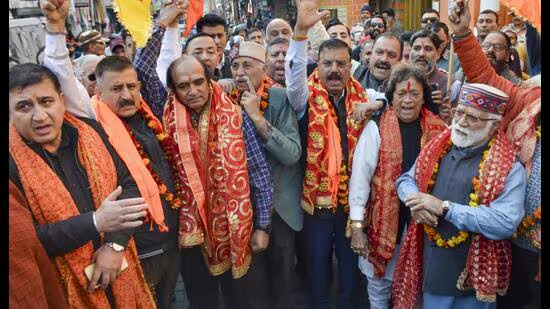
On Monday, Leader of Opposition in the Jammu & Kashmir Legislative Assembly, Sunil Sharma, met members of the Shri Mata Vaishno Devi Sangharsh Samiti, a prominent local body spearheading protests over the admission process at the medical college. The meeting comes amid sustained public anger following reports that 46 out of 50 students admitted to the first MBBS batch were from the Muslim community, triggering protests from several Hindu organisations in Jammu.
While the admissions were carried out under existing NEET-based merit norms, the controversy has quickly expanded beyond academic procedures, evolving into a broader debate on identity, representation, transparency, and the role of religiously associated institutions in secular education.
What Triggered the MBBS Admission Row?
At the heart of the dispute lies the first batch of MBBS admissions at Shri Mata Vaishno Devi Medical College, an institution named after the revered Vaishno Devi shrine and located in the Jammu region.
Key Flashpoint
-
50 MBBS seats were filled strictly on the basis of NEET merit and existing reservation rules.
-
46 seats reportedly went to Muslim students, with only a small number of Hindu students securing admission.
-
Local Hindu groups questioned whether an institution bearing the name of Mata Vaishno Devi, a deeply revered Hindu religious symbol, should reflect what they describe as the “demographic and cultural ethos” of the region.
While no illegality has been formally established, the optics of the admissions ignited anger in parts of Jammu, where the issue is being framed as one of representation and sentiment, rather than purely academic merit.
Enter the Sangharsh Samiti: Voice of Local Discontent
The Shri Mata Vaishno Devi Sangharsh Samiti has emerged as the primary platform articulating the grievances of protesting groups.
Their Core Arguments
-
The medical college, they argue, was conceptualised with a distinct cultural and religious association.
-
Admissions, while merit-based, should also reflect regional and community balance, especially in a sensitive socio-political environment like J&K.
-
Lack of clear communication and transparency from authorities has deepened mistrust.
The Samiti has consistently maintained that their protest is not against any community, but against what they see as a policy failure and administrative insensitivity.
Sunil Sharma’s Intervention: BJP Steps Into the Spotlight
Against this backdrop, Sunil Sharma’s meeting with the Sangharsh Samiti assumes significant political importance.
What Happened During the Meeting?
-
Sharma met the core group of the Sangharsh Samiti, engaging in a candid discussion.
-
Members raised sharp and uncomfortable questions about the BJP’s position and the Centre’s role.
-
Sharma assured the group that:
-
BJP MLAs have already taken up the issue with the Lieutenant Governor.
-
The party is committed to a resolution that ensures fairness, transparency, and social harmony.
-
The matter is being examined at the highest administrative level.
-
Sharma sought to position himself as a mediator, balancing constitutional norms with local sentiments.
BJP’s Tightrope Walk: Politics Meets Constitutional Reality
For the Bharatiya Janata Party, the controversy presents a complex challenge.
Political Calculus
-
Jammu remains a core BJP support base, where religious and cultural identity issues resonate strongly.
-
At the same time, admissions to medical colleges are governed by national laws, merit norms, and judicial scrutiny.
Sharma’s messaging reflected this balancing act:
-
He avoided endorsing demands that could be seen as communal or exclusionary.
-
Simultaneously, he acknowledged local hurt and emotional concerns, signalling political empathy.
This calibrated approach underscores BJP’s attempt to retain credibility in Jammu without crossing constitutional red lines.
Why This Issue Has Struck a Nerve in Jammu
The intensity of the protests cannot be understood in isolation.
Historical Context
-
Jammu has long harboured concerns of political and administrative marginalisation.
-
Educational institutions are often viewed as symbols of regional empowerment.
-
The use of religious symbolism in institutional naming amplifies emotional investment.
For many locals, the SMVD Medical College represents more than an academic institution—it is seen as a cultural landmark.
Education vs Identity: A Dangerous Binary
One of the most troubling aspects of the controversy is how quickly it has slipped into a religious binary.
Experts Warn
-
Framing admissions along religious lines risks:
-
Undermining meritocracy
-
Deepening communal divides
-
Politicising professional education
-
At the same time, ignoring local sensitivities risks alienating communities and fuelling resentment.
The challenge for policymakers lies in navigating this delicate intersection without compromising constitutional values.
Role of the Lieutenant Governor: Final Arbiter?
Sunil Sharma’s assurance that the issue has been raised with the Lieutenant Governor (LG) places the spotlight firmly on Raj Bhavan.
Why the LG Matters
-
In the Union Territory setup, the LG holds significant administrative authority.
-
Education policy, especially for new institutions, falls under direct administrative oversight.
Sources indicate that:
-
The LG’s office is examining admission procedures and communication gaps.
-
No rollback of admissions is under consideration, but policy clarifications may be explored.
Any intervention will need to balance legal sustainability, public order, and political optics.
Risks and Challenges Ahead
1. Communal Polarisation
If left unresolved or poorly communicated, the issue could:
-
Harden religious identities
-
Be exploited by fringe elements
-
Spill over into street protests
2. Legal Constraints
Admissions made through NEET and statutory rules are:
-
Difficult to reverse
-
Subject to judicial review
3. Governance Credibility
Failure to address concerns transparently could:
-
Damage trust in the administration
-
Reinforce perceptions of policy opacity
Public Perception: Between Anger and Anxiety
Among ordinary residents, reactions are mixed:
-
Some see the protests as legitimate expressions of hurt sentiment.
-
Others worry that students are being unfairly targeted for systemic issues.
Parents, educators, and civil society groups have urged restraint, warning against turning classrooms into battlegrounds.
What Could a Resolution Look Like?
While no easy solution exists, experts suggest a multi-pronged approach:
Possible Steps
-
Clear public explanation of admission rules and constraints
-
Future policy guidelines for regionally sensitive institutions
-
Dialogue forums involving community leaders, educators, and administrators
-
Avoiding retroactive actions that could harm students’ careers
The Bigger Picture: J&K’s Fragile Social Equilibrium
The SMVD Medical College row is symptomatic of a larger reality in Jammu & Kashmir:
-
High emotional stakes
-
Deep-seated mistrust
-
Politics intersecting with everyday governance
In such an environment, even routine administrative decisions can acquire outsized political meaning.
Editorial Takeaway: Governance Must Speak Before Streets Do
Sunil Sharma’s meeting with the Shri Mata Vaishno Devi Sangharsh Samiti reflects both political responsiveness and institutional anxiety.
While education must remain merit-driven and inclusive, governance in a sensitive region like J&K cannot afford to be tone-deaf. Transparency, communication, and empathy are no longer optional—they are essential tools of administration.
The way this controversy is resolved will send a powerful signal about how the state balances faith, fairness, and the future of its youth.
As Jammu watches closely, one truth stands out:
When education becomes political, the cost is paid by society at large.

