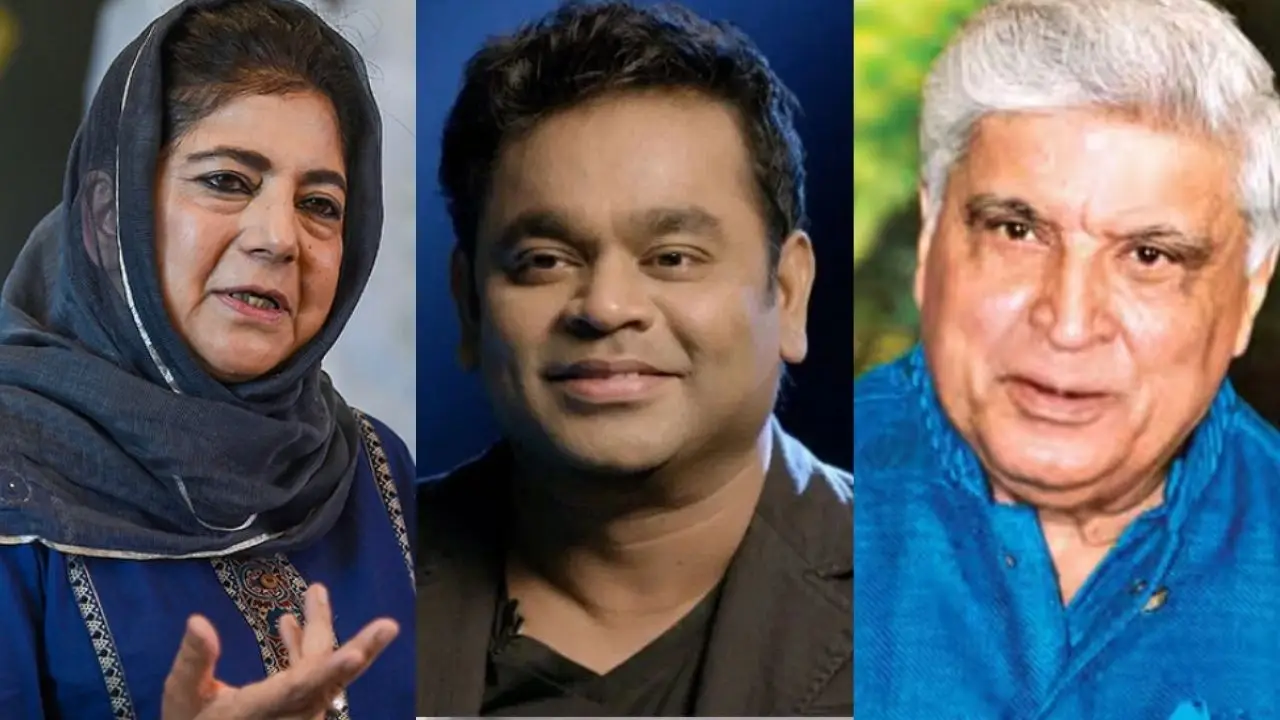
Mehbooba Mufti Backs AR Rahman, Questions Javed Akhtar on Communalism in Bollywood
By: Javid Amin | 18 January 2026
As A.R. Rahman’s remarks on feeling sidelined spark a nationwide debate, PDP president Mehbooba Mufti steps in, arguing that dismissing such concerns ignores the lived experiences of Indian Muslims and the changing character of Bollywood itself.
When Art, Identity, and Politics Collide
The ongoing debate around A.R. Rahman’s remarks on Bollywood and communalism has moved well beyond the film industry. What began as an artist’s personal reflection has now become a flashpoint in India’s wider socio-political conversation on inclusion, identity, and lived experience.
With veteran lyricist Javed Akhtar publicly dismissing Rahman’s concerns as exaggerated or misplaced, the discussion took a sharper turn. Enter Mehbooba Mufti, former Jammu and Kashmir chief minister and president of the Peoples Democratic Party (PDP), who offered a forceful counter-narrative. According to Mufti, Akhtar’s dismissal is “not in sync with the reality of Muslims in today’s India,” and Rahman’s words resonate precisely because they reflect that reality.
Her intervention underscores a deeper truth: Bollywood, long romanticized as a secular and inclusive space, is increasingly being viewed as a mirror of broader societal divisions.
A.R. Rahman’s Concerns—An Artist Speaks From Experience
A.R. Rahman’s comments did not emerge in a vacuum. Over the years, the Oscar-winning composer has gradually reduced his presence in mainstream Hindi cinema, even as his global stature has grown. When Rahman recently suggested that he feels sidelined in Bollywood and hinted that communalism may be a contributing factor, the statement struck a nerve.
Rahman did not make sweeping accusations. Instead, his remarks were measured, reflective, and rooted in personal experience. He spoke of an environment where opportunities appear uneven and where subtle biases may shape professional relationships. For many observers, especially from minority communities, this quiet articulation felt familiar.
Rahman’s stature adds weight to his words. If an artist of his global standing can feel marginalized, critics argue, it raises uncomfortable questions about the structural realities of the industry.
Javed Akhtar’s Rebuttal—A Generational and Ideological Divide
Javed Akhtar, one of Bollywood’s most respected lyricists and public intellectuals, was quick to counter Rahman’s claims. Akhtar suggested that the remarks were being misinterpreted or overstated, implying that Bollywood remains largely inclusive and that communal bias is not a defining factor in professional success.
Akhtar’s response reflected a worldview shaped by an earlier era of Hindi cinema—one often celebrated for its composite culture and ideological pluralism. In that context, Bollywood was seen as an exception to social divisions, a space where talent transcended identity.
However, critics argue that Akhtar’s position, while rooted in personal experience, may not adequately account for how the industry—and society—has evolved. What once felt instinctively inclusive to insiders may now appear exclusionary to those navigating it today.
Mehbooba Mufti Enters the Debate—“This Is the Reality”
Mehbooba Mufti’s intervention reframed the conversation. Backing Rahman unequivocally, she argued that dismissing his concerns amounts to denying the lived experiences of millions of Indian Muslims.
According to Mufti, Rahman’s remarks are not isolated grievances but part of a broader pattern. She emphasized that cultural spaces, including Bollywood, do not exist in isolation from society. When social polarization deepens, creative industries inevitably reflect those tensions.
By stating that Akhtar’s dismissal is “not in sync with reality,” Mufti positioned herself as speaking from the margins—articulating a truth that, in her view, is routinely minimized by those who do not face the same vulnerabilities.
Bollywood as a Mirror of Society, Not an Exception
For decades, Bollywood was celebrated as a symbol of India’s pluralism. Muslim writers, poets, composers, and actors played a foundational role in shaping its language and ethos. That legacy still exists, but many argue it is under strain.
Mehbooba Mufti’s remarks suggest that Bollywood is no longer insulated from the political currents shaping the rest of the country. Hiring patterns, public perceptions, and online campaigns now influence creative decisions in unprecedented ways.
In this context, Rahman’s concerns appear less like personal discontent and more like a symptom of structural change—where inclusivity is no longer assumed but contested.
The Politics of Lived Experience vs Perceived Reality
At the heart of the disagreement between Rahman, Akhtar, and Mufti lies a fundamental sociological divide: the gap between lived experience and perceived reality.
For Akhtar, Bollywood may still feel inclusive because it once was, and because his own journey affirmed that belief. For Rahman, operating in a more polarized era, subtle exclusion may feel tangible. For Mufti, these experiences align with a larger political narrative of marginalization.
This divergence does not necessarily imply bad faith on any side. Instead, it highlights how social position, generational context, and political awareness shape one’s understanding of reality.
Why Rahman’s Voice Carries Particular Weight
Rahman is not a political activist by design. His public persona has long been defined by restraint, spirituality, and artistic focus. This is precisely why his remarks resonated so widely.
When someone known for avoiding controversy speaks of discomfort, it disrupts complacent narratives. Mehbooba Mufti’s support amplifies that disruption, turning a cultural conversation into a political one.
The implication is clear: if voices like Rahman’s are brushed aside, it signals a narrowing of acceptable discourse rather than its expansion.
The Larger Implications for Indian Muslims
Mufti’s comments connect the Bollywood debate to the everyday realities of Indian Muslims—employment discrimination, social suspicion, and political othering. In her framing, Rahman’s experience is not exceptional but emblematic.
Whether one agrees with this assessment or not, the fact that such a debate has gained traction reflects a growing unease within minority communities. Cultural recognition, once taken for granted, is increasingly viewed as conditional.
A Debate Without Easy Resolution
The exchange between Rahman, Akhtar, and Mufti does not offer a neat conclusion. Instead, it exposes unresolved tensions about identity, belonging, and power in contemporary India.
Bollywood remains diverse, but diversity alone does not guarantee inclusion. As political polarization intensifies, the industry’s claim to neutrality is being questioned more sharply than ever.
Conclusion: More Than a Celebrity Dispute
This controversy is not merely about differing opinions among public figures. It is about whose experiences are validated, whose are dismissed, and how cultural spaces respond to social change.
Mehbooba Mufti’s defense of A.R. Rahman reframes the debate as one of empathy versus denial. Javed Akhtar’s skepticism represents a faith in an older idea of Bollywood. Rahman’s discomfort reflects the uncertainties of the present.
Together, these voices illustrate a nation grappling with itself—where even music and cinema are no longer separate from the politics of identity.
As the conversation continues, one reality is undeniable: Bollywood is no longer just entertainment. It has become a battleground of narratives, memories, and lived truths.


