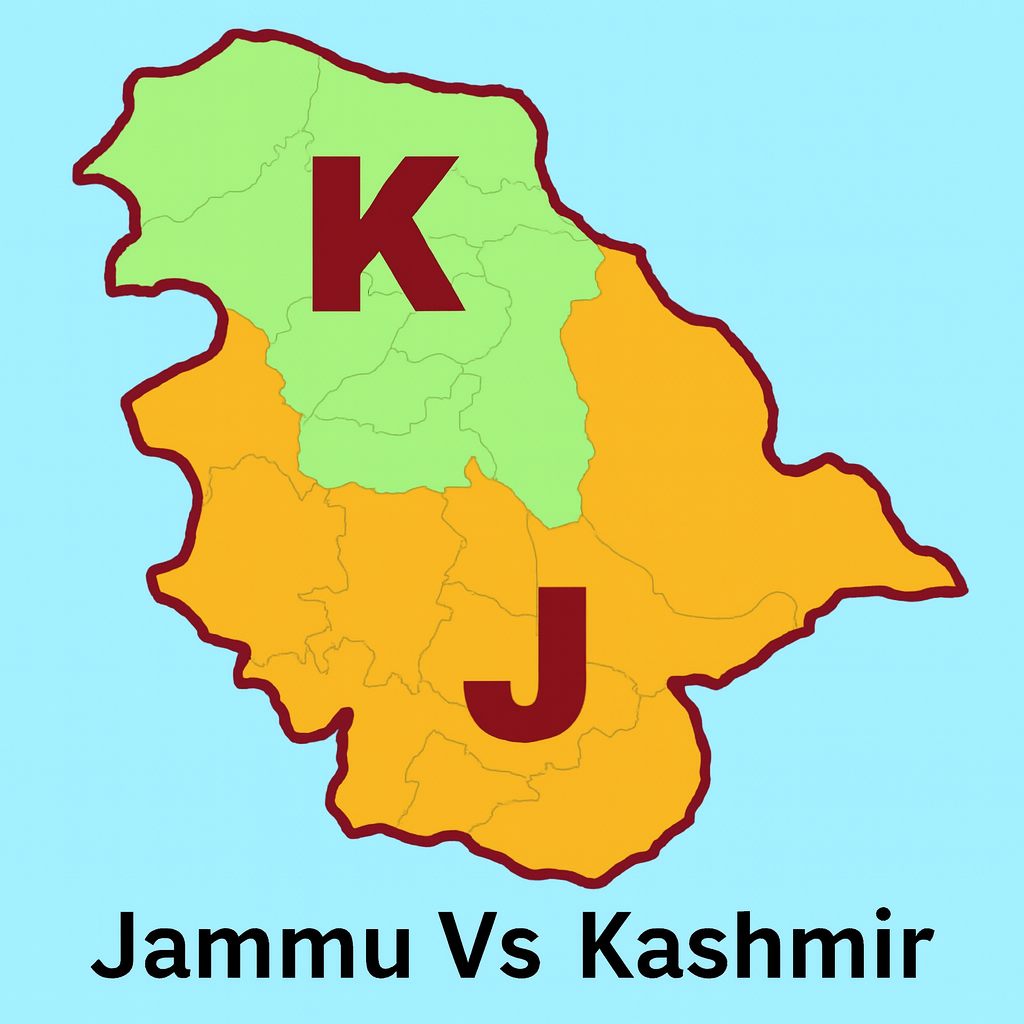
A Tale of Two Regions: Paradise Lost in Translation
By: Javid Amin | 08 January 2026
Jammu & Kashmir — The Union Territory once celebrated as Paradise on Earth finds itself caught in a paradox that epitomizes the deep fissures running through its social and political fabric. As January 2026 unfolds, two starkly contrasting narratives have emerged from this disputed region: while Jammu’s streets echo with celebrations over the de-recognition of a medical college, Kashmir’s youth stand in anguished protest over delayed reservation benefits they view as fundamental to their future.
This isn’t merely a disagreement over policy. It represents something far more troubling—a widening chasm between two regions administratively bound as one Union Territory, yet increasingly divergent in their aspirations, grievances, and visions of justice. The National Medical Commission’s withdrawal of recognition from Shri Mata Vaishno Devi Institute of Medical Excellence has triggered celebrations in Jammu, while simultaneously reservation policy protests have kept the Omar Abdullah government on edge, with students in Kashmir demanding transparency and fairness.
What makes this moment particularly significant is not just the divide itself, but what it reveals about the fractured identity of Jammu & Kashmir in the post-Article 370 era. Six years after the constitutional changes that stripped the region of its special status, these dual narratives expose fundamental questions about equity, representation, and the very meaning of justice in a deeply polarized landscape.
The Medical College Controversy: When Merit Meets Identity Politics
The Flashpoint: 42 Muslim Students, One Institution, Countless Tensions
The controversy surrounding Shri Mata Vaishno Devi Institute of Medical Excellence (SMVDIME) in Reasi district began not with academic concerns, but with demographic ones. When admissions for the inaugural MBBS batch of 50 students were completed through the NEET merit list, 42 students were Muslims—mostly from Kashmir—along with seven Hindu students from Jammu and one Sikh candidate.
This composition, determined purely by merit-based entrance examination scores, sparked an immediate and fierce backlash from right-wing Hindu groups in Jammu. The Sangharsh Samiti, a conglomerate of around 60 BJP and RSS affiliates, launched demonstrations demanding withdrawal of the admission list and reservation of seats exclusively for Hindu students. The protesters argued that many local candidates were unaware of admission notifications, though the merit list was prepared through the standardized national NEET-UG examination.
The protests escalated dramatically. Images emerged of protesters burning effigies of Lieutenant Governor Manoj Sinha, highlighting the deep community and political tensions. What began as a question about medical education admissions quickly transformed into a broader debate about religious identity, regional representation, and the very nature of merit-based selection in a polarized society.
The NMC Intervention: Timing Raises Questions
On January 7, 2026, the National Medical Commission’s Medical Assessment and Rating Board (MARB) withdrew the Letter of Permission granted to SMVDIME for running its MBBS course. The decision cited serious deficiencies in faculty, infrastructure, and clinical services discovered during a surprise inspection.
According to the official order, all students admitted to the college during counselling for the academic year 2025-26 shall be accommodated in other medical institutions in Jammu and Kashmir as supernumerary seats. This means no admitted student will lose their MBBS seat due to the withdrawal decision—they will simply be transferred to other recognized medical colleges in the Union Territory.
However, the timing of the NMC’s intervention has raised eyebrows across the political spectrum. National Conference spokesperson Imran Nabi Dar questioned how NMC gave consent to the same college a month ago and revoked it after one month. This temporal proximity between the protests and the regulatory action has led many to view the de-recognition as politically motivated rather than purely administrative.
The NMC cited poor infrastructure, lack of clinical material, and insufficient teaching staff as key reasons for the withdrawal. Yet critics point out that these deficiencies presumably existed when the initial permission was granted in September 2025, raising questions about why they only came to regulatory attention after the protests began.
Deficiencies Revealed: The Official Justification
The surprise inspection that led to de-recognition uncovered multiple serious lapses. According to official documentation, the institute failed to meet minimum standards in several critical areas:
Faculty Shortages: The college lacked adequate numbers of qualified teaching staff across multiple departments. Medical education requires specific faculty-to-student ratios, particularly for clinical training, and SMVDIME fell significantly short of these benchmarks.
Infrastructure Gaps: Essential physical facilities—from laboratories to lecture halls to hospital beds for clinical training—were found to be inadequate or missing entirely. Medical colleges require extensive infrastructure to provide hands-on training in diverse medical specialties.
Clinical Material Deficits: Perhaps most critically for a medical institution, there was insufficient clinical material and patient exposure opportunities for students to gain practical experience. This directly impacts the quality of doctors being trained.
Resident Doctor Absence: The lack of resident doctors meant insufficient supervision and mentoring for students during clinical rotations, a fundamental component of medical education.
The NMC’s order emphasized that allowing the institution to continue under such lapses would have a serious impact on the quality of medical education and academic interests of the students. From a regulatory standpoint, these are legitimate and serious concerns that warrant intervention.
Jammu’s Celebration: Relief or Communal Victory?
For many in Jammu, particularly those aligned with right-wing organizations, the NMC’s decision represented vindication. BJP state president Sat Sharma welcomed the decision, crediting the groups who pressed for cancellation of admissions, saying the institute is run by donations by Hindus.
This framing—that a Hindu-funded institution should primarily serve Hindu students—reveals the explicitly communal lens through which many in Jammu viewed the controversy. The Sangharsh Samiti, which led the protests, had openly demanded reservation of seats “exclusively for students professing faith in Mata Vaishno Devi,” effectively calling for religious criteria to override merit-based admission.
Parents and students in Jammu who supported the de-recognition articulated their stance differently. One parent told reporters, “We cannot compromise on medical education. De-recognition is painful, but necessary for credibility.” This framing emphasizes quality concerns over religious composition, though critics note that quality questions only emerged after the demographic composition became known.
The celebrations in Jammu were visible and organized. Members of the Shri Mata Vaishno Devi Sangharsh Samiti celebrated after the NMC decision to cancel recognition, distributing sweets and organizing public gatherings. For these celebrants, the closure represented accountability—though what exactly they felt accountable for remained ambiguous: was it truly about educational standards, or about the “wrong” students gaining admission?
Kashmir’s Anguish: Lost Opportunities and Long-term Costs
The response in Kashmir Valley stood in stark contrast. Political leaders, students, and civil society organizations viewed the de-recognition with dismay and suspicion, seeing it as a capitulation to communal pressure that would have lasting negative consequences for the entire region.
Chief Minister Omar Abdullah denounced the celebrations, asking what happiness there is in shutting down a medical college and playing with the future of J&K children. Abdullah pointed out the long-term cost: “After one or two years, these 50 seats would have become 400 seats. Out of those 400 seats, possibly 200 or 250 children would have been from Jammu. Tomorrow, those children will not get medical college seats because you got the entire college shut down in the name of religion.”
This argument highlights a crucial point often lost in the controversy’s heat: medical colleges typically expand their capacity over time. What began as 50 seats would likely have grown to several hundred, providing educational opportunities for students across the Union Territory regardless of region or religion. National Conference spokesperson Imran Nabi Dar emphasized that across the country, people fight to get a medical college, but here the BJP has ensured J&K lost a medical college because of its communal politics.
For the 42 Muslim students from Kashmir who had earned their seats through merit, the controversy and subsequent de-recognition represented something deeply personal. These students had successfully navigated the highly competitive NEET examination, securing spots through their academic achievement. Chief Minister Abdullah stated that the children passed exams and secured seats on their hard work, emphasizing none did any favor to them.
While the students will be accommodated in other institutions, the message sent is unmistakable: merit-based admission can be overturned if the demographic composition troubles certain groups. One Kashmiri student captured this sentiment: “We studied hard, we earned our seats fairly, and now we’re being treated like we did something wrong just by succeeding.”
Beyond individual students, National Conference media coordinator Vivek Sharma noted that an agitation driven by divisive politics to target Muslim students ended up hurting Hindu students as well, with hundreds of teaching and non-teaching jobs linked to the medical college effectively quashed. The economic impact extends to families, livelihoods, and the regional economy of Jammu.
The Broader Message: Merit Under Siege
Perhaps the most troubling aspect of this controversy is what it signals about the role of merit versus identity in educational access. India’s medical education system, whatever its flaws, has traditionally operated on clear merit-based criteria through national entrance examinations. The NEET system, despite controversies around coaching access and economic barriers, at least provides a standardized, objective measure.
The SMVDIME controversy suggests that even when students from marginalized or minority communities succeed within this merit-based framework, their achievements can be delegitimized through communal mobilization. The fact that protests centered not on questioning any individual student’s NEET scores, but simply on the religious and regional composition of successful candidates, reveals a fundamental challenge to merit-based admission itself.
PDP MLA Waheed Para said the move sends a very negative message against minorities across the country, noting it is unfortunate that the BJP believes in institutional division and disallows meritorious students on religious lines because they are Muslims. This framing positions the controversy within broader national debates about minority rights, educational access, and the limits of secularism in educational institutions.
The Reservation Debate: Kashmir’s Cry for Equity
While Jammu celebrated the medical college’s closure, Kashmir found itself engulfed in a different but equally fundamental battle: the fight for fair and transparent reservation policies. Throughout 2025 and into early 2026, the reservation issue has kept the Omar Abdullah government on tenterhooks, with the spotlight not seeming to end.
The Policy That Sparked Outrage
The roots of Kashmir’s current distress lie in amendments made to the Jammu & Kashmir Reservation Act of 2004. In 2024, the central government, under Lieutenant Governor Manoj Sinha’s administration, amended the rules to give the Pahari population 10 percent quota as scheduled category, including more than 15 other castes in the reservation list.
These amendments dramatically restructured the reservation landscape. The government decreased the percentage of reservation for open merit from 57% to 33%, and Resident of Backward Area (RBA) from 20% to 10%, while increasing scheduled tribe reservation from 10% to 20% and Social Caste from 02% to 08%.
The revised policy also introduced entirely new reservation categories: children of defense personnel (3%), children of police personnel (1%), candidates with exceptional sports performance (2%), persons with disabilities (3%), and residents of areas along the Line of Control and International Border (4%). Despite the Supreme Court’s 1992 mandate of a 50 percent ceiling, Jammu and Kashmir’s quota has increased to more than 60%.
The practical effect has been dramatic: open merit seats dropped from 57% to just 33%, effectively reducing by nearly half the opportunities for students competing without caste or category-based reservations.
The Regional Imbalance: Data Speaks Loudly
What transformed the reservation debate from a policy discussion into a major political crisis was data revealing stark regional disparities in how the policy played out. Data revealed by the J&K Government in the Assembly on March 15, 2025, showed that the current reservation policy was heavily tilted in favor of Jammu.
This wasn’t just perception or political rhetoric—government’s own figures demonstrated that the Jammu region benefited disproportionately from the new reservation structure. The inclusion of Pahari-speaking communities in the Scheduled Tribe category particularly benefited Jammu, where most of this population resides. Meanwhile, Kashmir Valley students found themselves competing for a dramatically reduced open merit pool.
The data showed disparities in:
Government Recruitment: The number of jobs secured by candidates from each region revealed significant imbalances, with Jammu region candidates receiving a disproportionate share relative to population.
Educational Admissions: Professional colleges and university admissions showed similar patterns, with Kashmir Valley students finding fewer opportunities despite strong academic performance.
Category Certificates Issued: The sheer volume of caste and category certificates issued in different regions exposed administrative patterns that favored Jammu.
For young Kashmiris, these weren’t abstract statistics—they represented closed doors, denied opportunities, and a future that seemed increasingly uncertain. As one student put it, “Reservation is not charity, it is justice. Without it, opportunities remain locked away from us.” But the question arose: whose justice was being served?
Students Take to the Streets: The December 2024 Watershed
The first major eruption of student anger came in December 2024, when hundreds of youth protested at the residence of Chief Minister Omar Abdullah in Srinagar. What made this protest particularly significant was that it included National Conference MP Aga Ruhullah Mehdi, whose participation created the biggest source of discord between the party and its own elected representative.
Mehdi’s decision to stand with protesting students despite being an MP from the ruling party sent shockwaves through Jammu & Kashmir’s political establishment. It highlighted that even within the National Conference, which had promised reservation policy review in its election manifesto, there were deep concerns about the government’s responsiveness to student grievances.
The December 2024 protests forced Chief Minister Abdullah to establish a Cabinet Sub-Committee to examine the reservation policy. However, months passed with no concrete action, no published report, and no clarity on what changes, if any, would be implemented.
The Year of Frustration: 2025
As 2025 progressed, student frustration only intensified. The Cabinet Sub-Committee formed to address the issue operated in opacity. The government’s response that it had not set a deadline for the Cabinet sub-committee to submit its report was described by the opposition as backtracking on its commitment.
Throughout 2025, the reservation issue dominated Jammu & Kashmir’s political discourse:
February-March 2025: Opposition legislators, particularly Handwara MLA Sajad Gani Lone, repeatedly raised the issue in the Assembly, demanding transparency and action.
October 2025: MP Ruhullah Mehdi demanded that the Cabinet Sub-Committee report be made public and shared with stakeholders, stating his future course of action would be guided by its contents. When Chief Minister Abdullah refused to disclose the recommendations, Ruhullah stayed away from campaigning in the Budgam by-election, leading to the National Conference’s defeat in its traditional stronghold.
November 2025: Mehdi urged the government to resolve the reservation issue before the Winter session of Parliament concludes, warning he would join quota protests if the delay continues.
December 2025: On December 3, the Cabinet finally approved a proposal, but specifics remained murky. Reports suggested the Cabinet recommended reducing Economically Weaker Sections (EWS) and Reserved Backward Area (RBA) quotas to increase the share of Open Merit by 10 percent.
However, even this decision required Lieutenant Governor approval and referral to the Union Ministry of Home Affairs—a process that could take months. Under the Transaction of Business Rules, 2019, any decision impacting minority communities, Scheduled Castes, Scheduled Tribes, or Backward Classes must be referred to Central Government.
The December 2025 Crackdown: When Protest Meets Resistance
As 2025 drew to a close, student frustration reached a boiling point. Plans emerged for a major sit-in protest on December 29, 2025, at Gupkar Road in Srinagar—the same location as the previous year’s demonstration. What happened next revealed the limits of democratic expression even under elected government.
Authorities placed several leaders, including PDP chief Mehbooba Mufti, her daughter Iltija Mufti, NC MP Ruhullah Mehdi, PDP leader Waheed Para, and former Srinagar mayor Junaid Mattoo, under house arrest to prevent them from joining the students’ protest. Authorities foiled the planned sit-in by open-merit students and job aspirants in Srinagar seeking rationalization of the reservation policy.
The irony was not lost on observers: an elected government, which had promised to address student concerns, was now preventing peaceful protest about the very issue it had pledged to resolve. PDP leader Para said it was unfortunate that leaders had been placed under house arrest to prevent them from showing solidarity with protesting students.
This crackdown sent a chilling message: even under elected governance, certain forms of dissent remained intolerable. The detention of elected representatives alongside students underscored the continued power of the Lieutenant Governor’s administration and the security establishment in shaping what political expression would be permitted.
The Recruitment Controversy: Adding Insult to Injury
As if the delayed policy rationalization weren’t frustrating enough, the government proceeded to announce major recruitment drives while the reservation framework remained unresolved. As of January 3, 2026, the government is pushing ahead with recruitment drives for more than 1,815 Executive Constable posts, along with selections for Armed Police, IRF, SDRF, and other departments, even as the Cabinet-approved proposal for rationalization continues to await notification.
The Jammu and Kashmir Students Association characterized this as proceeding with mass recruitments in the absence of a notified and rationalized reservation framework risks permanently entrenching structural imbalances. For students who had been demanding policy changes, seeing thousands of positions filled under the existing controversial framework felt like a betrayal.
PDP MLA Waheed Para accused the Omar Abdullah government of showing “zero intent” to resolve the reservation issue, calling it an existential matter striking at the very foundation of the future of younger generations. His criticism highlighted a fundamental complaint: the government had the power to pause recruitments pending policy clarification but chose not to, suggesting priorities lay elsewhere.
Voices from the Ground: Students Speak
Behind the statistics and political maneuvering are real people whose futures hang in balance. Student activists have been particularly articulate in expressing their grievances:
On Merit vs. Reservation: “We’re not against reservation for genuinely marginalized communities. But when reservation reaches 70% and benefits seem to flow disproportionately to one region, something is fundamentally wrong. The system should create opportunities, not close them.”
On Transparency: “It’s been over a year since the committee was formed. Why can’t the report be made public? Are we not stakeholders in our own future? This secrecy breeds suspicion and frustration.”
On Regional Disparity: “When data shows such clear regional imbalance in job placements and admissions, it’s not about being anti-reservation—it’s about asking whether the system is fair to all parts of J&K. Right now, it clearly isn’t.”
On Government Response: “We voted for change. We believed in the democratic process. But when peaceful protest is met with house arrests and when recruitments proceed despite unresolved concerns, what message does that send? That our voices don’t matter?”
On Future Prospects: “Every day that passes with this unfair system in place, thousands of positions get filled. These are opportunities we’ll never get back. This isn’t just about policy—it’s about our entire futures.”
The Opposition’s Critique
Political opposition parties have seized on the reservation issue, though their motives aren’t purely altruistic. PDP’s Waheed Para noted there was no justification to withhold the Cabinet sub-committee report from public scrutiny, even if recommendations were pending Lieutenant Governor approval.
The opposition’s argument centers on democratic accountability: if an elected government forms a committee to address public concerns, the findings should be transparent. The refusal to publish the report, they argue, suggests either the recommendations are politically unpalatable or the government lacks confidence in defending them.
Critics also point to structural issues. A petition filed in the High Court of Jammu & Kashmir and Ladakh challenged the amended J&K Reservation Rules 2005, seeking immediate revocation and requesting formation of an expert commission headed by a retired high court judge. The legal challenge argues the policy violates constitutional provisions by exceeding reasonable limits and creating unjustifiable regional disparities.
Understanding the Divide: Historical, Political, and Social Dimensions
The simultaneous celebration in Jammu and anguish in Kashmir over distinct yet related educational issues cannot be understood in isolation. These reactions emerge from deep-rooted historical, political, and social factors that have shaped the two regions differently.
The Post-Article 370 Context
Both controversies unfold in the shadow of August 2019’s constitutional changes. When the Indian government revoked Article 370, which granted special status to Jammu & Kashmir, and bifurcated the state into two Union Territories, it fundamentally altered the region’s political and administrative landscape.
Pre-2019, Jammu & Kashmir had its own constitution, its own flag, and significant autonomy in governance. The revocation brought the region directly under central government control, with a Lieutenant Governor wielding substantial powers even after the restoration of limited elected governance in October 2024.
This context matters because both controversies—the medical college and reservation policy—occur in a framework where ultimate decision-making power rests not with elected representatives but with the Union government in New Delhi. Any reservation policy changes require Lieutenant Governor approval and referral to the Ministry of Home Affairs, meaning local elected representatives have limited real power.
The Demographic and Regional Complexity
Jammu & Kashmir is not a homogeneous entity. The Union Territory comprises three distinct regions with different demographic, religious, and cultural compositions:
Kashmir Valley: Predominantly Muslim, culturally connected to South Asian and Central Asian Islamic traditions, historically the political and economic center of the erstwhile state.
Jammu Region: More religiously diverse with Hindu, Muslim, and Sikh populations, culturally closer to Punjab and Himachal Pradesh, traditionally viewed as more politically aligned with Indian nationalism.
Ladakh: (Now separate UT) Predominantly Buddhist and Muslim, culturally Tibetan, geographically isolated.
These regional differences create varying perspectives on virtually every policy issue. What Jammu sees as justified accountability, Kashmir often perceives as communal targeting. What Kashmir frames as deserved equity, Jammu sometimes views as unfair advantage.
The Politics of Recognition and Representation
At their core, both controversies center on questions of recognition and representation. Who gets to be recognized as deserving? How are opportunities distributed? Whose claims to justice are prioritized?
The Medical College Controversy raises questions about whether merit-based admission can be overridden by communal considerations. It asks whether an institution’s funding source or religious associations should determine who can study there, regardless of academic achievement.
The Reservation Debate grapples with how to balance competing justice claims in a diverse society. It asks how to address historical marginalization without creating new inequities, and how to ensure regional fairness in a territory where regions have distinct demographics and political relationships with the central state.
Both issues expose fundamental tensions in Indian democracy: between secularism and religious identity, between merit and social justice, between regional autonomy and central control, between historical grievances and contemporary needs.
The Role of Political Mobilization
Neither controversy arose spontaneously. Both involved organized political mobilization that shaped public discourse and influenced policy outcomes.
In the medical college case, the Sangharsh Samiti, a conglomerate of around 60 BJP and RSS affiliates, spearheaded the agitation, demonstrating how right-wing organizations could successfully pressure regulatory bodies through sustained protest.
In the reservation debate, student organizations, opposition political parties, and civil society groups mobilized repeatedly, though with less success in achieving immediate policy changes. The difference in outcomes raises questions about which forms of mobilization prove effective and why.
Economic Dimensions: Jobs, Education, and Future Prospects
Both controversies ultimately center on access to scarce resources in a region with high unemployment and limited economic opportunities. Jammu & Kashmir faces significant developmental challenges, and competition for educational seats and government jobs is intense.
Recruitment across departments have stalled due to the unresolved reservation policy, affecting thousands of aspirants. Meanwhile, the loss of a medical college—regardless of the reasons—means fewer future opportunities for aspiring doctors from the entire region.
Young people in both Jammu and Kashmir face uncertain futures. Economic opportunities remain limited, private sector employment is scarce, and government jobs are highly prized. In this context, education becomes not just about learning but about economic survival. Medical seats, engineering admissions, civil service positions—these represent pathways to middle-class stability in a turbulent region.
This economic desperation amplifies every controversy. When opportunities are plentiful, distributive conflicts matter less. When they’re scarce, every perceived unfairness becomes existential.
The National Context: Jammu & Kashmir as Microcosm
While these controversies are specific to Jammu & Kashmir, they reflect broader national debates about identity, equity, and governance in contemporary India.
The Merit vs. Reservation Debate Nationwide
India’s reservation system, constitutionally mandated to address historical caste-based discrimination, has always been contentious. Recent years have seen intensified debates as new groups seek reservation benefits and questions arise about whether current policies achieve their intended goals.
The Supreme Court’s recent judgment allowing sub-classification within Scheduled Castes and Scheduled Tribes has brought critical questions of whether uniform reservation policies truly serve all subgroups equally. The J&K reservation controversy reflects these national tensions, with added layers of regional and religious complexity.
Communal Politics and Educational Access
The SMVDIME controversy mirrors national concerns about the role of religious identity in educational institutions. Across India, debates rage about minority educational institutions, majority-dominated spaces, and whether merit-based systems adequately address historical discrimination or perpetuate privilege.
The move sends a very negative message against minorities across the country, suggesting implications beyond J&K’s borders. When merit-based admission can be challenged based on religious composition, it raises questions about the security of minority achievement nationwide.
The Limits of Democracy in Union Territories
The limitations faced by J&K’s elected government—unable to implement policy changes without central approval, unable to prevent house arrests of opposition leaders, unable to control timing of recruitments—reflect broader questions about what governance means in Union Territories.
If elected representatives lack real power over crucial policies, what does democracy actually mean for residents? This question applies not just to J&K but to other Union Territories like Delhi, where ongoing conflicts between elected governments and appointed Lieutenant Governors have raised similar concerns.
Expert Perspectives: Making Sense of the Divide
Sociologists: Identity Politics in Conflict Zones
Sociologists studying conflict zones note that distributive conflicts often become identity conflicts in post-conflict settings. Dr. Rekha Chowdhary, a political scientist who has extensively studied J&K politics, observes that “in societies emerging from prolonged conflict, every policy becomes a proxy for deeper anxieties about recognition, security, and power. The medical college and reservation controversies aren’t really about education—they’re about whose vision of J&K’s future will prevail.”
This framing helps explain the intensity of reactions. When Jammu celebrates a medical college’s closure, it’s not celebrating reduced educational opportunity per se—it’s celebrating what they perceive as resistance to demographic marginalization. When Kashmir protests reservation delays, it’s not just demanding policy changes—it’s demanding recognition of historical inequities and contemporary needs.
Legal Experts: Constitutional Questions
Legal scholars raise important constitutional questions about both controversies. On the medical college issue, advocates point to Chief Minister Abdullah’s statement that admission cannot be granted without merit and introducing religion into admissions would violate constitutional provisions.
The Indian Constitution guarantees both merit-based opportunity and protection against discrimination. When these principles seem to conflict—as when merit-based admissions are challenged on religious grounds—courts must balance competing constitutional values.
On reservation, the legal challenge argues that giving 70% reservation to various categories while leaving only 30% for open merit is ultra vires to the constitution, citing Supreme Court precedents establishing 50% as the general ceiling for reservations.
Education Policy Experts: Quality vs. Access Trade-offs
Education policy analysts emphasize the importance of both quality assurance and equitable access. The medical college de-recognition, from a purely technical standpoint, addressed legitimate quality concerns. Surprise inspections revealed non-compliance with minimum standards in faculty, infrastructure, and clinical services—issues that directly affect educational quality.
However, experts also note that regulatory standards must be applied consistently, not selectively. If SMVDIME was de-recognized for deficiencies, other institutions with similar problems should face equal scrutiny. The timing and context raise questions about whether standards were enforced fairly or leveraged for political purposes.
On reservation, policy experts emphasize the need for evidence-based approaches. The Supreme Court in M. Nagraj Case (2006) stressed the importance of empirical research and quantifiable data to precisely determine the most disadvantageous subgroups. J&K’s reservation policy should similarly rely on comprehensive data about which communities face genuine barriers to opportunity.
Political Analysts: Electoral Calculations and Power Dynamics
Political analysts see both controversies through the lens of electoral politics and power dynamics. The BJP, dominant at the central level but lacking majority support in Kashmir Valley, benefits from mobilizing Jammu’s Hindu constituencies through issues like the medical college controversy.
For the National Conference-led government, the reservation issue poses a dilemma: addressing Valley students’ concerns risks alienating Jammu constituents, while maintaining the status quo fuels Valley frustrations. The issue became the biggest source of discord between the National Conference and its MP Ruhullah Mehdi during the Budgam by-election, resulting in the party’s shock defeat in its traditional stronghold, demonstrating the electoral costs of mishandling reservation concerns.
The Path Forward: Can the Divide Be Bridged?
As January 2026 unfolds, Jammu & Kashmir stands at a crossroads. The challenge for policymakers, civil society, and citizens themselves is whether this divide can be bridged or whether it will continue deepening, potentially with dangerous consequences.
Short-term Imperatives
Medical Education: Chief Minister Abdullah has directed immediate relocation of students admitted to Mata Vaishno Devi Medical College to facilities in their hometowns. Ensuring these students complete their education without disruption must be the immediate priority, regardless of the broader controversies.
Reservation Policy Notification: The Cabinet-approved rationalization must move swiftly through Lieutenant Governor approval and central government clearance. Every week of delay means more recruitment proceeding under disputed rules, further entrenching the problems students protest against.
Transparent Communication: Publishing the Cabinet Sub-Committee report on reservation, even if recommendations haven’t been fully implemented, would demonstrate good faith and allow stakeholders to understand the government’s thinking. Secrecy breeds suspicion; transparency builds trust.
Halt Controversial Recruitments: Pausing large-scale recruitments until the reservation framework is clarified would signal that the government takes student concerns seriously. Proceeding with 1,800+ positions under disputed rules while claiming to address the issue appears contradictory.
Medium-term Reforms
Independent Quality Audits: To restore confidence in medical education regulation, conducting independent audits of all medical colleges in J&K would demonstrate that quality standards apply equally, not selectively. Transparency in how NMC decisions are made would reduce suspicions of political interference.
Data-Driven Reservation Policy: Commissioning comprehensive research on educational and employment outcomes across communities, regions, and categories would provide empirical basis for reservation policies. The Supreme Court’s emphasis on quantifiable data should guide J&K’s approach.
Stakeholder Consultation: Regular, structured dialogue with student organizations, community representatives, and civil society groups could help identify concerns early and build consensus around policy approaches. The current pattern of protests followed by crackdowns is unsustainable.
Regional Balance Mechanisms: Developing explicit mechanisms to monitor regional disparities in educational admissions and government recruitment would address Kashmir’s core grievance. If data shows persistent imbalances, corrective measures should be built into policy frameworks.
Long-term Structural Changes
Expanding Educational Infrastructure: The most sustainable solution to distributive conflicts is expanding the total pool of opportunities. Rather than fighting over fixed numbers of seats, J&K needs more medical colleges, engineering institutes, and universities. Investment in educational infrastructure benefits everyone.
Economic Development: Educational and employment competition intensifies in economically stagnant regions. Robust economic development creating private sector opportunities would reduce dependence on government jobs and ease pressures on educational admissions.
Healing Regional Divides: The deeper challenge is rebuilding trust and shared identity across J&K’s regions. This requires acknowledging historical grievances on all sides, creating spaces for dialogue, and developing narratives that emphasize commonality rather than difference.
Strengthening Democratic Institutions: Giving elected representatives meaningful power over policy decisions would enhance democratic accountability. The current system, where ultimate authority rests with appointed officials answerable to New Delhi, undermines local democracy and fuels frustration across political spectrum.
The Human Cost: Stories Behind Statistics
Behind every statistic, policy debate, and political controversy are human beings whose lives are profoundly affected.
Ayesha, 19, Kashmir Valley: “I scored 580 in NEET. I worked for two years to achieve this score, studying late nights while dealing with internet shutdowns and uncertainty. When I secured admission to the medical college, my family celebrated—we’re not wealthy, and becoming a doctor seemed possible. Now the college is closed, and I’m being transferred elsewhere. I’ll still study medicine, yes, but the message is clear: my achievement can be taken away anytime if the wrong people feel threatened by it.”
Rajesh, 21, Jammu City: “I’m not celebrating that a medical college closed. That’s stupid—we need more colleges, not fewer. But I am relieved that standards were enforced. My cousin studied at a private medical college where faculty barely showed up and clinical training was a joke. If this college had similar problems, better to close it than graduate incompetent doctors. I just wish the enforcement was consistent, not selective.”
Zahoor, 23, Anantnag (Job Aspirant): “I’ve been preparing for government jobs for three years. The reservation changes meant I needed to recalibrate my entire strategy—which exams to take, which categories I compete in. Now they keep saying the policy will change, but recruitments continue under old rules. How do I plan? Every position filled is one I might have gotten under a fair system. My entire life is in limbo because policymakers can’t make up their minds.”
Priya, 20, Reasi (Reservation Beneficiary): “My community was finally included in Scheduled Tribe category after decades of advocating. This opened doors my parents never had. Now I’m hearing people say the whole system is unfair. I understand concerns about open merit shrinking, but my community’s marginalization is real too. We need a system that addresses historical wrongs without creating new ones. That’s hard, but it’s what fairness requires.”
Dr. Khan, 45, Medical Education Administrator: “Every student deserves quality education. That’s non-negotiable. But quality requires resources—qualified faculty, proper infrastructure, adequate clinical exposure. We can’t pretend substandard institutions are acceptable just to increase seats. Equally, we can’t enforce standards selectively based on politics. The regulatory system must be fair, consistent, and above political pressure. Right now, I’m not confident it is.”
These voices reveal the human dimensions often lost in policy debates. Real people with real aspirations, caught in systems they didn’t design, hoping for fairness while fearing their futures are being determined by factors beyond their control.
Media’s Role: Amplifying Divides or Building Bridges?
Media coverage of both controversies has varied dramatically across outlets, often reflecting and reinforcing existing divides rather than bridging them.
National Media: Coverage has been sparse and often superficial, treating J&K controversies as regional curiosities rather than nationally significant issues. When national media does engage, framing often follows predictable patterns—channels aligned with the government emphasize quality concerns and security narratives, while opposition-aligned outlets highlight communal politics and democratic deficits.
Local Jammu Media: Outlets based in Jammu region generally framed the medical college controversy as accountability triumph, emphasizing infrastructure deficiencies and local students’ concerns. Coverage of reservation protests from Kashmir received less sympathetic treatment, often framing Valley students as unreasonable or ignoring regional disparities data.
Local Kashmir Media: Valley-based outlets highlighted what they termed communal targeting in the medical college case, extensively covering student perspectives and featuring critical voices. Reservation coverage emphasized government failures, delayed action, and democratic rights to protest, though sometimes oversimplifying the policy complexities.
Social Media: Perhaps most significantly, social media has become the primary battlefield for these narratives. WhatsApp groups, Facebook pages, and Twitter/X accounts affiliated with different political and regional identities circulate sharply contrasting versions of both controversies. Information silos mean many people encounter only perspectives confirming their existing biases.
This fragmented media landscape makes consensus increasingly difficult. When different communities consume fundamentally different narratives, finding common ground becomes nearly impossible.
International Implications: How the World Watches
While primarily domestic issues, these controversies attract international attention given J&K’s disputed status and history.
Pakistan’s Response: Pakistani media and officials have seized on both controversies as evidence of Indian misgovernance in Kashmir. The medical college incident has been framed as religious discrimination, while reservation protests are portrayed as Kashmiri resistance to Indian policies. These narratives serve Pakistan’s diplomatic messaging, though they often oversimplify complex internal dynamics.
Human Rights Organizations: International human rights groups monitoring J&K have noted concerns about restrictions on protests, house arrests of political leaders, and questions about whether reservation policies adequately address minority rights. While avoiding interference in internal policies, these organizations emphasize the importance of democratic processes and protection of dissent.
Diplomatic Community: Countries with interests in South Asian stability watch J&K developments closely. The controversies reinforce perceptions of J&K as volatile and politically complex, potentially affecting investment decisions and diplomatic calculations regarding India-Pakistan relations.
Diaspora Communities: Kashmiri diaspora communities, particularly in the UK, Canada, and United States, have organized solidarity protests and advocacy campaigns around both issues. These communities amplify local voices internationally, though they sometimes frame issues through lenses shaped more by diaspora politics than ground realities.
Looking Ahead: Scenarios for the Future
As we move deeper into 2026, several scenarios could unfold:
Scenario One: Managed Reconciliation The government successfully implements balanced reservation reforms addressing Valley concerns while maintaining support in Jammu. New medical education infrastructure is developed with transparent quality standards. Political dialogue reduces regional tensions. Economic development creates more opportunities, easing distributive conflicts. Gradual healing begins.
Likelihood: Moderate, if political will exists and central government supports
Scenario Two: Deepening Polarization Reservation controversies persist with inadequate reforms. Further educational or employment disputes emerge along regional-religious lines. Political parties increasingly appeal to narrow constituencies rather than building broad coalitions. Trust between regions continues eroding. Economic stagnation intensifies competition for scarce opportunities.
Likelihood: High, given current trajectories
Scenario Three: Authoritarian Resolution Frustrated with persistent controversies, authorities impose decisions without consultation, suppress protests forcefully, and tighten control over media and civil society. Short-term stability achieved through coercion, but underlying tensions remain unaddressed and potentially intensify.
Likelihood: Moderate to high, given Union Territory governance structure
Scenario Four: Democratic Revival Elected representatives gain genuine decision-making authority over education and employment policies. Transparent processes involving all stakeholders develop consensus-based solutions. Investment in expanding opportunities reduces zero-sum competition. Media develops more balanced, bridge-building narratives.
Likelihood: Low in near term, but possible with sustained effort
The path chosen will determine not just policy outcomes but the very nature of J&K’s future—whether it becomes a model of diverse democracy or a cautionary tale of unresolved divisions.
Conclusion: One State, Infinite Possibilities
The paradox at the heart of Jammu & Kashmir—one region celebrating while another mourns, over issues ultimately about opportunity and justice—reveals both the territory’s deep challenges and its potential.
These controversies remind us that administrative unity doesn’t guarantee social cohesion, that formal democracy doesn’t ensure meaningful participation, and that policies affecting different communities differently require exceptional care in design and implementation.
For Jammu & Kashmir to move forward, several truths must be acknowledged:
First, educational quality and equitable access aren’t opposing values—both are essential and must be pursued simultaneously. Closing substandard institutions while expanding quality opportunities benefits everyone.
Second, reservation policies must be evidence-based, transparent, and balanced. Addressing historical marginalization is crucial, but policies must not inadvertently create new inequities or regional imbalances.
Third, democratic governance requires real power for elected representatives. When ultimate authority remains with appointed officials, local democracy remains incomplete and frustrations inevitable.
Fourth, economic development is foundational. Educational and employment conflicts intensify when opportunities are scarce. Robust economic growth creating diverse opportunities would ease many current tensions.
Fifth, media and civil society must work to bridge divides rather than reinforce them. Responsible journalism presenting multiple perspectives, civil society dialogue creating spaces for encounter, and political leadership emphasizing commonality over difference—all are essential.
Sixth, patience and empathy matter. Decades of conflict, constitutional changes, and political uncertainty have left deep wounds across J&K’s communities. Healing takes time, and requires willingness to hear perspectives that challenge our own assumptions.
The challenge for policymakers is to balance quality assurance in education with equitable access to opportunities, to honor merit while addressing marginalization, to respect regional differences while building common identity, to maintain security while protecting democratic freedoms.
This is extraordinarily difficult work. But it’s essential work if Jammu & Kashmir is to realize its potential as a model of diversity, democracy, and development.
As 2026 unfolds and these controversies continue evolving, one question persists: Will policymakers, political leaders, and citizens themselves choose the hard path of bridge-building, or the easier path of reinforcing divisions?
The answer will shape not just Jammu & Kashmir’s immediate future, but whether the promise of Paradise on Earth can ever be redeemed—not through imposed unity, but through genuine reconciliation that honors all voices, addresses all grievances, and creates opportunities for all.
Until then, the bittersweet reality persists: One state, scores of differences—but also, one state, infinite possibilities for healing, justice, and shared prosperity, if only the will to pursue them can be found.
References and Further Reading
- National Medical Commission official orders on SMVDIME de-recognition, January 2026
- Jammu & Kashmir Assembly proceedings on reservation policy, March 2025-January 2026
- Government of J&K data on reservation policy implementation and regional distribution
- Ground reports from protests in Srinagar and Jammu, December 2024-January 2026
- Expert commentary from legal scholars, education policy analysts, and sociologists
- Student testimonies and interviews conducted across Jammu & Kashmir
- Political party statements and manifestos regarding education and reservation policies
- Supreme Court judgments on reservation policies and educational standards


