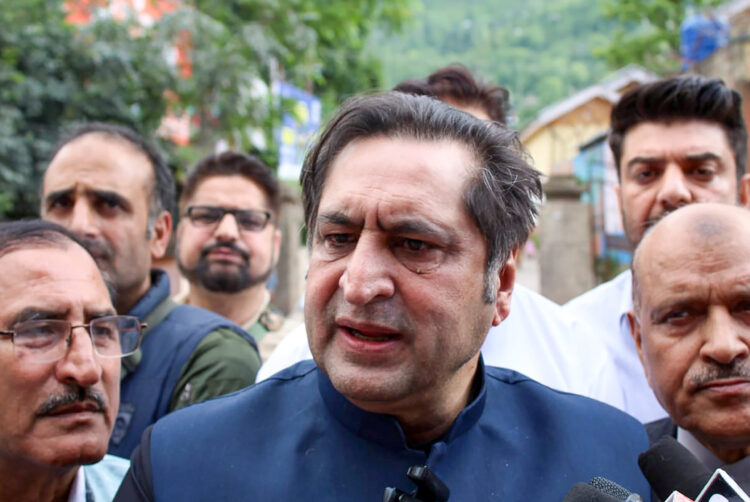
Sajad Lone Prays for Kashmir’s Separation from Jammu | Political Shockwaves in J&K
By: Javid Amin | 21 January 2026
A Statement That Breaks Political Convention
In the ever-evolving political landscape of Jammu and Kashmir, statements questioning the region’s unity are not new. However, when such remarks come from a Valley-based leader, they acquire a different resonance altogether. Peoples Conference president and Jammu and Kashmir MLA Sajad Lone’s declaration that he “prays for Kashmir’s separation from Jammu” has sent ripples across the region’s political spectrum.
By openly endorsing demands traditionally raised by sections of the Bharatiya Janata Party (BJP) for carving Jammu out as a separate state, Lone has challenged long-held assumptions about regional alignments. His remarks directly confront the ideological core of parties like the National Conference (NC), which have consistently framed the unity of Jammu and Kashmir as sacrosanct.
What Sajad Lone Said: Key Elements of the Statement
Sajad Lone’s comments were notable not only for their substance but also for their tone and framing.
Support for Jammu Statehood Demand
Lone publicly seconded BJP leaders, including senior leader Sham Lal Sharma, who have argued that Jammu deserves separate statehood due to its distinct cultural, demographic, and administrative identity. Such endorsement from a Kashmir-based politician is rare and politically significant.
“A Prayer for Separation”
Perhaps the most striking line of his statement was his assertion: “I pray to God that separation becomes possible. It would be true liberation.” By framing separation as liberation, Lone recast what is usually seen as a divisive demand into a moral and emotional appeal.
Warning of Political Resistance
Lone also cautioned that “big crocodiles will invent new stories tomorrow,” a metaphorical reference to entrenched political interests. He suggested that powerful actors benefit from maintaining the status quo and would resist any move toward separation by reshaping narratives.
Questioning the National Conference
In a pointed challenge to NC president Farooq Abdullah, Lone questioned who would bear the burden of preserving what he termed “so-called unity.” This remark directly targeted the NC’s foundational political philosophy.
Political Context: Where Does This Demand Come From?
BJP’s Longstanding Argument
The demand for separating Jammu from Kashmir has been periodically raised by BJP leaders, especially after the reorganization of Jammu and Kashmir in 2019. Proponents argue that Jammu has distinct political aspirations and has suffered administrative neglect.
A Valley Leader’s Endorsement
What makes Lone’s position remarkable is his geographical and political background. As an MLA from Handwara in north Kashmir and leader of a party rooted in the Valley, his support for Jammu-centric demands blurs traditional regional fault lines.
This convergence suggests a rethinking of political strategy, identity, and alliances in post-2019 Jammu and Kashmir.
Peoples Conference and Sajad Lone’s Political Trajectory
Sajad Lone has often positioned himself as a contrarian voice within Kashmiri politics. His party, the Peoples Conference, has historically advocated for dialogue, political pragmatism, and a break from entrenched narratives.
By supporting separation, Lone may be attempting to:
- Differentiate himself from dominant Valley parties like NC and PDP
- Appeal to a constituency fatigued by symbolic unity without perceived benefits
- Align tactically with national ruling narratives to expand political space
Reactions and Counterarguments
National Conference’s Position
The NC has consistently argued that unity provides political strength, economic interdependence, and constitutional leverage. Leaders like Farooq Abdullah and Omar Abdullah maintain that division would weaken both Jammu and Kashmir.
Concerns from Civil Society
Critics warn that separation risks deepening communal and regional divides. Civil society groups fear that administrative reconfiguration could entrench identity politics and undermine social cohesion.
Silence and Caution Elsewhere
Notably, several parties have responded cautiously, reflecting the sensitivity of the issue and uncertainty over public sentiment.
Governance and Policy Implications
Administrative Restructuring
Separating Jammu from Kashmir would require major constitutional and legislative steps, including parliamentary approval. No clear roadmap exists, raising concerns about policy uncertainty.
Resource Distribution
Division would necessitate renegotiation of resource allocation, infrastructure investment, and fiscal responsibility—areas already marked by contention.
Representation and Federalism
The debate also touches on broader questions of Indian federalism: how far should regional aspirations go, and who gets to decide them?
Risks of Heightened Polarization
Analysts caution that statements like Lone’s could intensify regional and communal polarization. In a region with a history of conflict, political rhetoric carries consequences beyond electoral arithmetic.
The fear is not merely administrative division, but the hardening of identities that could complicate reconciliation and governance.
A Post-2019 Political Reordering
The reorganization of Jammu and Kashmir has already altered political assumptions. Ladakh’s separation demonstrated that territorial reconfiguration is possible, emboldening other regional demands.
Lone’s remarks can thus be seen as part of a broader post-2019 reimagining of political boundaries and identities.
National Implications: Beyond J&K
At the national level, the debate feeds into discussions on decentralization, autonomy, and administrative efficiency. It also tests the BJP’s balancing act between encouraging regional aspirations and managing their fallout.
Conclusion: A Statement That Forces Uncomfortable Questions
Sajad Lone’s declaration that he prays for Kashmir’s separation from Jammu is more than a provocative soundbite. It represents a significant ideological departure for a Valley-based leader and underscores the fluidity of Jammu and Kashmir’s current political moment.
Whether this stance gains traction or remains an outlier will depend on public response, party calculations, and the central government’s approach. What is clear, however, is that the once-unquestioned idea of Jammu and Kashmir’s unity is now openly contested—from multiple directions and by unexpected voices.
In essence, Lone’s remarks have forced the region to confront an uncomfortable but unavoidable question: is unity a shared aspiration, or a political inheritance increasingly at odds with lived realities?