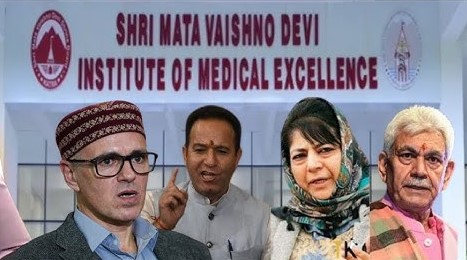
SMVD Medical College Controversy: Mehbooba Warns on Religious Division, BJP Defends Closure, NC Seeks Accountability in J&K
By: Javid Amin | 09 January 2026
A Technical Decision Turns Political
The derecognition of the Shri Mata Vaishno Devi Medical College (SMVDMC) by the National Medical Commission (NMC) has triggered a broader political debate in Jammu and Kashmir, drawing sharp and contrasting responses from the Peoples Democratic Party (PDP), the Bharatiya Janata Party (BJP), and the National Conference (NC).
While the NMC has cited regulatory non-compliance as the basis for its decision, political leaders have interpreted the fallout through different lenses—ranging from warnings about religious polarisation to calls for institutional accountability and assertions of administrative neutrality.
Mehbooba Mufti: Warning Against Religious Division and Precedent
PDP president Mehbooba Mufti has framed the controversy as part of a larger political and social pattern, warning that developments in Jammu and Kashmir risk setting precedents for the rest of the country.
Key Assertions by Mehbooba Mufti
-
The timing of the SMVDMC closure raises questions about whether the decision was pre-planned.
-
Abrupt institutional actions create fear and uncertainty among students and families.
-
Jammu and Kashmir is increasingly used as a testing ground for policies later replicated elsewhere in India.
-
Dividing the region on religious lines would effectively validate the two-nation theory.
Mufti has argued that any move—explicit or implicit—towards religiously defined political outcomes undermines the pluralistic foundations of India. She has urged national and regional leadership to exercise restraint and introspection.
BJP’s Position: Regulatory Compliance, Not Politics
The BJP has firmly rejected allegations of political or communal intent, defending the NMC’s decision as a technical and regulatory necessity.
Party leaders, including J&K General Secretary (Organization) Ashok Koul, have maintained that:
-
The closure was based solely on “gross deficiencies” flagged by the medical regulator.
-
Issues included inadequate faculty, insufficient clinical material, and incomplete infrastructure.
-
Linking the decision to religion or regional politics is misleading.
-
The BJP does not support dividing Jammu and Kashmir and remains committed to a united region with equitable development.
The party has also dismissed rumours of bifurcation, positioning itself as focused on governance, integration, and long-term institutional standards rather than identity-based politics.
National Conference (NC): Accountability Over Allegations
Former Chief Minister Omar Abdullah and the National Conference have taken a distinct third position, shifting the focus away from ideological confrontation toward administrative responsibility.
NC’s Core Argument
-
The primary issue is not communal politics but governance failure.
-
Authorities must fix responsibility for how a government-backed medical institution was allowed to fall short of mandatory standards.
-
Regulatory lapses over years indicate systemic neglect, not overnight failure.
-
Without accountability, similar institutions may face the same fate.
Omar Abdullah has emphasized that students should not pay the price for administrative shortcomings and that lessons must be institutionalized to prevent future crises.
How the Same Event Is Being Interpreted Differently
| Stakeholder | Core Interpretation | Primary Concern |
|---|---|---|
| PDP (Mehbooba Mufti) | Political & ideological precedent | Religious polarisation, national impact |
| BJP | Regulatory enforcement | Institutional standards, unity narrative |
| NC (Omar Abdullah) | Administrative failure | Accountability, governance reform |
| Students & public | Mixed | Career uncertainty, trust deficit |
Why This Debate Matters Beyond One College
The SMVDMC controversy has evolved into a proxy debate touching on:
-
Trust in regulatory institutions
-
Regional and communal sensitivities
-
The future of medical education in J&K
-
Long-standing Jammu–Kashmir political fault lines
For many observers, the issue reflects how technical governance decisions in Jammu and Kashmir often acquire political and ideological weight, regardless of their original intent.
Conclusion: A Regulatory Issue With Political Consequences
At its core, the SMVD Medical College closure is a regulatory decision rooted in compliance failures. However, the political responses—from Mehbooba Mufti’s ideological warnings to BJP’s emphasis on neutrality and NC’s demand for accountability—demonstrate how governance, identity, and trust intersect in Jammu and Kashmir.
As the debate continues, the challenge for policymakers remains balancing transparent regulation with sensitivity to a region where administrative actions are rarely viewed in isolation from history and politics.