“No Encroachment Should Be Viewed Through a Regional Lens”: How a BJP MLA’s Remark Sparked a Political Firestorm in the Jammu & Kashmir Assembly
By: Javid Amin | 13 February 2026
When a Question Hour Became a Political Flashpoint
In New Delhi’s parliamentary tradition, Question Hour is designed to hold the executive accountable — a procedural mechanism for rigorous but respectful political exchange.
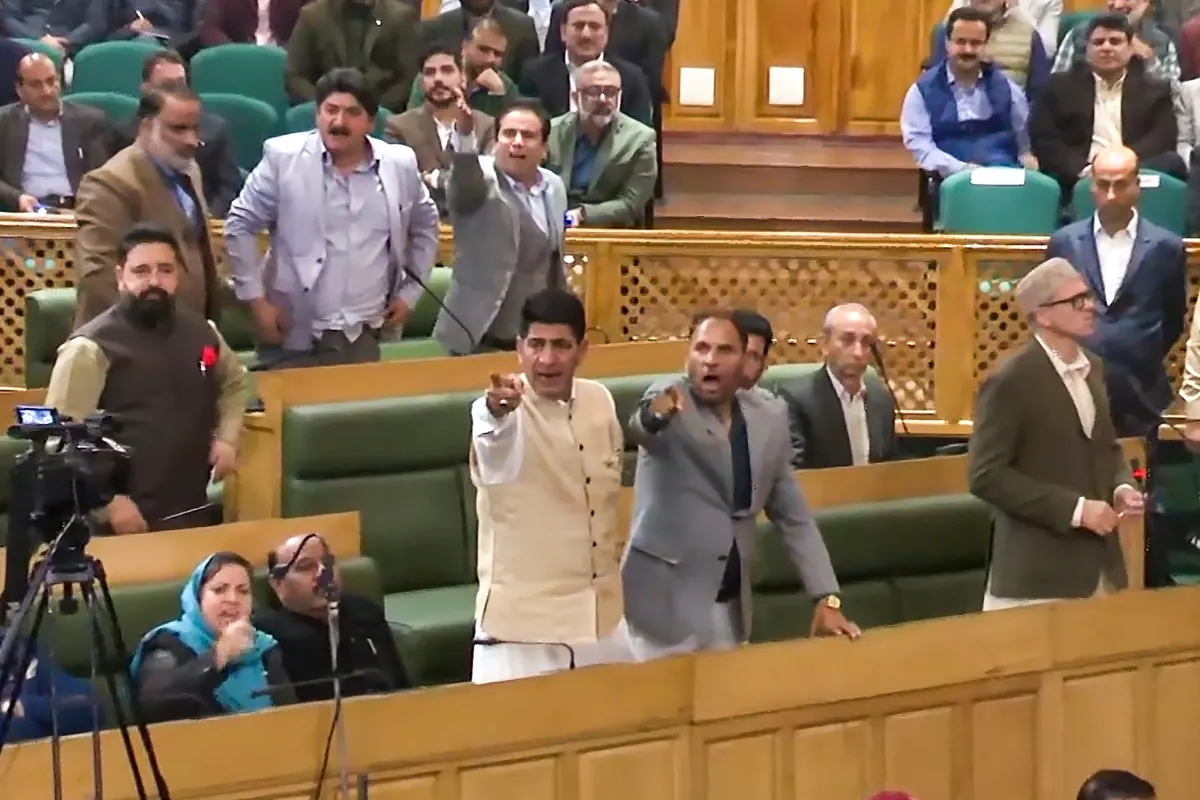
On February 13, 2026, in the Jammu & Kashmir Legislative Assembly, one question triggered an unexpected and explosive reaction that escalated far beyond routine legislative scrutiny.
During the Question Hour, Vikram Randhawa, a BJP lawmaker representing the Bahu Assembly constituency, accused residents from the Kashmir Valley of encroaching on public land in Jammu city — a remark that ignited uproar across party lines and underscored deep-rooted regional sensitivities in Jammu & Kashmir’s political landscape.
The ensuing debate became about land governance, historical urban planning failures, regional identity politics, and enforcement of law — all unfolding under the glare of legislative scrutiny.
This feature unpacks not just the immediate clash — but the larger governance context of land rights and planning in Jammu & Kashmir.
The Trigger: BJP MLA’s Allegation on Encroachment
During the session, Randhawa claimed that:
People hailing from the Kashmir Valley have encroached upon land in Jammu city, including property belonging to the Jammu Development Authority (JDA).
He asserted that significant habitations on government and JDA land had been established by individuals from the Valley, and authorities had failed to act decisively. Randhawa even claimed that roughly 90% of these cases involved Valley residents and urged authorities to act swiftly.
Randhawa’s intervention, which he insisted was driven by genuine concern for law enforcement and equitable application of rules, was not framed merely as an administrative question — but as a political allegation with social undertones.
His contention:
-
Encroachments on government land are widespread.
-
Jammu Development Authority land in his constituency was under threat.
-
Enforcement was weak and ineffective.
-
The demographic profile of encroachers was skewed — in his view — toward Kashmir Valley residents.
In an emotionally charged Assembly environment, such assertions carried political weight, regional undertones, and potential for controversy.
Official Government Response: Facts, Figures, and Legal Framework
The government, represented by Sakina Itoo, responded with concrete figures and legal context:
According to official land records cited in the Assembly:
-
688 kanals and 17 marlas of land in Tehsil Bahu
-
579 kanals in Tehsil Jammu South
were listed as encroached upon.
To clarify the terminology:
-
1 kanal = 1/8 acre
-
1 marla = 1/160 acre
These figures represent not just residential sprawl but longstanding occupation of public property, as acknowledged by the ruling National Conference government.
The minister stated that:
-
These encroachments are not new — they are longstanding, and
-
Enforcement action has been taken under the Jammu and Kashmir Public Premises (Eviction of Unauthorised Occupants) Act,
-
And other relevant laws related to urban and revenue land governance.
She added that since January 2025, authorities have conducted 34 anti-encroachment drives in Jammu’s Bahu and South tehsils, retrieving:
-
140 kanals and 11 marlas of JDA land.
This response highlighted that:
-
The issue was recognised by the government as administrative and legal, not exclusively political.
-
Action was being taken through multiple agencies — JDA, municipal bodies, revenue officials, and police.
-
Land reclamation efforts were underway, though the scale of encroachment remained large.
Anti-Encroachment Drives: Policy, Practice, and Public Reaction
The Assembly exchange reflects a deeper governance exercise underway in Jammu & Kashmir — ongoing anti-encroachment and demolition drives intended to recover public land and enforce urban planning norms.
These drives have been active for several years, involving multiple agencies:
-
JDA anti-encroachment efforts in urban and peri-urban areas.
-
JMC (Jammu Municipal Corporation) operations to remove illegal structures and commercial encroachments.
-
Joint administration enforcement involving revenue departments and police.
These actions are bolstered by judicial directives — for instance, the J&K & Ladakh High Court ordered fortnightly anti-encroachment drives to prevent obstruction of public roads and pavement encroachments.
Across the region, such enforcement actions have been significant in recent years — reclaiming land, demolishing unapproved structures, and responding to urban expansion that often outpaced planning processes.
Reclaimed Land vs Remaining Encroachments
While over 140 kanals have been retrieved since 2025, the larger figures cited by Randhawa — over 16,000 kanals of encroached JDA land — signal the vast scale of the challenge.
The sheer volume of affected land — tens of thousands of kanals — reflects:
-
Historical planning deficits.
-
Multiple decades of informal settlements.
-
Weak enforcement during previous administrative regimes.
Encroachments can include:
-
Residential expansions
-
Shanties and informal settlements
-
Commercial structures without approvals
-
Public land occupation
All these scenarios complicate enforcement.
Where Governance Meets Regional Politics
What made the Assembly exchange particularly explosive was how Randhawa framed the matter — not strictly as an administrative oversight, but with an implied regional framing:
“People from Kashmir Valley” allegedly responsible for encroachments in Jammu.
This is where political and social sensitivities intersect.
Regional Identity and Political Sensitivities in J&K
Since the reorganisation of Jammu & Kashmir as a Union Territory in 2019, regional identities — particularly between Jammu and Kashmir divisions — have been politically salient and emotionally charged.
Land and settlement patterns are sometimes interpreted through the lens of:
-
Demographic change
-
Economic opportunity
-
Historical mobility
While administrative migration and land purchases are entirely legal, when governance issues are tied to regional identity, tensions can amplify.
Randhawa’s assertion that 90% of encroachments involved Valley residents was viewed by opposition and ruling members as:
-
Generalising a governance problem along regional lines
-
Politically divisive
-
Risking communal or regional tensions
This response was swift and sharp in the Assembly.
Government’s Pushback: Law, Not Division
In pushing back, the government emphasised a clear line:
Encroachment is a legal and administrative issue — not a matter of regional blame.
Minister Itoo stated:
“Encroachment issues should not be viewed through a regional lens and Jammu and Kashmir should not be divided on such grounds.”
This response aimed to:
-
Remind the Assembly of legal principles
-
Depoliticise administrative enforcement
-
Maintain social harmony across regions
By stressing that land recovery is being conducted as per law, and that enforcement actions involve coordination with the Jammu Municipal Corporation, Revenue Department, and police, the government sought to reiterate a non-partisan, rule-based approach.
The Broader Political Fallout
The reaction in the Assembly was not merely procedural — it revealed deep currents in J&K politics:
-
Opposition Friction: NC and other ruling members objected not only to the allegation but to its framing as a regional problem, charging that it could inflame already sensitive political sentiments.
-
BJP Defensive Stand: Randhawa insisted that action was needed and that the government was not providing lists of encroachers in his constituency — a claim that widened the debate beyond Question Hour to accountability and transparency.
-
Regional Balance Narrative: Critics argued that throwing demographics into a land enforcement debate injects identity politics into an administrative issue — complicating efforts at harmonious governance.
The political recriminations reflect a larger theme long present in Jammu & Kashmir: balancing administrative law enforcement with noble goals of maintaining regional harmony and avoiding polarising narratives.
Encroachment Drives and Historical Context: Past Controversies
Encroachment enforcement in J&K has a long, complex history:
-
Anti-encroachment drives have occasionally left communities homeless, raising questions about notice, rehabilitation, and planning policies.
-
In some cases, demolitions helped spark public and political backlash, prompting debates about transparency, fairness, and socioeconomic impact.
-
In 2025 and beyond, municipal drives in Jammu focused on encroachments, illegal constructions, and clearing footpaths for public safety and urban planning.
The current drive is part of that ongoing policy environment — but the political framing in the Assembly has taken it into a different dimension.
Land Governance, Legal Frameworks, and Public Policy Challenges
To fully understand the debate, it helps to unpack the legal structure surrounding encroachment enforcement:
Legal Frameworks at Play
-
The Public Premises (Eviction of Unauthorised Occupants) Act, 1988 empowers eviction of unauthorised occupants from government land.
-
Urban and municipal laws govern construction approvals, building permissions, and municipal licensing.
-
High Court directives can mandate periodic drives to clear public pathways and ensure compliance.
These laws are intended to ensure:
-
Public land is protected.
-
Urban planning and infrastructure development can proceed without illegal interference.
-
Public health and safety are not compromised by unregulated construction.
However, enforcement of these laws depends on:
-
Coordination among departments
-
Accurate land records
-
Political will
-
Fair and transparent procedures
Where Policy Meets Public Perception
Even when actions are legal, public perception can differ:
-
Residents affected by retrieval efforts often argue they have lived there for years, sometimes with tacit approval or unclear land records.
-
Others raise concerns over lack of resettlement or compensation.
-
Political interpretations can turn administrative decisions into ideological debates.
This is why land governance in Jammu & Kashmir has historically been more than lines on a map — it has been tied to:
-
Livelihoods
-
Trust in governance
-
Regional balance
-
Political narratives
Conclusion: A Legislative Clash With Deeper Governance Implications
The uproar triggered by Randhawa’s encroachment remark did more than disrupt a Question Hour — it reopened longstanding disputes about land governance, administrative enforcement, and regional identity in Jammu & Kashmir.
What began as a question about JDA land quickly evolved into a broader political confrontation involving:
-
Enforcement of law
-
Interpretation of demographic trends
-
Regional sensitivities
-
Legislative responsibility
The government’s rejection of a regional framing — and its emphasis on legal process and procedural enforcement — suggests an ongoing attempt to balance governance with maintaining social harmony.
But the political rift exposed in the Assembly reflects a deeper truth:
In Jammu & Kashmir, administrative actions are seldom purely administrative — they resonate in a political and emotional landscape where law, identity and history are deeply intertwined.

