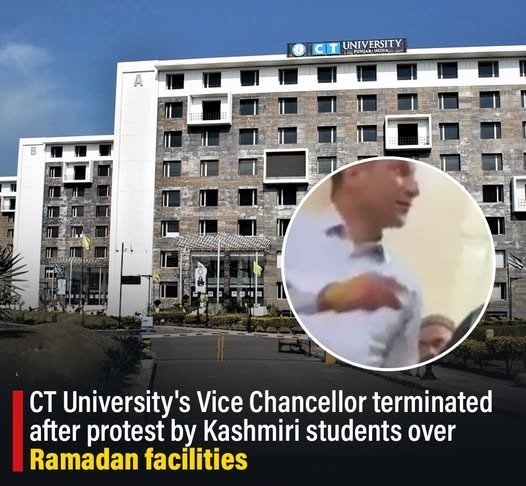
CT University Ramadhan Row: VC Removed After Kashmiri Students Allege Threats Over Sehri & Iftar Meals
By: Javid Amin | 25 Febuary 2026
What Happened at CT University
A controversy erupted at CT University in Ludhiana after Kashmiri Muslim students requested Sehri and Iftar meal arrangements in the hostel mess during Ramadhan.
According to student accounts, instead of addressing the request administratively, Vice Chancellor Nitin Tandon allegedly used abusive language and threatened eviction and cancellation of admissions.
A video purportedly capturing part of the exchange circulated widely on social media, triggering public outrage and drawing attention from student groups and civil society.
Immediate Outcome
Following protests and intervention by the Jammu & Kashmir Students Association (JKSA), the university terminated Dr. Tandon’s services on February 24, 2026.
University Chancellor Charanjit Singh Channi confirmed the removal and announced the initiation of an internal inquiry into the incident.
Punjab’s Chief Secretary reportedly informed JKSA that the issue had been taken up at the highest administrative level and resolved through the VC’s removal pending investigation.
Key Issues Raised
1. Student Safety and Welfare
The incident has once again spotlighted concerns about the safety and treatment of Kashmiri students studying outside Jammu & Kashmir. Over the years, student bodies have flagged instances of alleged discrimination, particularly during periods of political or communal sensitivity.
2. Religious Accommodation in Educational Institutions
The controversy raises broader questions about institutional preparedness to accommodate religious practices such as:
-
Sehri (pre-dawn meal)
-
Iftar (breaking the fast)
Most residential universities across India provide special meal timings during Ramadhan. Failure to do so can be interpreted as administrative insensitivity rather than mere logistical oversight.
3. Institutional Accountability
The swift removal of the Vice Chancellor indicates increasing scrutiny on university leadership. Administrations are under pressure to:
-
Ensure inclusive campus policies.
-
Respond promptly to grievances.
-
Prevent escalation through dialogue rather than confrontation.
4. Role of Student Associations
The involvement of JKSA underscores the growing influence of regional student advocacy groups in safeguarding minority rights. Their intervention helped escalate the issue to state authorities, resulting in a rapid administrative decision.
Political and Social Sensitivity
Given the recurring discourse around Kashmiri students’ experiences outside the Valley, such incidents often transcend campus boundaries and enter national political conversations.
The swift administrative response appears aimed at:
-
Containing unrest.
-
Reassuring affected students.
-
Demonstrating zero tolerance for alleged misconduct.
Current Status
-
Dr. Nitin Tandon’s services have been terminated.
-
An internal probe has been ordered.
-
State authorities have acknowledged and addressed the issue.
-
The university is expected to review its hostel and grievance redressal protocols.
Conclusion
The CT University episode illustrates the intersection of campus governance, minority rights, and administrative accountability.
While the immediate action taken may have diffused tensions, the internal investigation will determine whether systemic changes follow. The broader takeaway remains clear: educational institutions are increasingly being judged not just on academic excellence, but on inclusivity, sensitivity, and institutional ethics.