800 Missing in 31 Days: A Capital in Distress
By: Javid Amin | 04 February 2026
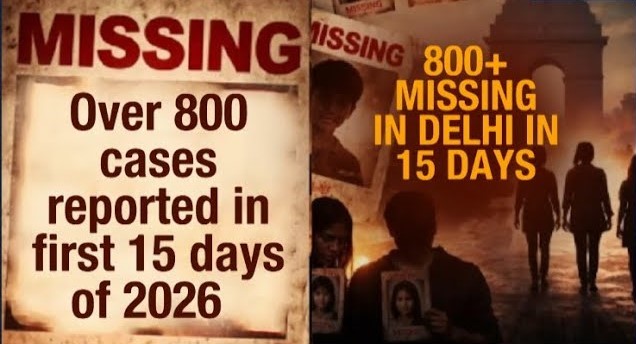
Delhi, India’s national capital and one of the most heavily policed cities in the country, has reported a deeply troubling statistic: over 800 people went missing in January 2026 alone, according to police data. Of those cases, around 500 involve women, and a significant share involve minors.
The numbers are not just administrative entries in police logs. They represent families waiting, phones ringing without answers, and homes suspended in uncertainty. On average, more than 50 people disappeared every single day during the month — a rate that has triggered alarm among safety experts, women’s rights advocates, and social workers.
While police confirm that some individuals have been traced, hundreds remain unaccounted for, turning January into one of the most worrying months in recent years for missing persons reporting in Delhi.
Behind each statistic is a human story — and collectively, they reveal a systemic challenge that extends beyond crime into social vulnerability, urban stress, and institutional response capacity.
The Gendered Pattern: Why Are Women Disproportionately Missing?
The most striking aspect of the January figures is the gender imbalance.
With roughly 500 women reported missing, the data suggests that women are not merely incidental victims but part of a recurring pattern of vulnerability.
Experts working in gender safety note several overlapping risk factors:
-
Domestic conflict leading to forced disappearance or runaway cases
-
Human trafficking networks targeting economically vulnerable women
-
Exploitation tied to informal labor migration
-
Online grooming and digital luring
-
Interpersonal violence and coercion
Urban sociologists emphasize that cities like Delhi create paradoxical conditions: opportunity and anonymity coexist with isolation and exploitation. Women migrating for work or education often lack protective social networks, making them more exposed to manipulation or harm.
The disproportionate number of missing women forces a difficult question: Is Delhi’s urban environment failing to protect its most vulnerable residents?
Children Vanishing: A Silent Emergency
Equally alarming is the number of minors among the missing.
Child protection organizations warn that missing children cases are often linked to:
-
Trafficking for labor or sexual exploitation
-
Forced begging rings
-
Runaways escaping abuse
-
Online recruitment traps
-
Child labor networks
A missing child case is rarely just a disappearance; it is often an entry point into criminal ecosystems that operate across state lines.
Every hour matters in such cases. Research globally shows that the first 24–48 hours dramatically affect recovery outcomes. Delayed response reduces the probability of safe tracing.
The January spike has intensified calls for a dedicated, rapid-response missing children task force operating with real-time interstate coordination.
Families in Limbo: The Psychological Toll
Beyond policing statistics lies the invisible crisis: the mental health impact on families.
Psychologists describe families of missing persons as living in a state of “ambiguous loss” — a unique trauma where closure is impossible. Unlike confirmed death or reunion, disappearance traps relatives in a permanent emotional suspension.
Common psychological effects include:
-
chronic anxiety
-
depression
-
sleep disorders
-
financial instability
-
social withdrawal
-
guilt and self-blame
Parents of missing minors often experience long-term trauma comparable to war survivors. Families of missing women report stigma, fear, and community pressure.
The crisis is therefore not only about law enforcement. It is about mental health infrastructure and community support systems that are currently inadequate.
Are Surveillance Systems Failing?
Delhi has invested heavily in CCTV networks, facial recognition systems, and smart policing tools. Yet the January numbers raise serious questions:
-
Are cameras strategically placed in high-risk zones?
-
Is footage reviewed quickly enough to act in real time?
-
Are databases integrated across districts and states?
-
Do missing persons units have technological staffing support?
Safety analysts argue that technology alone cannot prevent disappearances. Surveillance must be paired with human intelligence, neighborhood policing, and social outreach.
A camera records an event. It does not intervene.
Police Response: Capacity vs Reality
Delhi Police operate one of the largest metropolitan forces in the world. However, missing persons units face operational challenges:
-
high case load per officer
-
bureaucratic delays
-
inter-state jurisdiction gaps
-
shortage of forensic tracking specialists
-
limited psychological training for victim families
Families often report delays in FIR registration or inadequate early response. While police cite procedural safeguards and case complexity, critics argue that missing persons cases are not treated with the urgency of violent crimes.
The January spike has renewed calls for:
-
mandatory immediate FIR registration
-
digital real-time tracking dashboards
-
interstate coordination cells
-
family liaison officers
-
psychological support units
The Urban Vulnerability Factor
Delhi’s rapid expansion has produced pockets of extreme vulnerability:
-
migrant labor colonies
-
informal settlements
-
transport hubs
-
nightlife zones
-
industrial outskirts
These are areas where people can disappear into anonymity.
Urban planners note that safety is not just policing; it is design:
-
lighting
-
safe public transport
-
pedestrian visibility
-
secure rental housing
-
community networks
Cities that design for safety reduce disappearance risk structurally, not reactively.
Trafficking Fears: A Shadow Economy
Human trafficking remains one of the darkest possibilities behind missing persons data.
India has long been identified as both a source and transit region for trafficking networks. Missing women and minors are particularly vulnerable to exploitation in:
-
forced labor
-
domestic servitude
-
sexual exploitation
-
cyber exploitation
-
cross-border trafficking
Anti-trafficking NGOs warn that spikes in missing persons reporting often correlate with organized recruitment activity.
This transforms the crisis from a local policing issue into a national security and human rights concern.
Public Trust and Institutional Credibility
When hundreds remain missing, public trust erodes.
Families measure safety not by crime statistics, but by recovery rates. A city where people vanish without closure becomes psychologically unsafe.
Trust requires:
-
transparent reporting
-
public accountability
-
visible search efforts
-
victim-centered policing
-
media cooperation
Without trust, communities withdraw cooperation — making prevention harder.
Preventive Measures: What Can Actually Work
Experts across policing, sociology, and psychology recommend multi-layered reform.
Neighborhood Policing
Community officers embedded in vulnerable areas build early-warning networks.
Rapid Response Units
Specialized teams activated within minutes of reporting.
Women & Child Safety Cells
Dedicated officers trained in gender-sensitive investigation.
Public Awareness
Schools and workplaces teaching safety and digital literacy.
NGO Collaboration
Civil society often reaches victims faster than institutions.
Data Integration
Unified national missing persons database accessible in real time.
Family Support Services
Mental health assistance for affected households.
Prevention is not one reform. It is an ecosystem.
A Human Crisis, Not a Statistical Spike
Numbers numb empathy. But each case is a life interrupted.
A missing daughter.
A vanished son.
A parent waiting at a police station bench.
A phone that never rings.
January’s figures are not merely alarming — they are a mirror held up to the capital’s social architecture.
Urban safety is not measured by flyovers or GDP. It is measured by whether citizens return home.
Policy Debate: A Moment of Reckoning
The spike has triggered urgent political debate:
-
Should Delhi create a Missing Persons Commissioner?
-
Do we need a national rapid-response framework?
-
Are women’s safety budgets being effectively used?
-
Should surveillance laws be expanded?
-
Can schools integrate anti-trafficking education?
This moment may shape urban safety policy for the next decade.
Conclusion: The Capital Cannot Normalize Disappearance
When over 800 people vanish in a single month, the city must refuse normalization.
The crisis demands coordination between:
-
police
-
lawmakers
-
mental health professionals
-
educators
-
urban planners
-
community leaders
Missing persons cases are not isolated tragedies. They are stress fractures in the social system.
Delhi now faces a choice: treat January as a statistical anomaly — or as a warning signal demanding structural reform.
History will judge which path is chosen.