Ruckus in the Assembly: A Session That Exposed J&K’s Political Fault Lines
By: Javid Amin | 03 February 2026
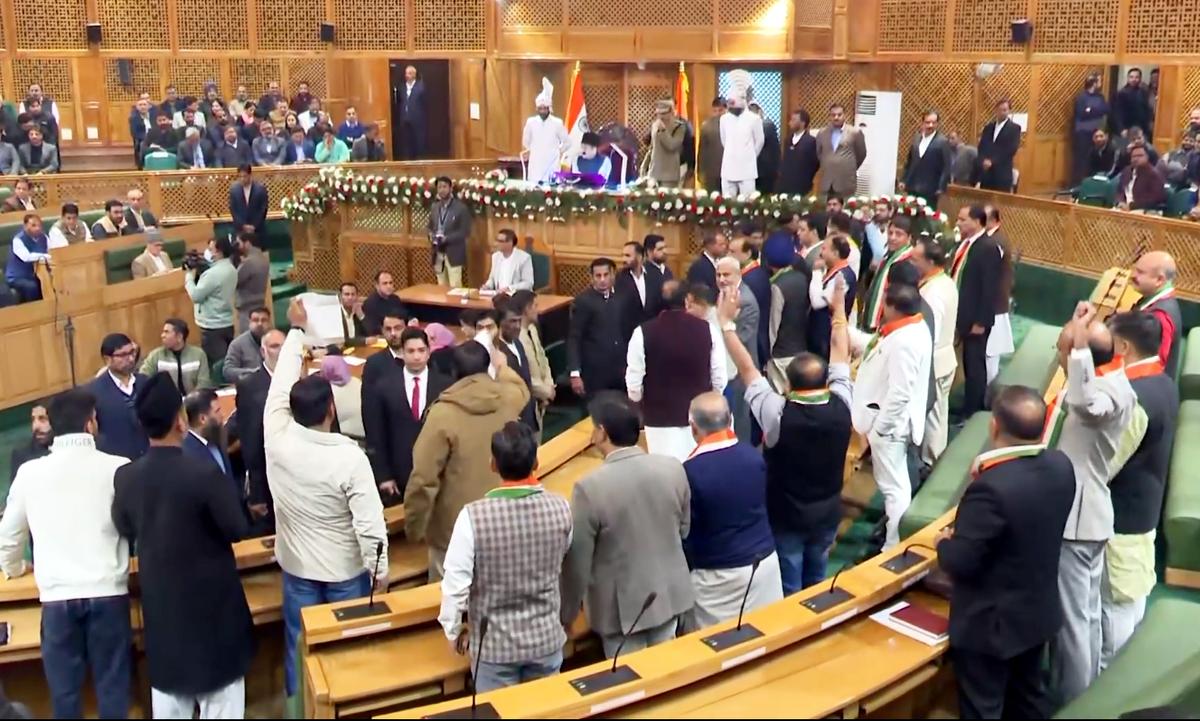
A routine legislative sitting in the Jammu & Kashmir Assembly escalated into a charged confrontation when Deputy Chief Minister Surinder Choudhary accused the Bharatiya Janata Party of playing “Jammu versus Kashmir politics.” His remarks triggered immediate protests from BJP legislators, leading to a brief disruption that symbolized the fragile equilibrium of regional politics in the Union Territory.
Within hours, the atmosphere deteriorated further. Two BJP MLAs staged a dramatic walkout over what they described as government indifference to Jammu’s concerns, while ruling National Conference members simultaneously protested attacks on Kashmiris outside the UT. The Assembly floor became a theatre where competing narratives of identity, development, and justice collided.
The events were not isolated parliamentary theatrics. They reflected a deeper contest over how Jammu & Kashmir is governed, represented, and imagined politically — as a single integrated entity or as two regions with competing grievances.
What Triggered the Clash
The flashpoint came during discussions when Deputy CM Surinder Choudhary issued a forceful statement asserting that the government would not tolerate attempts to politically divide the Union Territory.
“For this government, Jammu and Kashmir is one. We will never divide it. If Jammu has a problem, the government has a problem. If Kashmir has a problem, the government has a problem.”
His assertion was framed as a declaration of administrative philosophy: governance must treat the Union Territory as indivisible. But the second part of his intervention — accusing the BJP of cultivating a narrative of separation — ignited the storm.
Choudhary alleged that the BJP was trying to portray Jammu and Kashmir as competing political identities rather than components of a unified administrative structure. According to him, such framing risked deepening polarization and undermining social cohesion.
BJP members immediately objected, calling the remarks inflammatory and unfair. They accused the Deputy CM of politicizing legitimate regional grievances and misrepresenting their demands as divisive.
Within minutes, shouting matches erupted across the aisle.
BJP’s Response: “We Are Raising Jammu’s Real Issues”
BJP legislators rejected the accusation that they were promoting division. Instead, they argued that highlighting Jammu’s developmental concerns was not separatism but democratic accountability.
According to BJP members, their focus on issues such as flood restoration funds, institutional distribution, and regional investment stems from persistent complaints by constituents that Jammu’s needs are overlooked.
The party framed its stance as corrective, not divisive:
-
Jammu faces infrastructure and disaster recovery challenges
-
Fund allocation requires transparency
-
Institutional parity is a legitimate governance demand
BJP MLAs insisted that calling attention to disparities should not be conflated with promoting regional antagonism.
The tension between these positions — unity narrative vs grievance politics — became the ideological backbone of the session’s confrontation.
The Walkout: Flood Funds Become a Flashpoint
The ruckus reached a new stage when Rajiv Jasrotia (Kathua) walked out of the Assembly, accusing the government of providing evasive answers regarding flood restoration and constituency issues.
Shortly afterward, Pawan Gupta (Udhampur) joined him in solidarity.
The two MLAs claimed that Jammu’s flood-affected areas were being neglected and that the government’s responses lacked clarity and commitment.
The Deputy CM responded with financial figures meant to counter allegations of discrimination:
-
₹289.39 crore allocated under the State Disaster Response Fund (SDRF)
-
₹100 crore provisioned under the UT Capex Budget
-
No central funds released yet for FY 2025–26 flood restoration
Choudhary argued that the absence of central funding was procedural, not political, and that the UT government had distributed available resources fairly.
BJP legislators dismissed the explanation as inadequate, maintaining that the scale of damage warranted greater urgency.
The walkout, therefore, was not just symbolic — it was an attempt to dramatize what the party sees as systemic neglect of Jammu’s fiscal priorities.
Parallel Protest: NC Raises Kashmir Safety and Statehood
While BJP MLAs protested over development and funding, National Conference members staged a dharna inside the Assembly premises on a different axis altogether.
Their demands centered on:
-
Protection of Kashmiris facing attacks outside the UT
-
Stronger government intervention on hate crimes
-
Restoration of J&K’s statehood
This created a striking visual and political contrast: one side highlighting Jammu’s development concerns, the other emphasizing Kashmiri safety and constitutional restoration.
The Assembly session thus became a compressed representation of J&K’s layered political tensions — regional equity, minority protection, and governance status all colliding in the same chamber.
The Symbolism of “Jammu vs Kashmir” Politics
The phrase invoked by the Deputy CM carries historical weight.
Since before the reorganization of J&K in 2019, political discourse has often revolved around allegations that one region benefits at the expense of the other. Electoral rhetoric, resource allocation debates, and institutional placements have repeatedly been filtered through this lens.
The Deputy CM’s intervention was an attempt to neutralize that binary by asserting a unified governance doctrine. But the BJP interpreted the accusation as a strategy to delegitimize regional advocacy.
This tension reveals a structural dilemma:
-
If regional grievances are emphasized, it risks polarization
-
If unity is emphasized, it risks erasing local disparities
Balancing these two realities is one of the central governance challenges of post-reorganization J&K.
Why the Incident Matters Politically
The Assembly confrontation has implications beyond a single session.
1. Electoral Signaling
Both sides are messaging to their constituencies:
-
BJP positioning itself as Jammu’s defender
-
NC projecting itself as protector of Kashmiri rights
-
Coalition leadership emphasizing territorial unity
Each narrative is aimed at consolidating political bases ahead of future contests.
2. Governance Credibility
Public confidence depends on whether the government can demonstrate:
-
Fair distribution of funds
-
Equal administrative attention
-
Responsive crisis management
Failure to address perception gaps can harden regional narratives.
3. Identity Politics vs Administrative Policy
The incident underscores how quickly technical policy debates — flood relief budgets, disaster funds, institutional planning — can morph into identity conflicts in J&K’s political environment.
The Fragile Balance of Coalition Governance
The ruling coalition must walk a tightrope:
-
Acknowledge Jammu’s grievances without alienating Kashmir
-
Address Kashmiri safety without appearing regionally biased
-
Maintain fiscal transparency
-
Resist symbolic polarization
The Deputy CM’s statement signals an official effort to craft a unity narrative, but the Assembly chaos shows how difficult it is to maintain consensus in a politically sensitive landscape.
What Happens Next
Several outcomes are possible:
-
Formal clarifications on flood fund distribution
-
Legislative debate on regional development equity
-
Government statements on protecting Kashmiris outside the UT
-
Renewed calls for statehood restoration
If handled constructively, the episode could trigger institutional reforms. If mishandled, it risks entrenching regional mistrust.
Conclusion: A Microcosm of J&K’s Political Reality
The Assembly ruckus was not just noise. It was a concentrated display of Jammu & Kashmir’s enduring political tensions.
Deputy CM Surinder Choudhary’s assertion of unity collided with BJP’s insistence on regional advocacy. The walkout dramatized fiscal grievances. The NC protest highlighted identity and security concerns.
Together, they formed a portrait of a Union Territory still negotiating its post-reorganization political identity — a space where governance, memory, and regional pride intersect daily.
The challenge for leadership is not merely to quiet the House, but to address the structural anxieties that fuel such confrontations. Until those anxieties are resolved through transparent policy and inclusive governance, the Assembly floor will continue to mirror the unresolved debates shaping J&K’s future.