Winter Without Winter: Kashmir’s 7°C February Heat Shock and the Collapse of Seasonal Certainty
By: Javid Amin | 16 February 2026
Two Dry Winters, a Warm February, and a Valley Rewriting Its Climate Memory
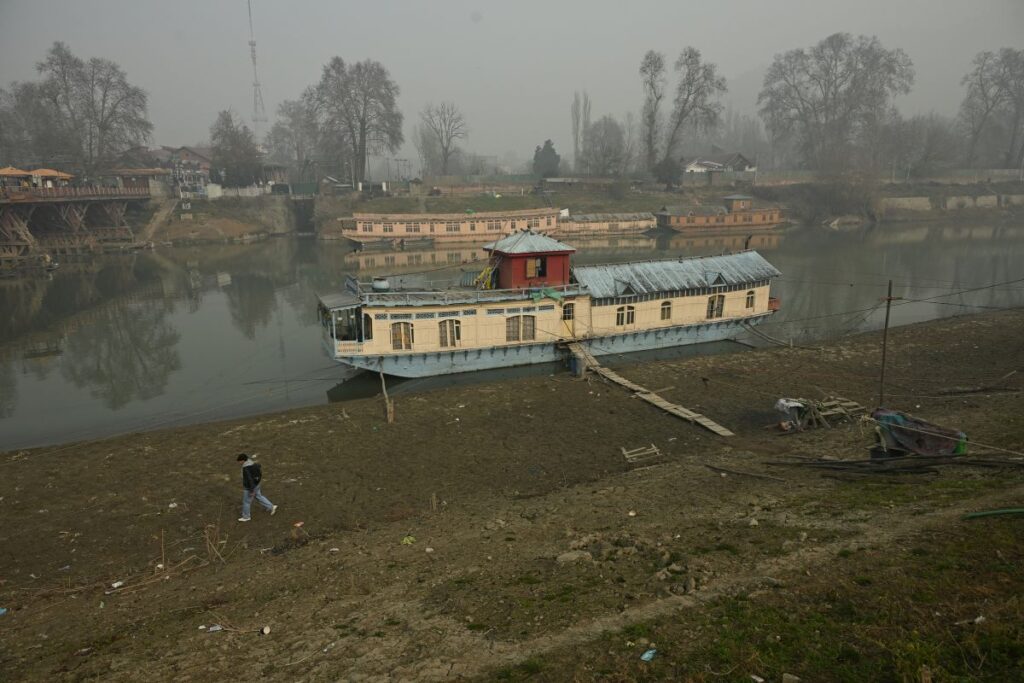
Kashmir is passing through a winter that barely resembles winter. During what should be the harshest stretch of the 70-day cold season, daytime temperatures are running 7–8°C above normal, snowfall is scarce, reservoirs are undercharged, and lawmakers are openly debating climate risk inside the Assembly.
The Valley is not merely experiencing a warm spell. It is confronting a structural warning: the climate system that sustained its agriculture, tourism, and water security for generations is becoming unstable.
For the first time in decades, winter itself feels uncertain.
A February That Broke the Thermometer
In Srinagar, February afternoons are repeatedly touching 14–18°C — temperatures that historically belong to early April. Normal February highs sit between 6–10°C. A +7°C anomaly in a mountain winter climate is not minor variability; it is an extreme event.
Residents describe:
-
frost melting by mid-morning
-
bare streets instead of icy roads
-
orchards standing dry and exposed
-
snowlines retreating into higher ridges
Even in Gulmarg, Kashmir’s snow capital, temperatures near 10°C have replaced the usual sub-freezing chill. Slopes that should be thick with snow look prematurely springlike.
The visual landscape has shifted. The psychological landscape is following.
Snow Is Kashmir’s Water Bank
Winter snow in Kashmir is not decoration. It is delayed water storage.
Snow accumulates gradually and releases meltwater slowly into:
-
rivers
-
springs
-
irrigation canals
-
aquifers
-
municipal reservoirs
This year’s snow account is dangerously underfunded.
Meteorological records show overall winter precipitation at less than half of normal levels. Two consecutive winters have produced deficits severe enough to alarm hydrologists. When snow fails, the Valley loses its seasonal buffer.
Water stress does not arrive in winter.
It arrives in spring and summer.
And by then, it is too late to fix.
Assembly Alarm: Climate Enters Politics
Inside the Jammu and Kashmir Assembly, the government formally acknowledged two back-to-back winters with insufficient snowfall. The admission marks a political turning point: climate variability has crossed into legislative territory.
Lawmakers raised concerns over:
-
irrigation vulnerability
-
tourism revenue collapse
-
drinking water pressure
-
horticultural stress
-
hydropower uncertainty
Opposition members accused authorities of reacting too slowly after the first weak winter. Government representatives emphasized monitoring and long-term planning.
The debate revealed something deeper: climate is no longer an environmental sidebar. It is now a budget issue.
Once climate affects livelihoods, it becomes political currency.
Tourism Without Snow: A Fragile Economy
Winter tourism is a snow economy. Travelers book Kashmir expecting alpine scenery, ski slopes, and frozen landscapes.
Destinations like Pahalgam and Sonmarg rely on predictable snowfall to sustain seasonal employment.
When snow disappears:
-
ski operations shrink
-
bookings fall
-
cancellations spike
-
worker incomes collapse
-
investor confidence weakens
Tourism workers operate on narrow margins. Two poor winters erase savings and increase debt exposure.
A snow economy cannot survive on hope.
It needs reliability.
And reliability is what climate change erodes first.
Agriculture on Thin Ice
Farmers depend on winter snow for soil moisture. Without it, spring planting becomes risky.
Reduced snowpack leads to:
-
early soil drying
-
higher irrigation demand
-
groundwater overuse
-
yield uncertainty
Wheat and mustard crops are especially sensitive. Orchard systems — apples, walnuts, cherries — require winter chill combined with spring hydration. Warm winters disrupt flowering cycles and pest dynamics.
Agriculture becomes speculative.
Speculation increases stress.
For farming communities, climate variability translates directly into financial anxiety.
Rivers Losing Their Rhythm
Kashmir’s rivers evolved around snowmelt timing. Engineers designed irrigation and hydropower systems assuming predictable melt seasons.
That rhythm is breaking.
With thin snowpack:
-
peak runoff arrives earlier
-
summer flows weaken
-
dry intervals lengthen
-
reservoirs underperform
Hydrology is shifting from stable to volatile.
The Valley must now plan for water timing, not just water volume.
And timing errors are expensive.
The Avalanche Paradox
Warm winters create unstable snow layers. Irregular thaw-freeze cycles weaken structural integrity.
Authorities warn that avalanche risk may increase even when snowfall decreases. Thin snowpacks are more sensitive to temperature swings and mechanical stress.
Less snow does not mean less danger.
It means less predictable danger.
Mountain safety now depends on real-time weather intelligence, not seasonal expectations.
Climate as Identity Shock
Snow is embedded in Kashmir’s cultural memory. It shapes architecture, clothing, poetry, and seasonal rituals.
A winter without snow feels incomplete.
Residents speak of emotional disorientation: familiar seasons no longer behave as remembered. Climate change alters how a place feels before it alters how a place functions.
That emotional shift is politically powerful.
People act faster to protect identity than statistics.
Governance Versus Climate Speed
Government adaptation plans exist — irrigation expansion, climate-resilient agriculture, meteorological monitoring, and long-term environmental frameworks. But climate moves faster than bureaucracy.
Policy cycles are measured in years.
Climate shifts are measured in seasons.
The Valley faces a structural challenge: redesign infrastructure while the system is already under stress.
Adaptation delayed becomes adaptation forced.
And forced adaptation costs more.
The Strategic Fork in the Road
Kashmir must choose between two planning models:
Model 1: Historical Assumption
Treat weak winters as temporary anomalies.
Model 2: New Baseline
Plan for warmer winters as the norm.
Every sector depends on this decision:
-
agriculture
-
hydropower
-
tourism
-
urban planning
-
water governance
Planning for the wrong baseline is the real disaster.
The snowfall shortage is not the crisis.
Misreading it would be.
A Valley at a Threshold
Kashmir is not yet in ecological collapse. It stands at a threshold moment — early enough to adapt, late enough to feel urgency.
That window is rare.
Regions that act during thresholds survive transitions. Regions that wait for catastrophe enter survival mode.
The Valley still has agency.
The question is whether adaptation becomes proactive policy or reactive emergency.
The Future Without Assumptions
Snow can no longer be assumed. That is the central lesson of Winter 2026.
From now on, resilience must replace expectation.
Water systems must plan for deficit years.
Agriculture must diversify against temperature risk.
Tourism must redesign beyond snow dependency.
Cities must prepare for heat stress.
Governance must integrate climate into every budget line.
This is not pessimism.
It is modernization.
Kashmir has always adapted to altitude, terrain, and history. Climate is the next chapter of that adaptation story.
The snow may thin.
The Valley’s capacity to respond does not have to.


