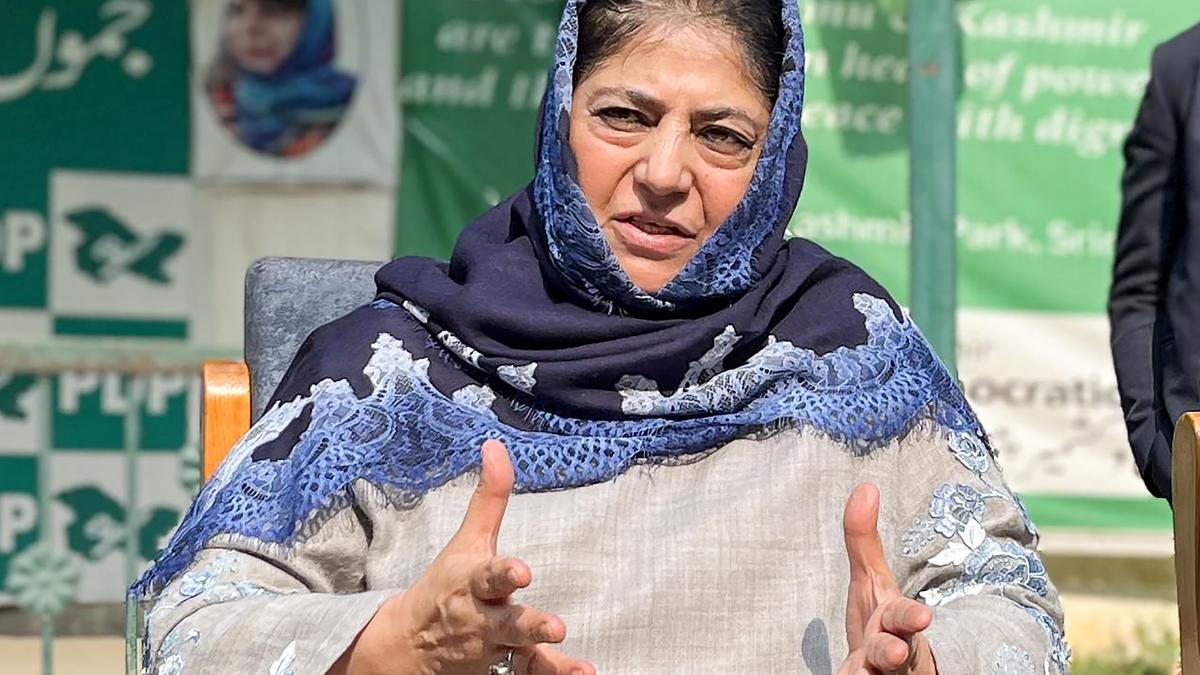
Mehbooba Mufti Revives Push for Liquor Ban in Kashmir
By: Javid Amin | 04 February 2026
Peoples Democratic Party (PDP) president Mehbooba Mufti has reignited a long-standing social and political debate by calling for a complete ban on liquor in the Kashmir Valley, arguing that restricting alcohol aligns with the region’s cultural values and contributes to public safety — particularly for women.
Speaking on February 4, 2026, Mufti said that while Jammu may resist prohibition, the “majority sentiment in Kashmir supports it.” Her remarks come as the PDP prepares to introduce a private member’s bill in the Jammu & Kashmir Assembly seeking formal legislative action.
She directly appealed to Chief Minister Omar Abdullah to personally intervene and allow the proposal to be debated, framing the issue not as moral policing but as a public policy question tied to social order and community well-being.
The Core Argument: Social Fabric and Women’s Safety
Mufti’s central claim is that limited alcohol availability has historically contributed to Kashmir’s social stability. She argued that the Valley’s relative safety — especially for women in public spaces — is linked to cultural norms discouraging alcohol consumption.
According to her, expanding liquor access risks:
-
Increasing public disorder
-
Undermining traditional community structures
-
Exposing vulnerable populations to substance abuse
-
Weakening women’s sense of security
She described prohibition as a preventive social policy, not merely a religious or cultural demand.
The framing is strategic: it shifts the conversation from morality to public safety and social health, broadening the appeal beyond conservative constituencies.
Tourism Argument: “Dry States Still Thrive”
One of the strongest criticisms against prohibition proposals is their perceived economic impact — especially on tourism. Kashmir’s hospitality sector, already fragile due to years of instability, is sensitive to any policy that could deter visitors.
Mufti rejected that logic outright.
She cited Gujarat and Bihar, both dry states, as examples where tourism continues despite prohibition. Her position is that tourism is shaped more by landscape, culture, and hospitality than alcohol availability.
Her argument suggests Kashmir can develop a model of:
-
Curated cultural tourism
-
eco-tourism
-
heritage tourism
-
family-friendly travel experiences
without relying on liquor sales as an economic pillar.
This reframes prohibition not as anti-tourism, but as an opportunity to define a distinct tourism identity.
Regional Divide: Kashmir vs Jammu
The liquor ban proposal has reopened a familiar political fault line in Jammu & Kashmir: regional policy divergence.
Kashmir Valley’s Position
Supporters in the Valley argue prohibition aligns with:
-
Religious and cultural norms
-
Community expectations
-
social discipline
-
public morality
Many local clerics and social organizations have historically supported restrictions on alcohol sales, viewing them as incompatible with the Valley’s social ethos.
Jammu’s Concerns
In contrast, opposition in Jammu is driven largely by economic and administrative concerns:
-
Loss of excise revenue
-
impact on hospitality businesses
-
tourism competitiveness
-
enforcement challenges
Critics argue that a selective regional ban could create uneven policy frameworks within the Union Territory and complicate governance.
This tension transforms a social policy debate into a regional governance dilemma.
Political Strategy Behind the Proposal
Mufti’s intervention is not occurring in isolation. It intersects with broader PDP positioning:
-
reclaiming social issues as political ground
-
appealing to conservative Valley sentiment
-
distinguishing PDP from ruling coalition priorities
-
asserting cultural autonomy narratives
On the same day, she demanded a separate development budget for Srinagar’s old city (Shehr-e-Khaas), linking unemployment, urban neglect, and social decay to policy failure — and again tying in the liquor ban demand.
This bundling of economic and social arguments suggests a strategy to portray prohibition as part of a larger cultural preservation agenda.
Governance Challenges of a Liquor Ban
If introduced and debated, the proposal raises complex implementation questions:
Enforcement
-
Would prohibition apply only to the Valley?
-
How would cross-regional smuggling be controlled?
-
What administrative structure would oversee enforcement?
Revenue
-
Liquor taxes form a non-trivial part of excise collections
-
Replacement revenue sources would need identification
Legal Framework
-
Would the ban withstand judicial scrutiny?
-
How would it align with Union Territory fiscal authority?
Social Outcomes
Evidence from dry states in India is mixed. While prohibition can reduce visible consumption, critics warn it may also create:
-
black markets
-
illicit brewing
-
enforcement corruption
Supporters counter that strong community backing improves compliance.
Women’s Safety: Symbolism vs Policy Evidence
Mufti’s strongest emotional appeal is the claim that alcohol access correlates with threats to women’s safety.
Research globally shows complex relationships between substance abuse and gender violence. However, policy experts caution that prohibition alone cannot guarantee safety without:
-
policing reform
-
legal deterrence
-
social education
-
community accountability
The liquor ban debate therefore intersects with broader questions about gender justice, not just excise policy.
Tourism Sector Reaction
Industry stakeholders remain divided.
Some hoteliers fear that prohibition could reduce Kashmir’s appeal to international travelers accustomed to liberal hospitality environments.
Others argue the Valley already markets itself as a family and nature destination, where alcohol is not central to visitor expectations.
If prohibition becomes law, Kashmir’s tourism branding may pivot toward:
-
wellness tourism
-
spiritual tourism
-
eco-retreat experiences
creating a niche distinct from party-centric travel destinations.
A Policy Debate That Reflects Identity Politics
The liquor ban proposal is not merely administrative. It touches identity, culture, and autonomy — perennial themes in J&K politics.
For supporters, it represents:
-
cultural self-determination
-
protection of social values
-
assertion of regional character
For critics, it risks:
-
economic contraction
-
overregulation
-
symbolic politics overshadowing development
This duality explains why the debate resonates beyond excise policy.
What Happens Next
The next stage depends on Assembly procedure:
-
PDP introduces private member’s bill
-
Speaker decides admissibility
-
debate scheduled or deferred
-
government signals support or opposition
Even if the bill does not pass immediately, the issue is likely to remain politically alive, shaping future electoral narratives.
Conclusion: A Debate Bigger Than Alcohol
Mehbooba Mufti’s push for a liquor ban is less about alcohol and more about how Kashmir defines its social and political identity in a post-reorganization era.
It forces policymakers to confront competing priorities:
-
culture vs commerce
-
safety vs freedom
-
revenue vs social values
-
regional autonomy vs administrative uniformity
Whether the ban succeeds or fails legislatively, the conversation it has sparked reveals the enduring complexity of governing a region where policy is inseparable from identity.
The Assembly’s response will signal not just excise policy direction, but how Jammu & Kashmir negotiates the balance between economic modernization and cultural preservation.


