Special Status Returns to Centre Stage: Why the J&K Assembly Clash Matters
By: Javid Amin | 07 February 2026
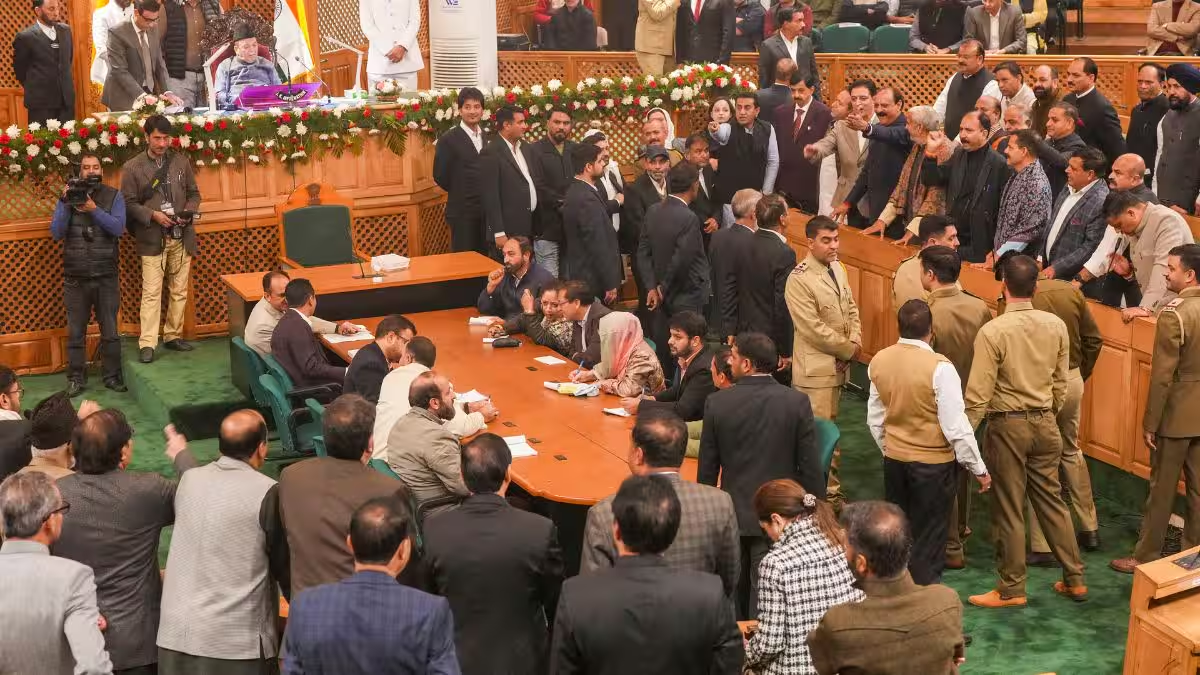
The Jammu & Kashmir Legislative Assembly once again became the arena for one of India’s most sensitive and emotionally charged political debates: the question of J&K’s “special status.” Years after the abrogation of Article 370, the issue refuses to fade. Instead, it continues to resurface—often dramatically—reflecting unresolved political aspirations, constitutional disagreements, and deep public anxieties about identity, rights, and governance.
What unfolded on the Assembly floor was not merely a shouting match between rival parties. It was a symbolic replay of a much larger national argument—one that pits constitutional literalism against political memory, and governance pragmatism against emotive politics.
At the heart of the clash were two sharply opposed positions. The National Conference (NC), through its senior legislator Javid Baig, demanded the restoration of J&K’s special status, linking it directly to Article 370 and Article 35A. The Bharatiya Janata Party (BJP), led in the House by Leader of Opposition Sunil Sharma, responded with an uncompromising challenge: Show me where the Indian Constitution even uses the words ‘special status’.
That single provocation ignited the House.
What Exactly Happened Inside the Assembly
The exchange began during a discussion that was initially expected to revolve around governance and administrative issues. However, Javid Baig steered the debate toward constitutional identity, arguing that the erosion of J&K’s special position had directly impacted employment protections, land ownership rights, and the psychological sense of security among residents.
Baig asserted that Article 370 was not a concession, but a constitutional bridge that defined Jammu & Kashmir’s relationship with the Union of India. He reminded the House that Article 35A had empowered the state legislature to define permanent residency, thereby safeguarding local interests.
BJP’s Sunil Sharma rose swiftly to counter the narrative.
“Show me where the words ‘special status’ exist in the Constitution of India,” Sharma challenged, adding pointedly that if anyone could prove him wrong, he was willing to face punishment. The statement was as theatrical as it was calculated, designed to shift the debate from emotion to textual constitutionalism.
What followed was predictable—and explosive.
NC legislators erupted into slogans: “Special status le ke rahenge” and “Leke rahenge apna haq.” BJP MLAs responded with nationalist chants of “Vande Mataram” and “Bharat Mata ki Jai.” The Assembly floor briefly transformed into a political amphitheatre, echoing slogans that mirrored street-level politics across the region.
Article 370 and 35A: Explained in Simple Terms
To understand why such debates continue to ignite passions, one must revisit what Article 370 and Article 35A actually represented.
Article 370, incorporated into the Indian Constitution in 1950, granted Jammu & Kashmir a unique constitutional position. Unlike other states, J&K had its own Constitution, its own flag, and autonomy over all matters except defence, foreign affairs, and communications.
Article 35A, added through a Presidential Order in 1954, empowered the J&K legislature to define “permanent residents.” This provision restricted land ownership, government jobs, and certain welfare benefits to locals.
For supporters, these articles were protective shields—mechanisms that preserved demographic stability and economic opportunities. For critics, they symbolised separation, inefficiency, and unequal integration.
When Article 370 was effectively nullified in August 2019 and Article 35A ceased to operate, the constitutional architecture of J&K changed irrevocably. Yet, as the Assembly clash shows, political memory did not.
NC’s Political Logic: Identity Before Administration
For the National Conference, the special status narrative is both ideological and strategic. Historically, NC has positioned itself as the custodian of J&K’s autonomy within India. Reviving the issue serves multiple purposes.
First, it reinforces the party’s ideological roots among its core electorate, particularly in the Kashmir Valley. Second, it reframes public discourse away from immediate governance failures toward constitutional injustice. Third, it places the BJP on the defensive, forcing it to justify decisions taken in 2019.
Javid Baig’s intervention was therefore not accidental. It was a calculated reminder that NC remains committed to restoring what it calls J&K’s “dignified constitutional position.”
BJP’s Counter-Narrative: Constitution Over Emotion
The BJP’s position is equally consistent. By challenging the very phrase “special status,” Sunil Sharma sought to anchor the debate strictly within constitutional text rather than political sentiment.
From the BJP’s perspective, Article 370 was a temporary provision that hindered development, enabled corruption, and kept J&K politically isolated. The party argues that post-2019 reforms have brought uniform laws, greater investment potential, and clearer governance structures.
Sharma accused the NC of using emotionally charged rhetoric to distract from pressing issues such as unemployment, the plight of daily wagers, and delays in welfare disbursement.
In essence, BJP wants the debate to move from identity to implementation.
Governance vs Rhetoric: The Unspoken Undercurrent
Beyond slogans, the clash exposes a deeper tension in J&K politics: the struggle between symbolic politics and everyday governance.
Unemployment remains a significant concern, particularly among educated youth. Daily wagers continue to demand regularisation. Welfare beneficiaries complain of bureaucratic delays. These issues rarely generate the same emotional mobilisation as constitutional identity, yet they dominate daily life.
BJP insists that such bread-and-butter issues deserve priority. NC counters that without constitutional safeguards, governance itself becomes hollow.
Ground Sentiment: What People Say Off-Camera
Ground reports suggest a nuanced public mood. While many residents emotionally resonate with the idea of special status, there is also fatigue. Younger citizens, in particular, express frustration that political debates rarely translate into tangible improvements.
In Jammu, the response is more mixed, with sections viewing the special status debate as Valley-centric. In Kashmir, the issue retains symbolic power, though expectations of actual restoration remain cautious.
Why This Debate Refuses to Die
The persistence of the special status debate reflects unresolved political reconciliation after 2019. Legal challenges remain pending. Electoral politics incentivise sharp positioning. Most importantly, identity questions cannot be legislated out of public consciousness overnight.
The Assembly clash was therefore not an aberration—it was inevitable.
What Lies Ahead
Realistically, restoration of Article 370 remains constitutionally and politically improbable in the near term. However, demands for safeguards, land protections, and job security are likely to intensify.
Future politics in J&K may revolve less around reversing 2019 and more around negotiating protections within the new framework. Whether parties choose dialogue or drama will shape the region’s political stability.
Final Word: Beyond the Noise
The slogans will fade, but the questions will not. Jammu & Kashmir’s special status debate is no longer just about constitutional clauses—it is about trust, dignity, and the relationship between citizens and the Indian state.
Until those deeper issues are addressed, the Assembly will continue to echo—not just with chants, but with unresolved history.


