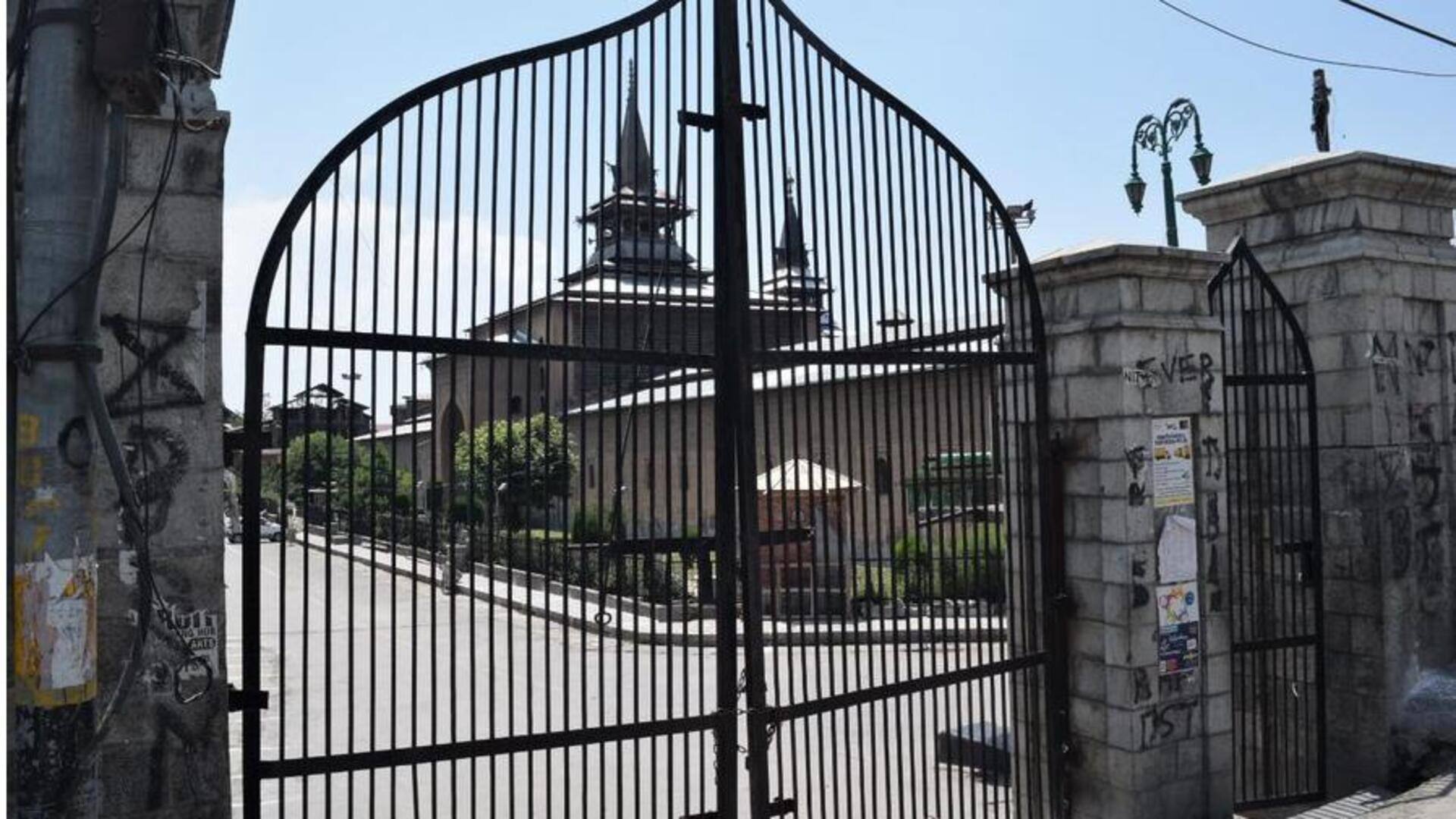
Eid Without Jamia Masjid: Omar Abdullah Questions ‘Normalcy’ as Kashmir Marks a Divided Festival
By: Javid Amin | 21 March 2026
A Ground Report on Eid 2026 in Kashmir — Faith, Restrictions, and Political Messaging
Eid in Kashmir is traditionally a moment of unity—of shared prayers, open courtyards, and collective joy. But on March 21, 2026, that sense of unity appeared fractured.
At the center of the controversy stood the closure of Jamia Masjid, Srinagar’s historic and largest congregational mosque, where Eid prayers were not allowed. The decision triggered sharp political reactions, including a pointed response from Omar Abdullah, who termed the move “unfortunate and painful.”
His remarks have reignited a familiar debate in Kashmir—between claims of normalcy and the lived realities on the ground.
Eid in Kashmir: Peaceful Prayers, But a Symbolic Absence
Across Jammu and Kashmir, Eid al-Fitr prayers were largely conducted peacefully under tight security arrangements.
One of the largest gatherings took place at the revered Hazratbal Shrine, where thousands of worshippers assembled in the early hours, offering prayers in a calm but closely monitored environment.
Other mosques and Eidgah grounds across districts also witnessed orderly congregations.
However, the absence of prayers at Jamia Masjid created a visible and emotional void—particularly in Srinagar’s old city, where the mosque has historically served as a central hub for Eid gatherings.
For many residents, the issue was not merely logistical—it was symbolic.
Jamia Masjid Closure: A Recurring Flashpoint
The closure of Jamia Masjid on Eid is not an isolated incident but part of a recurring pattern tied to security considerations.
Authorities have, in the past, restricted access to the mosque on:
- Major religious occasions
- Politically sensitive anniversaries
- Periods of heightened tension
While official explanations typically cite law-and-order concerns, the repeated nature of such restrictions continues to generate public debate.
This year, the move once again raised questions about:
- Religious freedom
- Administrative transparency
- The credibility of “normalcy” narratives
Omar Abdullah Speaks: “Unfortunate and Painful”
After offering Eid prayers at Hazratbal, Chief Minister Omar Abdullah publicly expressed his discontent.
His statement struck a careful balance between festive greetings and political critique:
“It is unfortunate and painful that once again Eid prayers were not allowed at Jamia Masjid.”
He went further, questioning the official narrative of stability:
“What kind of normalcy is it when permission is not given to offer prayers at Srinagar’s biggest mosque?”
Political Significance of His Remarks
Omar Abdullah’s comments are notable for several reasons:
- They directly challenge administrative decisions
- They reflect growing political discomfort over recurring restrictions
- They resonate with public sentiment in parts of the Valley
As a mainstream political leader and sitting Chief Minister, his criticism adds institutional weight to concerns often voiced by opposition groups.
Mehbooba Mufti’s Response: “Deeply Regrettable”
Echoing similar concerns, Mehbooba Mufti, president of the People’s Democratic Party (PDP), described the closure as “deeply regrettable.”
Her criticism extended beyond the Jamia Masjid issue.
She also raised concerns over the absence of special prayers for Iran and Palestine at Hazratbal—an omission she framed as politically significant.
Reading Between the Lines
Mufti’s remarks highlight a broader theme:
- Religious spaces in Kashmir often intersect with political expression
- Even prayer content can become a subject of scrutiny
- Symbolic gestures carry geopolitical meaning
The Global Layer: Omar Abdullah’s ‘War’ Remark
In a move that broadened the scope of the discussion, Omar Abdullah linked his Eid message to international developments.
He criticized what he described as:
- An “illegal war imposed on the world by the US and Israel”
- A situation causing uncertainty across the Muslim world
Why This Matters
Such statements serve multiple purposes:
- Express solidarity with global Muslim concerns
- Reflect local resonance with international conflicts
- Position Kashmir within a wider geopolitical discourse
In Kashmir, where global Muslim issues often find emotional and political resonance, such messaging carries weight beyond rhetoric.
Security vs. Normalcy: The Core Debate
At the heart of the controversy lies a persistent and unresolved question:
Can a region be considered “normal” if its central religious institutions face repeated restrictions?
The Administration’s Perspective
Authorities typically argue:
- Restrictions are preventive, not punitive
- Large gatherings can pose security risks
- Measures are temporary and situation-specific
The Political Counterpoint
Leaders like Omar Abdullah and Mehbooba Mufti counter that:
- Repeated restrictions undermine trust
- They contradict claims of stability
- They alienate sections of the population
Public Sentiment: Between Faith and Frustration
Among ordinary Kashmiris, reactions are nuanced but emotionally charged.
Many worshippers expressed:
- Disappointment over missing Eid prayers at Jamia Masjid
- A sense of exclusion from a central religious tradition
- Frustration over recurring disruptions
For older residents, the closure carries historical weight—Jamia Masjid has long been a focal point of Eid celebrations.
For younger generations, it reinforces a pattern they have grown accustomed to.
Jamia Masjid: A Symbol Beyond Worship
To understand the intensity of reactions, one must appreciate what Jamia Masjid represents.
Beyond its architectural and historical significance, it is:
- A center of collective identity
- A space where religion and community intersect
- A platform that has historically hosted both spiritual and socio-political discourse
Closing such a space—even temporarily—has implications that go far beyond prayer logistics.
Broader Implications
1. Religious Freedom
The repeated closure of a major mosque during key occasions raises fundamental concerns about:
- Freedom of worship
- Access to religious spaces
- The role of the state in regulating religious practice
2. Political Messaging
Religious occasions are increasingly becoming platforms for:
- Highlighting local grievances
- Expressing political dissent
- Building narratives around identity and rights
3. Governance and Trust
Each restriction adds to a cumulative perception that affects:
- Public trust in institutions
- The credibility of official narratives
- The relationship between citizens and administration
4. International Optics
Statements linking local events to global conflicts amplify:
- International attention on Kashmir
- Human rights discourse
- Diplomatic sensitivities
A Festival of Contrasts
Eid 2026 in Kashmir was marked by contrasts:
- Peaceful prayers in many parts of the region
- A closed Jamia Masjid in Srinagar
- Festive greetings alongside political criticism
- Local issues intertwined with global concerns
This duality reflects the complexity of Kashmir itself—where moments of calm coexist with underlying tensions.
Conclusion: Eid, Interrupted
The closure of Jamia Masjid during Eid is more than an administrative decision—it is a moment that encapsulates larger questions about Kashmir.
- About faith and access
- About governance and perception
- About local realities and global narratives
As Omar Abdullah asked: What defines normalcy?
In Kashmir, the answer may not lie in official statements alone—but in whether people can gather, pray, and celebrate without interruption.
Until then, Eid in the Valley may continue to be observed not just with prayers—but with questions.


