NH-44 Blocked, Rain Threat Looms: Kashmir’s Lifeline Disrupted as Apple Farmers Face Climate Crisis
By: Javid Amin | 06 April 2026
A Valley Cut Off: When the Road Stops, Kashmir Holds Its Breath
In the fragile geography of the Himalayas, roads are not just infrastructure—they are lifelines. And when that lifeline snaps, the consequences ripple far beyond traffic jams.
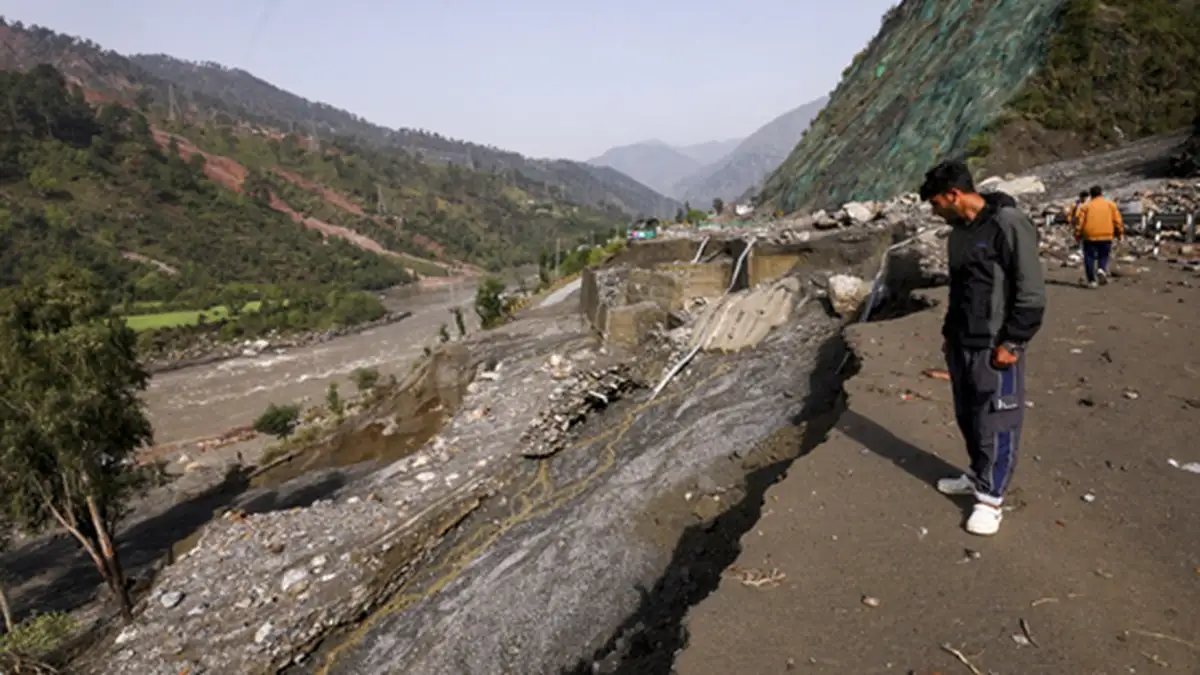
The recent closure of National Highway 44 (NH-44)—the arterial route connecting the Kashmir Valley to the rest of India—has once again exposed the region’s deep vulnerability to natural disruptions. Triggered by landslides and relentless “shooting stones” in mountainous stretches, the highway has been blocked in both directions, halting passenger movement and choking supply chains.
For residents, traders, and especially farmers, this is not just a temporary inconvenience. It is a recurring crisis—one that is now being intensified by climate change.
NH-44 Disruption: A Lifeline Under Siege
Why NH-44 Matters So Much
Stretching through treacherous terrain, NH-44 is the only all-weather road linking the Kashmir Valley with Jammu and the rest of India. Every day, thousands of vehicles—ranging from passenger buses to trucks carrying essential goods—depend on this route.
When it shuts down:
- Essential supplies like food, fuel, and medicines are delayed
- Fruit and vegetable shipments risk spoilage
- Tourism takes an immediate hit
- Emergency travel becomes nearly impossible
The current blockade, caused by landslides in vulnerable zones such as Ramban and Banihal, has once again halted this critical movement.
What Are ‘Shooting Stones’?
Unlike large landslides, “shooting stones” refer to smaller rocks that suddenly fall from unstable slopes. Though individually small, they are deadly and unpredictable, often forcing authorities to suspend traffic entirely for safety.
Officials from the administration confirm that clearance operations are underway, but continuous slope instability is making restoration difficult.
Rain on the Radar: A Forecast That Sparks Fear
As if the situation were not already precarious, the India Meteorological Department (IMD) has issued a forecast warning of fresh rainfall starting April 7.
Why This Matters
Rainfall in mountainous regions like Kashmir is a double-edged sword:
- It loosens already fragile soil layers
- Increases the likelihood of fresh landslides
- Slows down ongoing road clearance operations
- Heightens the risk of flash floods in some areas
For NH-44, this means the possibility of prolonged closure, potentially stretching into days or even weeks if conditions worsen.
Tourism and Logistics on Edge
Tour operators and logistics companies are already bracing for disruption:
- Bookings are being cancelled or postponed
- Travel itineraries are being reworked
- Supply chains are facing uncertainty
For a region heavily dependent on seasonal tourism, even a few days of disruption can translate into significant economic losses.
Apple Farmers in Distress: Climate Change Tightens Its Grip
The Backbone of Kashmir’s Economy
Apple cultivation is not just an agricultural activity in Kashmir—it is an economic pillar. The region produces nearly 75% of India’s apples, supporting lakhs of families directly and indirectly.
But today, that backbone is under strain.
Erratic Weather: The New Normal
Farmers across districts like Shopian, Sopore, and Anantnag are witnessing a troubling trend:
- Untimely rains during flowering season
- Sudden temperature fluctuations affecting fruit setting
- Unexpected snowfall damaging blossoms
- Extended dry spells followed by heavy rainfall
These erratic patterns are increasingly being linked to climate change.
Impact on Yield and Quality
The consequences are severe:
- Reduced fruit size and quality
- Increased disease incidence
- Lower market prices due to inconsistent produce
- Rising input costs for pest and weather management
For farmers, this means shrinking margins and growing uncertainty.
Climate Change in the Himalayas: A Silent Crisis
Scientific studies and ground observations both point to a clear trend: the Himalayan region is warming faster than the global average.
What’s Changing?
- Glaciers are retreating
- Snowfall patterns are shifting
- Rainfall is becoming more intense and erratic
- Soil stability is decreasing
All of these factors contribute directly to both landslides and agricultural stress.
A Vicious Cycle
The situation creates a feedback loop:
- Climate change causes erratic weather
- Erratic weather triggers landslides
- Landslides disrupt transport
- Transport disruption affects agricultural income
- Reduced income limits farmers’ ability to adapt
This cycle is becoming increasingly difficult to break.
Voices from the Ground: Farmers Speak
Farmers across Kashmir are not just worried—they are frustrated.
Many say that traditional knowledge, passed down through generations, is no longer reliable.
“Earlier, we knew when the blossoms would come and when to expect rain. Now, everything is unpredictable,” says a farmer from Shopian.
Others highlight the economic strain:
- Increased cost of fertilizers and pesticides
- Losses due to crop damage
- Delays in transporting produce due to road blockages
The sentiment is clear: adaptation is no longer optional—it is urgent.
Infrastructure vs Nature: A Fragile Balance
The repeated disruption of NH-44 raises an important question: Is current infrastructure resilient enough for changing climatic realities?
Challenges
- Roads built through geologically unstable terrain
- Inadequate slope stabilization measures
- Limited use of modern landslide prediction systems
Possible Solutions
- Advanced slope reinforcement technologies
- Real-time monitoring systems
- Alternative transport routes (including rail expansion)
- Better drainage systems to handle heavy rainfall
Without such measures, disruptions may become more frequent and severe.
Adapting to Change: What Farmers Need
Short-Term Measures
- Weather-based advisory systems
- Crop insurance coverage
- Immediate financial relief during losses
Long-Term Strategies
- Introduction of climate-resilient apple varieties
- Diversification into other crops
- Investment in cold storage and supply chain infrastructure
- Training programs on modern farming techniques
Farmers emphasize that government intervention is crucial—not just reactive, but proactive.
Economic Ripple Effects: Beyond Agriculture
The impact of NH-44 closure is not limited to farmers.
Trade and Commerce
- Delayed shipments increase costs
- Perishable goods face spoilage
- Businesses suffer revenue losses
Daily Life
- Commuters stranded
- Medical emergencies complicated
- Essential goods become scarce in remote areas
Tourism Sector
- Hotel cancellations
- Reduced footfall
- Loss of income for local guides and workers
Key Takeaways
- Closure of National Highway 44 disrupts Kashmir’s connectivity and economy
- Rain forecast by India Meteorological Department raises risk of prolonged blockages
- Apple farmers face increasing climate-related challenges
- Infrastructure needs urgent upgrades to withstand environmental stress
- Adaptive strategies and policy support are critical for long-term resilience
Conclusion: A Region at a Crossroads
Kashmir today stands at the intersection of nature’s unpredictability and human vulnerability.
The blockage of NH-44 is not just a traffic update—it is a stark reminder of how fragile connectivity, livelihoods, and ecosystems have become in the face of climate change.
For apple farmers, the stakes are deeply personal. For policymakers, the challenge is systemic. And for the region as a whole, the path forward demands resilience, innovation, and urgent action.
Because in Kashmir, when the road closes, it’s not just movement that stops—it’s momentum, livelihoods, and hope that hang in the balance.


