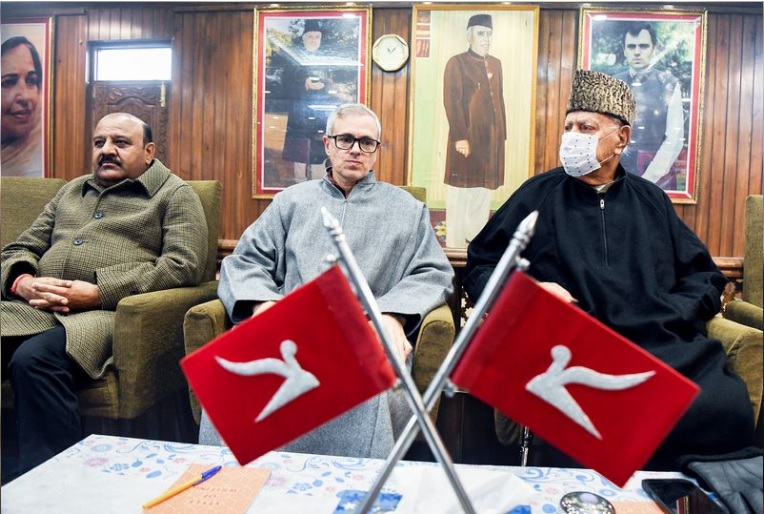
Year Into Power, Special Status Back on NC’s Core Agenda
A Political Turnaround Redrawn
One year since the Omar Abdullah–led Jammu & Kashmir National Conference (NC) formed the government in Jammu and Kashmir, political dynamics are shifting — sharply. What began as a technocratic governance-first approach after 2024 assembly elections is now evolving into a renewed, intense focus on constitutional identity, special status, and statehood.
In late November 2025, the NC’s Working Committee passed a resolution reaffirming its “unwavering commitment” to restore J&K’s special status and demand full statehood.
Why this sudden comeback? A mix of internal pressure, public discontent, and electoral setback have forced the NC to re-anchor itself to its traditional core agenda — but questions linger whether this is mere symbolism or the start of real political momentum.
This feature delves deep into the ground realities: what went wrong in the first year, the backlash, internal fissures, and whether NC can salvage its credibility or risks being dismissed as a party recycling rhetoric.
Ground Realities: Governance Struggles, Public Discontent & Electoral Fallout
01. Dual Power, Diluted Authority: Why Governance Has Struggled
For any party in power, the first year is about delivery — but in J&K’s unique context, that has proven difficult. The NC government has had to operate within a complex administrative ecosystem: elected bodies co-exist alongside central agencies, Union Territory governance structures, and lingering bureaucratic constraints. As critics argue, this “dual administration” continues to dilute the authority of the elected government, making even well-intentioned policies hard to implement effectively.
While the NC has initiated infrastructural projects — roads, tourism plans — locals say progress is slow, patchy, and often delayed. Similarly, investments in education and healthcare have so far fallen short of expectations. Across Kashmir and Jammu, many people express a growing sense that promises remain unfulfilled.
These governance hurdles have sown deeper frustration among citizens, especially those who voted for a change and expected tangible improvement within a year.
02. The Budgam Shock: What the Bypoll Revealed
The 2025 bypoll — especially in Budgam — became a referendum on NC’s first-year performance. Budgam has long been regarded as a near-sacrosanct stronghold of the NC, a bastion of legacy support and entrenched grassroots networks.
Yet, when the votes were counted:
-
The seat went to Peoples Democratic Party (PDP)’s Aga Syed Muntazir Mehdi, with 21,576 votes.
-
NC’s candidate, Aga Syed Mehmood Al‑Mosavi, trailed with 17,098 votes — a margin of 4,478 votes.
Turnout was around 50 percent of the roughly 1.26 lakh electorate.
This result doesn’t merely reflect shifting loyalties — it signals a severe erosion of faith in NC’s ability to deliver. For many Budgam voters, it was a protest: unfulfilled promises, unmet expectations on jobs, power subsidies (200 free electricity units), LPG cylinders, fair reservations — all were part of the narrative during the 2024 elections.
Several local residents told media they felt betrayed. One said, “Omar Abdullah had said during the 2024 campaign that he would retain the seat he wins with a bigger margin. He won from Budgam but betrayed us.”
03. Public Grievances: Education, Jobs, Youth Disillusionment
Beyond electoral politics, frustration has been simmering on multiple fronts:
-
Education & reservation controversies: The new reservation policy and perceived inequities in its enforcement sparked controversies and public backlash. Some critics claim that students are losing opportunities, and that the government’s handling of the issue lacks transparency.
-
Unemployment and lack of economic opportunities: Despite promises during the campaign, youth and job-seekers report little sign of improvement. The slow pace of infrastructure and economic initiatives has further eroded trust. Local grievances suggest that many feel left behind, even as the government announces plans.
-
Healthcare & public services: Increased burden on hospitals — especially during seasonal illness spikes — exposes the region’s unpreparedness. People say state intervention has been limited and response weak.
Taken together, these accumulated frustrations have fed into a growing perception: NC may be in power, but for many ordinary citizens, its rule has not delivered meaningful change.
Politics Within: Dissent, Factionalism, and a Party Under Strain
01. The Return of Special Status — But Is It Credible?
In late November 2025, at a crucial meeting, the NC Working Committee unanimously passed resolutions demanding restoration of J&K’s special status and urging immediate reinstatement of full statehood.
Official statements framed this as reaffirmation of NC’s foundational commitment: “The issue is central to the aspirations and dignity of the people,” the resolution declared.
Party leadership — including Omar Abdullah — described the move as necessary to counter criticism that NC had softened its traditional stance, or worse, started aligning with the ruling national party.
But while the resolution is symbolic and politically significant, sceptics argue: Where is the concrete roadmap? There is no detailed timeline, no legislative blueprint, no guarantee of actual progress — only a statement of intent. The concern among many Kashmir watchers: this could remain rhetoric, rather than result in tangible change.
02. Dissent From Within: Aga Syed Ruhullah Mehdi’s Reproach
Perhaps the biggest sign of internal strain is coming from within NC itself. Ruhullah Mehdi — a senior MP and a prominent face especially among certain Kashmiri constituencies — has openly criticized the party’s leadership for what he calls “political inaction.”
He has reiterated that mere talk of statehood is insufficient: for him, the fight must be for restoration of Article 370, and not just statehood. “To settle for statehood alone,” he said, “is to betray the mandate we received.”
Ruhullah skipped campaigning during the Budgam bypoll — a move many insiders believe contributed to NC’s defeat there.
When tensions became publicly visible, the party disappointed many by not inviting him to the Working Committee meeting — something unprecedented since 2002.
He dismissed speculation of launching a new party. Instead, he insists he remains loyal to the “people’s mandate,” demanding the party return to its ideological roots and honour promises made before 2019.
This internal dissent underlines a critical fault-line: the growing divide between the “governance-first” establishment led by Omar Abdullah, and a faction demanding ideological fidelity and aggressive political action.
03. Political Positioning: Opposition to National Parties, but Also Self-Criticism
With the NC re-emphasizing special status and statehood, its political rhetoric against the Bharatiya Janata Party (BJP) and rivals has sharpened. NC leaders argue the abrogation of Article 370 and conversion of the erstwhile state into a Union Territory weakened J&K’s identity, autonomy, and dignity.
At the same time, the Budgam bypoll loss — coupled with criticism from within — has forced NC into self-introspection. The party seems to realize that governance alone may not suffice; symbolic promises without public trust can backfire as severely as concrete failures.
Thus, the recalibration: partly defensive, partly aspirational. Restore the narrative that won them public support, while signaling a commitment to deliver. Whether this is enough to regain lost ground remains to be seen.
Report Card: Promises vs. Delivery in First Year
| Area | What Was Promised / Expected | What Was Delivered / Reality (as of Year-1) | Gap / Issues |
|---|---|---|---|
| Special Status & Statehood | Restore special constitutional status; regain full statehood for J&K. | Resolution passed by NC Working Committee reaffirming commitment. | No legislative or legal action; lack of concrete roadmap. |
| Article 370 / Autonomy | Reversal of 2019 revocation; restore Article 370. | Politically invoked; rhetorical emphasis renewed. | NC leadership remains cautious; no formal steps. Moderates (incl. Ruhullah) feel side-lined. |
| Infrastructure & Development | Accelerate road, tourism, and development projects. | Some projects initiated. | Delays and slow pace have frustrated beneficiaries. Public sentiment says “little real improvement.” |
| Employment & Public Services | Job creation, youth welfare, improved services. | Minimal visible impact; unemployment remains major grievance. | Citizens report continued joblessness and lack of timely public-service delivery. |
| Education & Reservation | Implement fair reservation and education policies per manifesto. | New reservation policy introduced; student protests and criticism. | Accusations of mismanagement, lack of transparency; alienation among some youth. |
| Healthcare & Social Welfare | Strengthen hospitals, health access, welfare schemes. | Overburdened hospitals during illness peaks; limited government intervention. | Services remain inadequate; public feels left neglected. |
| Political Outreach & Connect | Rebuild grassroots connect; re-engage public trust. | Some mass-contact programmes attempted. | Budgam loss shows limited resonance; public outreach seemed insufficient. |
Overall verdict: On many of its major promises — especially the constitutional and identity-based commitments — NC has only delivered statements, not substance. On welfare, development, and public services, delivery has been patchy, too slow, and often felt inadequate by the masses. The Budgam bypoll result is the clearest indicator of this widening gap.
Why Special Status Is Back: A Strategic, Political and Symbolic Reset
01. Response to Internal & External Pressure
The resurgence of “special status” on NC’s agenda cannot be seen in isolation. It is a direct outcome of:
-
Internal pressure led by voices like Ruhullah Mehdi, who demand ideological fidelity.
-
Public dissatisfaction — people are frustrated with slow delivery and unmet expectations.
-
Electoral setback — the Budgam bypoll served as a harsh wake-up call.
By reviving special-status politics, NC hopes to regain lost ground, recapture public imagination, and reassert its political identity. It also allows the party to reclaim moral high ground over rivals, crafting a narrative of dignity, autonomy, and long-term vision.
02. Countering Accusations of Compromise
In recent months, critics accused NC of softening its stance, aligning too much with central directives, or becoming a “governance-only” party detached from the core aspirations of Kashmiris. The resolution passed by the Working Committee is a clear attempt to push back on those narratives.
By publicly recommitting to special status and statehood, NC aims to re-affirm its foundational identity, reassure long-time supporters, and counter criticism of ideological dilution. It is also a message to younger leaders and critics within the party that traditions and promises still matter.
03. Re-energizing the Base: Politics Beyond Governance
For NC, restoring special status is more than constitutional semantics — it’s about reclaiming its grassroots. In a region where identity, dignity, historical memory, and a sense of betrayal after 2019 still resonate deeply, the narrative of “restore our status, restore our rights” has emotional weight.
This reset is less about immediate governance impact, and more about rekindling hope, rebuilding trust, and re-establishing a bond between the party and the people. Politically, this could position NC as the principal voice for Kashmiri identity — especially as public expectations rise, and as central policies come under intense scrutiny.
Risks & Challenges: Why Rhetoric May Not Be Enough
While the renewed focus on special status offers political opportunity, it also comes laden with risk.
01. Credibility Gap: Words vs. Action
Promises and resolutions — even unanimous ones — do not guarantee action. For many Kashmiris, the difference between speech and delivery has become all too real. The Budgam vote was a stark reminder that angry voters remember unmet promises more than political posturing.
If NC cannot back its rhetoric with concrete steps — legal, constitutional, social — the credibility gap will only widen. And in a region where patience is finite and hope has been eroded, that gap can be fatal to political fortunes.
02. Internal Divisions: Could Dissent Break the Party?
The growing rift between party establishment and dissenting voices like Ruhullah Mehdi is worrisome. His public criticisms, refusal to campaign, and demand for ideological fidelity expose deep fault-lines.
If the leadership continues to marginalize dissenters, NC risks alienating a loyal base — not to mention potential splintering or defections. On the other hand, embracing dissent means opening up hard choices — potentially diluting the “governance-first” strategy or derailing administrative priorities.
Either way, internal cohesion looks increasingly precarious, and a repeat of public dissent (or worse) could destabilize the party from within.
03. Public Expectations vs. Structural Constraints
Even if NC is sincere, the road to restoring special status/statehood is structurally and constitutionally complex. It would involve negotiations with the Centre, possibly Parliament, and navigating legal, constitutional frameworks that have changed post-2019.
Until then, the constant invocation of special status may raise hopes — and also generate frustration if nothing tangible happens. The risk of disillusionment looms large: the same people who felt betrayed in Budgam could feel fooled again.
04. The Opposition’s Growing Confidence — Rebuilding of Rivals
The Budgam bypoll not only exposed NC’s weaknesses — it also signaled resurgence of rivals, particularly Peoples Democratic Party (PDP), which won the seat.
A strong PDP — or any other opposition — could capitalize on NC’s rhetorical shift, especially if it fails to deliver. Competition could intensify, fragmenting the “anti-BJP / pro-autonomy” vote, and complicating the political landscape even further.
What Needs to Be Done: Pathways for NC & J&K’s Future
For the NC — and for J&K — merely returning to the rhetoric of special status isn’t enough. To regain ground, rebuild trust, and deliver on promise, the following steps will matter:
-
Formulate a concrete, legally-grounded roadmap — publicise a phased plan for how, when, and under what conditions special status and statehood will be pursued.
-
Bridge internal divides — meaningfully engage dissenting voices (like Ruhullah Mehdi), incorporate suggestions, and avoid alienation. Internal unity will matter as much as public support.
-
Mixed governance + identity agenda — don’t abandon welfare, development, and public services; deliver visible results in roads, healthcare, education, jobs — while simultaneously pursuing constitutional aims.
-
Transparent public outreach and dialogue — engage with citizens from all regions and communities, understand their grievances, and create feedback mechanisms to restore trust.
-
Strategic political alliances and pragmatic negotiation with the Centre — restoration of status/statehood will ultimately depend on legal and constitutional processes. A careful, inclusive, realistic approach is needed.
Only a balanced strategy — of ideals + delivery — can redeem the current credibility crisis and reinstate public faith in the NC.
Outlook: Can NC Turn Rhetoric into Reality — Or Is It Recycling the Past?
The resurgence of special status and statehood as core agenda is, for now, a strategic recalibration by the NC. It reflects both internal pressure and public demand, and offers a chance to regenerate lost support.
Yet, without concrete action, this reset risks being interpreted by many as a return to politics of slogans — a recycling of old promises at a time when patience among the masses is thin.
In the coming months, political observers will watch closely: Will NC translate the November 2025 resolution into measurable progress? Will internal dissent be addressed constructively, or will it deepen? Will voters — especially in key constituencies like Budgam — be convinced that this time, things will actually change?
For now, the NC stands at a critical juncture: continue as a status-quo government with fading credibility, or re-emerge as the champion of J&K’s identity, rights, and future. The next few chapters in Kashmir’s politics may well be written around this choice.