Vaishno Devi Medical College Admissions Row
By: Javid Amin | 05 December 2025
In early December 2025, the peaceful façade of Jammu and Kashmir’s education landscape was jolted by a simmering controversy that erupted into protests, political volleys, and a deep societal debate. At the centre was the newly-established Shri Mata Vaishno Devi Institute of Medical Excellence (SMVDIME), a medical college backed by donations to a revered shrine. Its first MBBS admission list for the 2025–26 academic year, drawn from the national entrance test (NEET), saw 42 of the 50 seats awarded to Muslim students — mostly from Kashmir — leaving only seven seats for Hindu students and one for a Sikh.
What followed was a rapid escalation: Hindu-right groups demanded that Muslim students be shifted out; a march under the banner of the Shri Mata Vaishno Devi Sangharsh Samiti (SMVSS) brought the matter to the streets. Political leaders weighed in, accusing each other of undermining merit or stoking divisive communal sentiment. In just a few days, the controversy morphed into a broader debate: Should shrine-funded institutions allow admissions purely on merit? Or do they — by virtue of their funding and spiritual linkage — owe preferential representation to believers?
This article unpacks the events, the arguments, the risks, and the broader implications — not just for SMVDIME, but for India’s principles of secularism, equity, and faith in governance.
The Spark: SMVDIME’s Maiden MBBS Batch & How It Unleashed the Storm
What is SMVDIME and how were seats allocated
The SMVDIME is a medical college in Reasi district, affiliated with the Shri Mata Vaishno Devi Shrine Board (SMVDSB), established to provide quality medical education under its auspices. For the 2025–26 academic year, the institute was sanctioned 50 MBBS seats. Admissions were carried out by the Jammu & Kashmir Board of Professional Entrance Examination (JKBOPEE) on the basis of the national common entrance test National Eligibility‑cum‑Entrance Test (NEET).
The resulting selection list showed that 42 students admitted into the first batch were Muslims, mostly from Kashmir; seven were Hindus (from Jammu), and one was a Sikh.
Because SMVDIME has not been granted minority-institution status, officials maintain that there was no scope for religion-based quotas or preferential admissions; merit via NEET was the sole criterion.
The March & Demands: Sangharsh Samiti Goes to the Streets
Who marched, what they demanded, and why
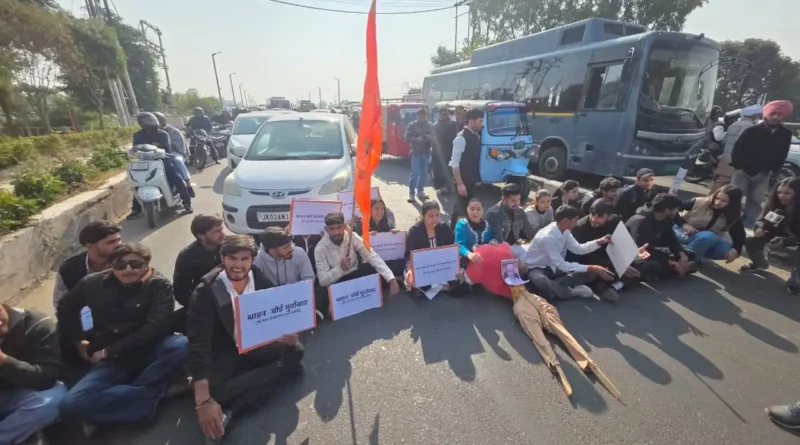
On Friday, December 5, 2025, several Hindu right-wing groups under the umbrella of the SMVSS staged a protest march in Jammu city, demanding that Muslim students admitted to SMVDIME be shifted out. The rally — under slogans against the government and the shrine board — culminated in a “dharna” (sit-in) near Tawi bridge, blocking traffic briefly. Protesters even burnt an effigy of the Union Territory’s Chief Minister as a show of anger.
SMVSS convenor, Col (retd) Sukhvir Mankotia, told reporters the protest was a response to what they called the “failure” of the government and shrine board to heed the sentiments of Hindu donors and devotees. He emphasized that institutions built from temple/shrine donations must “respect Sanatan Dharma” and the religious sentiments of the community.
They demanded that the 2025–26 MBBS selection list be cancelled or reworked, with seats reserved for Hindus. Some even called for the institution to be granted “minority status” for Hindus — to enable religion-based reservation.
Why the anger — beyond just numbers
From the point of view of protestors, the issue isn’t merely that too many Muslims got admitted. The anger hinges on deeper issues:
-
The college is financed by donations from Hindu pilgrims to the shrine; donors expected their money to benefit the Hindu community.
-
The lack of Hindu representation is perceived as betrayal and disregard of cultural/religious ownership of the institution.
-
They view the situation as part of a broader trend: what they claim is “weakening” of Hindu religious institutions through alleged misuse of funds.
In their narrative, this is not just an admission list — it’s about identity, faith, communal pride, and what the shrine-funded college represents.
Political Responses: Condemnation, Defence, and the Wider Fallout
Opposition view: Mehbooba Mufti (PDP) condemns religious quota demand
The demand to allocate seats based on religion instead of merit drew sharp criticism from the president of the Peoples Democratic Party, Mehbooba Mufti. She said that such appeals, if accepted, would damage the social fabric — not just of Jammu & Kashmir but of the entire country. She emphasised that merit must not be sacrificed for religious appeasement.
Mehbooba warned that accommodating religion-based admissions would set a dangerous precedent. “If this begins here, it will spread elsewhere,” she said, underlining that institutions intended for all communities must remain inclusive.
She also recalled that when universities like the shrine-linked Mata Vaishno Devi University and Baba Ghulam Shah University were established, the vision was clear: quality education for all, regardless of community or religion.
Government / Administration stance: Merit-based admissions — no religion lens
On behalf of the government, the Surinder Kumar Choudhary (Deputy Chief Minister) asserted that admissions to SMVDIME were “purely on merit” and should not be viewed through a religious lens. He reminded that the institution does not have minority status, and thus religion-based reservations are not applicable.
Similarly, the Omar Abdullah — Chief Minister of J&K — defended the admission list, saying the university’s founding legislation did not include any provision for religious quotas; admissions must remain secular and merit-based.
Officials from JKBOPEE and SMVDIME also reiterated that admissions followed standard national guidelines (NEET), and there was no scope for shifting admitted students.
Meanwhile, student organisations warned that if religion becomes a factor, it could lead to reciprocal demands at Muslim-run institutions elsewhere — undermining the secular ethos of education nationwide.
The Core Issues: Merit, Religion & the Future of Faith-Linked Institutions
At the heart of this controversy lie fundamental questions about what kind of society India — and particularly Jammu & Kashmir — wants to be. The SMVDIME row exposes a fragile balance between faith, public trust, meritocracy, and communal harmony.
Merit vs Faith-based Allocation
-
Meritocracy: Supporters of merit-based admissions argue that every individual — regardless of religion — should get a fair chance if they qualify. In this case, NEET was the established benchmark. Denying seats based on religion would undermine the principle of merit and open the door to non-academic criteria.
-
Faith-based Preference: On the other hand, groups backing faith-based preference contend that since the college is built and funded by devotees of a Hindu shrine, it should honour their cultural/religious identity by giving preferential access to Hindus.
This tension brings to fore a deep question: should institutions with religious or cultural funding adhere strictly to secular, merit-based norms — or do they inherently carry a communal identity that justifies preferential treatment?
Communal Polarization: Risks to Social Harmony
The demand to evict Muslim students from a medical college — or to reserve seats for Hindus exclusively — is more than an administrative plea; it is a communal assertion.
Allowing such demands to succeed risks legitimizing religion as a criterion for access to education. In a sensitive region like Jammu & Kashmir — already marked by communal sensitivities — such moves can deepen divides, invite backlash, and erode social cohesion. Opposition voices warn that this could create a slippery slope, where every community claims exclusive rights over institutions, fragmenting the idea of shared public spaces.
Governance Credibility & Institutional Trust
The way authorities respond to this controversy — and whether they uphold merit and constitutional principles — will significantly impact public confidence in governance.
-
If admissions are reversed or revised on communal demands, it could signal that political pressure trumps fairness and law.
-
If the protest is suppressed without transparent dialogue, trust among sections of the population may be eroded.
-
Conversely, upholding merit while engaging communities in dialogue — and addressing their larger concerns (e.g. demographic representation, local youth access) — could strengthen institutional credibility.
Broader Implications: What This Means for Education, Secularism & Minority Rights
The SMVDIME controversy doesn’t exist in a vacuum. Its reverberations could influence:
The Future of Shrine- and Faith-Linked Institutions
Many medical colleges, schools, and universities in India are run or funded by religious trusts, shrine boards, or community donations. If religion-based allocations become acceptable, these institutions might be under constant pressure to reserve seats for the community they represent — undermining the principle of open merit-based access. This could set a precedent: once one shrine-based college yields, others may follow — unraveling decades of secular, merit-based education norms.
The Meaning of Minority Status & Secular Governance
The demand to grant minority institution status to SMVDIME — but for Hindus — turns on its head the conventional discourse on minorities. It challenges whether minority-status mechanisms are only for religious or linguistic minorities traditionally underrepresented. Accepting such demands would blur the lines between constitutional safeguards intended for historically marginalized communities, and contemporary majoritarian demands for preferential access.
Student Aspirations & Psychological Impact
For students — admitted or aspiring — such controversies produce uncertainty, fear, and insecurity. A student who has earned a seat on merit might fear eviction or having to transfer. This undermines the sanctity of academic achievement and could discourage students from marginalized or minority communities from seeking admission — out of fear of backlash.
Communal Harmony & Social Trust
At a time when communal tensions in different parts of India have proved how quickly social fabric can unravel, education should serve as a bridge, not as a wedge. Events like these risk deepening divides. They can stoke mistrust and seed suspicion in community relations — not just in Jammu & Kashmir, but across plural India.
Counterarguments & Critical Perspectives
To construct a fair, balanced view, it is important to examine counterarguments — and understand why many see the agitation not just as a demand for representation, but as a political tactic with implications beyond SMVDIME.
Merit Doesn’t Guarantee Community Representation
Critics of the admission list note that while the process was technically merit-based, the outcome — disproportionately favouring one community — raises questions about geographic and social representation. Many argue that admissions processes, while merit-driven, must also ensure that local candidates (e.g. from Jammu, or local Hindu youth) get fair access — especially when the institution is locally funded.
Religious Donations ≠ Community Ownership
Just because a shrine is funded by Hindu devotees does not automatically make a public-facing institution (like a medical college) a private, religion-exclusive domain. Once such institutions are granted government approvals, seats by national entrance tests, and serve a broad population, they enter the public education sphere — and therefore should adhere to secular and non-discriminatory norms.
Dangerous Precedent of Religion-Based Admissions
Accepting religious quota demands risks opening the door to similar claims from every religious or regional group. If this becomes accepted, entrance to public-relevant institutions (colleges, hospitals, universities) could fragment along religious lines — undermining national unity, and the constitutional guarantee of equality before law.
Margin for Communal Exploitation
In a politically volatile region like Jammu & Kashmir, such demands — even if small — can be exploited by parties seeking to polarize communities. The pressure to “give in to faith-based demands” can set off cycles of protests, counter-protests, inter-community distrust, and even violence in worst cases.
The risk is not just about this batch or this college; it’s about a future where access to education becomes a matter of religion, not merit.
Voices from the Ground: What Stakeholders Say
Protesters & Hindu-right Groups:
-
According to SMVSS convenor Col Mankotia, “We do not want neglect of the community in institutions built from donations of Hindus.”
-
Protest slogans have accused the government and the Shrine Board of betrayal, claiming this is a “well-planned strategy to weaken the community and its religious institutions.”
Government & Administration:
-
Deputy CM Choudhary: “Children’s education should not be judged on the scale of religion … selected students are meritorious candidates.”
-
CM Omar Abdullah: Admissions were through NEET, and there was no clause in the founding Act for religion-based preference.
-
JKBOPEE / SMVDIME officials: They stated they cannot unilaterally shift students. The admission process followed national standards.
Student & Civil Society Responses:
Some student organisations noted that if religion becomes the criterion here, similar demands may arise at Muslim-run institutions — potentially fragmenting higher education along communal lines.
Leaders from opposition parties (like Mehbooba Mufti) warned that such moves would erode social fabric and secular ethos.
What Happens Next: Scenarios & Possible Outcomes
Given the intensity of the controversy — and the strong positions on both sides — several possible developments may unfold in coming days/weeks.
-
Status Quo Holds — Admissions Remain as Is:
-
The government sticks to merit-based policy.
-
Protesters may continue to hold demonstrations, but no roll-back occurs.
-
Dialogue may be initiated to address community representation concerns (e.g. more seats next year for local Hindu youth).
-
-
Partial Revision — Institutional Reforms or Quotas Introduced:
-
Authorities may agree to increased transparency, seat-distribution quotas (e.g. local / regional quotas) — though not strictly religious.
-
Minor changes in by-laws or seat-allocation norms to appease local sentiments.
-
-
Full Roll-back or Transfer Demand Succeeds:
-
Under political pressure, the admission list could be cancelled or reworked, or some students asked to transfer out.
-
This would set a precedent for religion-based admissions — with far-reaching implications for similar institutions.
-
-
Legal / Judicial Challenge:
-
Students or civil-society groups could move courts, seeking protection of merit-based admissions and enforcement of constitutional secularism.
-
A legal clarification might be sought on whether shrine-funded institutions can apply religion-based preferences.
-
-
Polarization Escalates — Communal Backlash:
-
If roll-back or preferential treatment is granted, it may provoke anger among affected students/families and communities.
-
Could trigger further protests, communal distrust, or even violence — especially in a tension-prone region.
-
Why This Debate Matters — Beyond SMVDIME
This controversy is not merely about one batch of medical students, or one institution. It is a microcosm of deeper questions facing Indian society today:
-
Can education remain a bridge across communities? If access begins to close based on religion, the very idea of secular, inclusive public institutions erodes.
-
What is the role of religious/trust-based funding in public welfare? Many institutions are financed by religious trusts, but once they serve a public function (hospital, college), should they remain faith-based or transition into secular public-serving bodies?
-
How do we balance donor sentiment with constitutional values? Donors give their offerings — but institutions built with such funds might need to transcend identity boundaries, especially in diverse societies.
-
Will meritocracy survive? If admissions begin to depend on religion, caste, region or donor community rather than ability, long-term quality, equity, and trust in the system are at stake.
-
Finally — what message does it send to future generations? If religion becomes a criteria for education access, it could discourage meritorious candidates from minority or non-favoured communities, undermining social mobility and fueling division.
In a diverse, pluralistic country like India — and especially in a region as sensitive as Jammu & Kashmir — these are not academic questions. They are fundamental to social harmony, national integrity, and future of public institutions.
Bottom-Line: A Crossroads for Jammu & Kashmir’s Educational and Social Future
The SMVDIME admission controversy is more than a local dispute — it is a potential turning point. If authorities yield to religion-based demands, the door to communalization of educational institutions in J&K (and perhaps elsewhere) may be opened. If they firmly uphold merit and constitutional values, they reaffirm faith in equal opportunity and secular governance.
What unfolds will be a test — of political will, social maturity, and the principles enshrined in India’s constitutional framework.
For the students — Muslim, Hindu, Sikh — who earned their seats through hard work and competition, the dust must settle quickly and fairly; for the guarantors of educational equity, the broader precedent must be carefully guarded. For society at large, this is a moment to reaffirm that institutions — especially those meant for public welfare — belong not to a single community, but to all of us.
The world will be watching: will merit, fairness and unity prevail — or will the narrow politics of identity carve up our classrooms and campuses along religious lines?