Private School Power or Public Oversight Failure? A Srinagar Institution Exposes a Disturbing Pattern of Exploitation & Impunity
By: Javid Amin| 06 December 2025
Private education in Jammu & Kashmir stands at a dangerous crossroads. Once viewed as reliable alternatives to underfunded government institutions, many private schools today are accused of operating more like profit-driven enterprises than centres of learning.
Among the most alarming examples is the situation unfolding at a prominent private school in Gogji Bagh, Srinagar, where parents have levelled a long list of serious allegations: unreasonable fee hikes, curriculum manipulation, forced digital learning for toddlers, harassment tactics, and near-complete disregard for government regulations.
What makes this case even more troubling is not just the allegations themselves — but the persistent silence of those meant to regulate these institutions.
Parents now openly ask:
Are some private schools and authorities working hand-in-glove?
Is money influencing silence?
Has the regulatory system become paralysed — or purchased?
This feature investigates the allegations in depth, amplifies parents’ lived experiences, analyses systemic governance collapse, and asks the fundamental question:
When private schools behave like unregulated empires, who protects the child and the parent?
The Long Shadow of Unregulated Private Schools in J&K
Over the past two decades, private schooling has expanded rapidly across J&K. Families hoped for better learning, discipline, and modern teaching approaches.
But alongside this growth, an uncomfortable truth has emerged:
Private schools now hold disproportionate, often unchecked power.
The regulatory ecosystem, instead of evolving with the sector, has stagnated. Today, parents widely recognise the following problems:
-
Delayed or symbolic action by authorities
-
Zero follow-up on complaints
-
Weak enforcement of fee and curriculum guidelines
-
No transparent audits
-
Political-business-institution nexuses
-
Selective accountability
This has produced a climate where institutions feel emboldened, even untouchable — while parents feel helpless, intimidated, or forced into compliance.
The governance vacuum has created an opportunity for exploitation.
A Srinagar Private School as a Case Study in Arbitrary Power
Parents from a well-known private school in Gogji Bagh report that they have been raising concerns for years, and yet, each complaint has gone nowhere.
Their most alarming assertion:
“The school behaves as if no rules apply to them because nobody dares question them.”
The parents allege a systematic pattern of malpractice, not isolated incidents.
Curriculum Violations & Syllabus Manipulation — Learning or Looting?
Parents claim that the school:
-
Does not follow the JKBOSE-prescribed curriculum
-
Pushes an unapproved alternative syllabus
-
Mandates expensive private-publisher books
-
Frequently changes book lists without academic justification
-
Rejects widely available affordable options
These practices have three major implications:
1. Academic Disruption
Students changing schools or streams face curriculum mismatch and learning gaps.
2. Financial Exploitation
Frequent, unnecessary book changes impose heavy annual costs.
3. Possible Commercial Partnerships
In many states, private publishers incentivise schools financially — a practice widely criticised.
Parents openly describe the situation as:
“A syllabus business disguised as education.”
They believe this commercial interest may explain why authorities look away.
Forced LEAD App Curriculum for Toddlers — A Digital Trap?
Parents allege that even 3–5-year-olds are forced into screen-dependent learning under the LEAD curriculum:
-
Mandatory app usage
-
Mobile/tablet exposure for toddlers
-
Reduced human teaching time
-
Daily digital tasks
-
No parental consultation
This violates global early childhood guidelines.
WHO and leading psychologists warn:
Children under 5 must have extremely limited screen time.
Yet the school reportedly prioritises app-based learning, which parents believe is driven by commercial contracts, not pedagogy.
One parent asks:
“Why force a toddler onto an app unless there is a financial partnership behind it?”
Fee-Linked Harassment — Assignments Withheld Until Payments Cleared
One of the most disturbing allegations:
Parents who had not cleared fees till January 2025 were told:
“No winter assignment until you pay.”
This results in:
-
Emotional stress for children
-
Academic disadvantage
-
Pressure tactics on families
-
Fear of victimisation
Legally, no school can withhold academic material over fees.
This is academic blackmail — a term increasingly used by parent associations nationwide.
Unexplained Annual Fees — A Complete Black Box
Parents say they are charged annual fees without:
-
Any breakup
-
Any utilisation report
-
Any audit
-
Any regulatory approval
The explanations given include:
-
“Maintenance”
-
“Administration”
-
“General charges”
Yet no documents are provided.
It becomes, essentially:
A compulsory donation under the guise of fees.
And once again parents ask:
“Who allows this? Who benefits from ignoring it?”
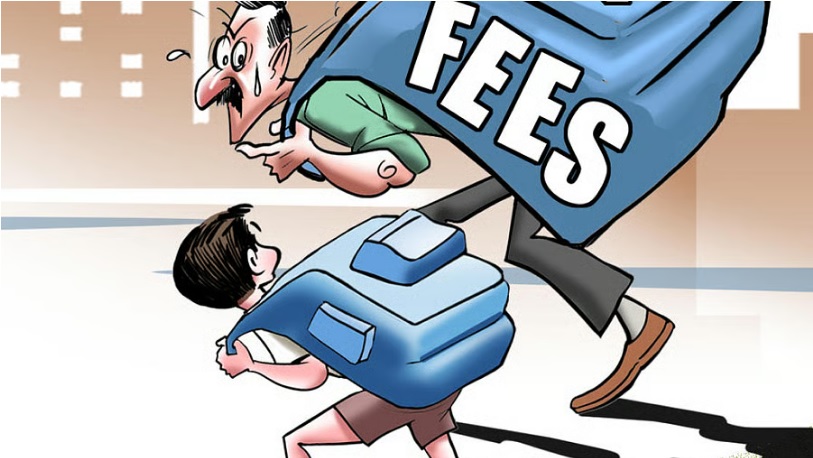
₹250 for a 12-Page Fee Booklet — Extortion in Microform
A 12-page fee booklet allegedly costs ₹250.
A booklet that could be replaced by simple receipts.
This small example reveals a larger reality:
When lack of regulation becomes a habit, exploitation becomes a business model.
Parents say:
“If they tax us for booklets, diaries, belts and bags — imagine what happens in bigger areas like curriculum and annual fee.”
Sudden 15% Tuition Fee Hike — No Notice, No Transparency
Parents allege the school increased tuition fees by 15%:
-
Without prior notice
-
Without justification
-
Without approval from fee committees
-
Without sharing expenditure data
This directly violates fee-regulation norms.
Parents say they were told:
“The fee is increased. You must pay.”
This raises the core question:
When schools violate laws boldly, does that mean authorities are looking away — or looking the other way for a reason?
Are Authorities Silent Because They Are “Hand-in-Glove”?
Parents have submitted multiple complaints over the years.
They say:
-
No inquiry
-
No audit
-
No inspection
-
No accountability
-
No written response
This has led to a growing suspicion:
Is the silence of authorities merely inefficiency — or complicity?
Are private schools influencing, pressuring, or financially incentivising decision-makers?
Why does every complaint disappear into a void?
Parents now openly use phrases like:
-
“Bought authority”
-
“Private school mafia”
-
“Systemic silence”
-
“Financial understanding”
While these allegations require investigation, the absence of action fuels the belief that:
Something is deeply wrong inside the regulatory system.
Psychological Toll on Parents & Children
Children experience:
-
Anxiety
-
Fear of academic exclusion
-
Stress due to fee-linked punishments
-
Negative school association
Parents experience:
-
Financial pressure
-
Emotional exhaustion
-
Constant fear of victimisation
-
Powerlessness in the face of institutional arrogance
Education becomes a trauma instead of a journey.
What Parents Want — Reasonable, Legal, Necessary
Parents demand:
-
Immediate inspection of the school
-
Enforcement of JKBOSE curriculum
-
Ban on forced private-publisher books
-
Transparent fee structures
-
Strict limits on screen-based learning for toddlers
-
No assignment withholding
-
Reversal of the unjustified fee hike
-
Accountability for repeated violations
They are not demanding favours.
They are demanding basic rights.
What This Case Reveals About J&K’s Education System
The situation reflects a much larger crisis:
-
Curriculum manipulation
-
Commercial tie-ups
-
Device dependency
-
Arbitrary fee structures
-
Weak regulation
-
Parent harassment
-
Zero accountability
Unless meaningful action is taken, private schooling may transform into an unregulated industry, not an educational system.
What Authorities MUST Do Now
To restore trust, authorities must:
-
Conduct urgent inspections
-
Audit fee structures
-
Mandate JKBOSE curriculum compliance
-
Regulate digital-learning partnerships
-
Penalise exploitative practices
-
Form a parent grievance redressal commission
-
Enforce annual caps on fee hikes
-
Introduce transparent audit systems
Anything less will deepen public mistrust.
Conclusion — Education Cannot Become a Market of Fear
Parents across Srinagar and J&K are raising a very clear alarm:
“If private schools become unchecked empires, who will protect our children?”
This crisis is no longer about one school.
It is about a governance structure that appears uninterested, incapable — or compromised.
The question now stands before the administration:
Will they act — or will silence continue to shield exploitation?
Are schools too powerful, or is oversight too weak — or too influenced?
The people of J&K await an answer.