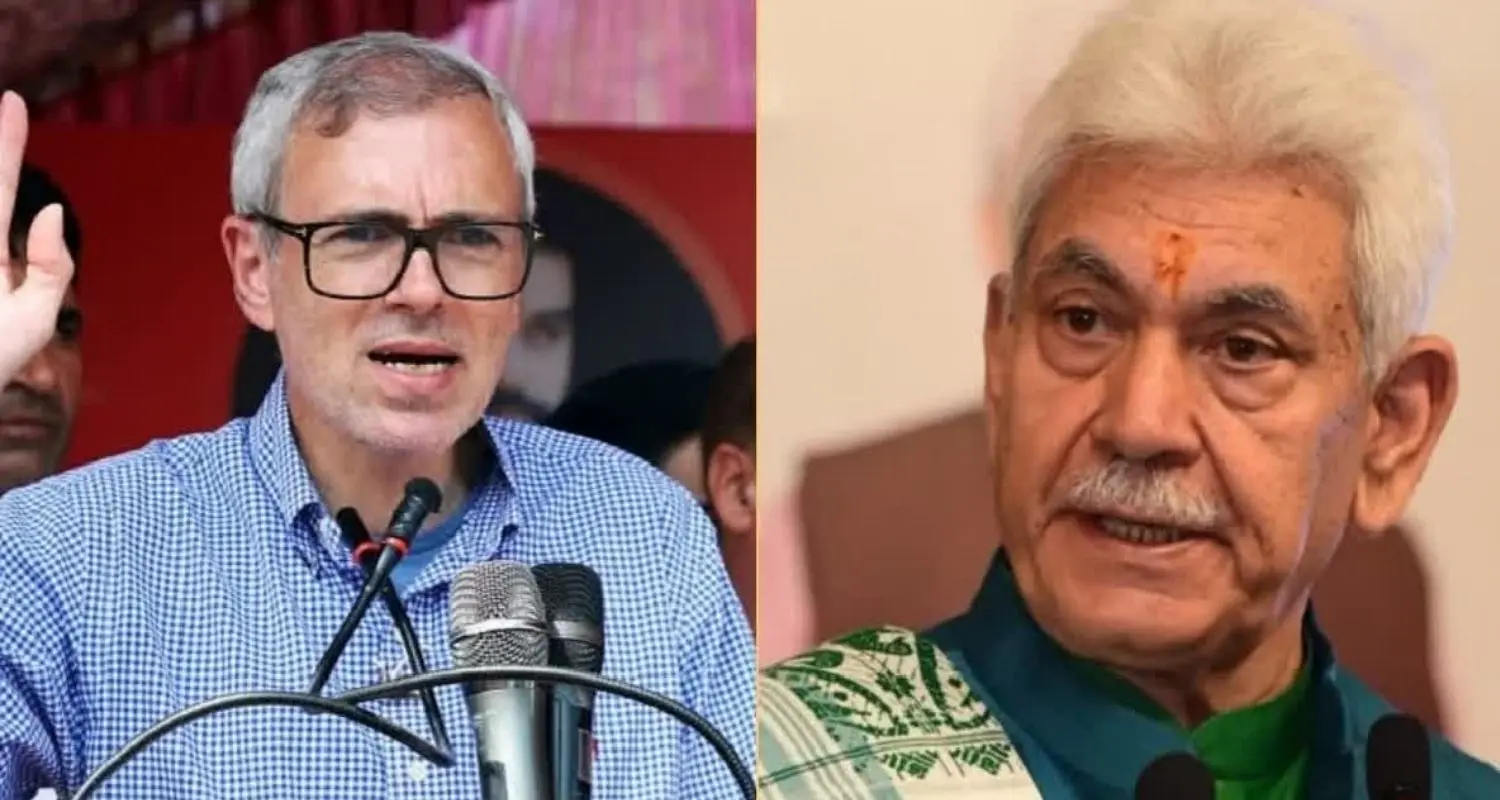
Exam or Election-Year Battle?
By: Javid Amin | 06 December 2025
As thousands of hopefuls across Jammu & Kashmir prepared to take the Combined Competitive Examination (CCE) on December 7, 2025, they found themselves caught not in the familiar stress of exam-day jitters, but in the crossfire of a bitter political confrontation. At stake: their eligibility, fairness of process, and the credibility of institutions meant to select civil servants on merit.
In a dramatic turn, the offices of Lt Governor Manoj Sinha and Chief Minister Omar Abdullah traded charges, while aspirants faced uncertainty, travel chaos, and anxiety. With the exam date looming, the Jammu & Kashmir Public Service Commission (JKPSC) declared that the CCE would be held as scheduled — leaving many to wonder: is this steadfast adherence to process or a callous dismissal of fairness and students’ plight?
This mega-feature unpacks the entire episode — how it unfolded, why it matters, what’s being argued, and what it means for governance and civil service recruitment in Jammu & Kashmir.
What Sparked the Crisis: Age Relaxation Demand Meets Flight Disruptions
Age Limit Debate: From 32 to 37 — Long-standing Demand
Candidates appearing for the JKAS/CCE had been demanding that the upper age limit for eligibility be relaxed — from 32 years to 37 years. According to media reports, this relaxation had reportedly been extended in the past four years.
Many argued that in a region beset by years of upheaval, intermittent shutdowns, and lost opportunities, rigid age caps were unfair, especially when aspirants may have lost time to prepare. Some also said that age-relaxation would bring J&K’s civil-service eligibility norms in parity with national-level exams.
The File Ping-Pong: Who Is Actually Responsible for Delay?
According to the J&K government (led by Chief Minister Omar Abdullah), a complete file seeking age relaxation was forwarded to the Raj Bhavan (Lok Bhavan, office of LG) for approval well before the exam date.
But the Lt Governor’s office responded with a sharp rebuttal: they received the file on December 2, and returned it the same day — the delay thereafter being the result of no response from the government. They argued that at such a late stage, changing eligibility criteria and accommodating age relaxation would be logistically unmanageable.
Thus began a public blame-game between the two ‘power centres’ — the elected government and the Raj Bhavan.
Aspirants’ Plight: Travel Chaos Adds to Confusion
To compound matters, many aspirants — especially those who live outside Jammu & Kashmir — were already facing severe travel disruptions due to widespread flight cancellations in recent days. Reports noted large-scale airline cancellations that left many stranded in Delhi, Bengaluru, Mumbai, Hyderabad and other cities, unable to reach their exam centres.
Protests broke out: some candidates began a small hunger strike, complaining of being “abandoned and disappointed” as the authorities remained silent.
In short: candidates faced a triple whammy — uncertainty over age eligibility, lack of clarity on postponement, and logistical hassles to travel and appear for the exam.
The Flashpoint Date: December 6–7 — When All Hell Broke Loose
The Chief Minister’s Plea: Postpone CCE in Interest of Aspirants
On December 6, just a day before the exam, Chief Minister Omar Abdullah sent a letter to the JKPSC Chairman (Arun Kumar Choudhary), requesting postponement of the CCE. In the letter, he cited “widespread travel chaos due to ongoing airline issues,” compounded by the “uncertainty resulting from Lok Bhavan’s delay in approving age relaxation” which — according to him — had “placed unprecedented mental and logistical stress on competing candidates.” He urged the Commission to defer the exam for a “reasonable duration,” invoking the principles of fairness, equity and equal opportunity for all aspirants.
Around the same time, the CM’s office and his advisors publicly reiterated that the exam should be deferred until the age-relaxation decision was finalised.
The LG’s Response: File Returned Promptly; Social Media Claims Misleading
In a strong rebuttal, the office of Lt Governor Manoj Sinha took to social media (X) and issued a statement calling various media and social-media posts “misleading.” The statement clarified that the Raj Bhavan had received the file on December 2 and returned it the same day, with only a logistical query about the feasibility of changing eligibility norms so close to the exam date. It emphasized that there was no communication on exam postponement or cancellation, and that the delay thereafter was because the government did not respond.
Officials argued that tasks like printing and distributing admit cards, assigning exam centres, logistics etc., had already been set into motion — making last minute changes impractical.
JKPSC’s Decision: Exam Goes On — Status Quo Holds
By Saturday evening (December 6), the JKPSC — through its Chairperson Arun Kumar Choudhary — announced that the Combined Competitive Examination (CCE) would proceed as scheduled on Sunday, December 7.
No further comment was offered on the age-relaxation request. The commission signalled that, in absence of final government orders, it cannot revise eligibility criteria or defer exams at the last minute.
Reactions from the Political Sphere, Aspirants & Civil-Society
Opposition Parties and Student Bodies Decry Decision
The decision to proceed with the exam sparked strong criticism from various quarters. Senior leaders from opposition parties and civil-society organisations described the move as unfair, particularly to over-aged aspirants and those stranded due to travel chaos.
Student associations and youth-wing leaders demanded immediate intervention by the government to postpone the exam. They warned that conducting the CCE under such “uncertainty and disadvantage” would unfairly penalize many aspirants.
Some political leaders urged both the Lt Governor and Chief Minister to intervene and restore calm, insisting that aspirants deserve clarity and fairness before being forced to sit for a high-stakes exam.
Criticism from the Lt Governor & Supporters of Process
Supporters of the Raj Bhavan’s decision argued that frequent last-minute changes to eligibility norms undermine the sanctity and logistical feasibility of large-scale competitive exams. They contended that allowing age relaxation just days before the exam — without clearly polling all stakeholders and logistical readiness — could lead to administrative chaos, inconsistency, and potential legal challenges.
They also insisted that such files should have been moved much earlier; raising them just days before exam date smacks of political opportunism rather than genuine concern for aspirants.
Key Issues at Stake — Beyond Just an Exam Date
The dispute over JKPSC CCE 2025 is more than an isolated administrative disagreement. It reflects deeper structural and constitutional questions about governance, fairness, and institutional credibility in a delicate region like Jammu & Kashmir.
1. Fairness to Aspirants: Merit vs. Eligibility Uncertainty
For aspirants — many of whom have prepared for years — the last-minute uncertainty over age limits, travel disruptions, and sudden calls for postponement create enormous stress. The risk: deserving candidates might be forced to skip the exam; or those eligible under older rules may be unfairly penalized if age relaxation is implemented late or retroactively.
One student’s protest and hunger-strike outside the JKPSC premises is symbolic of the broader anxiety: thousands may be compelled to gamble on their future without clear guidelines.
2. Governance Crisis — Dual Power Centres and Institutional Friction
The episode illustrates the profound structural challenge of dual power centres — one led by the elected government (Chief Minister) and another by the appointed Lt Governor. The public spat between them underlines how administrative control, approvals and governance in Jammu & Kashmir often get entangled in overlapping jurisdictions.
When critical decisions — like age-relaxation for civil-service aspirants — get tied in such institutional wrangles, what suffers most is transparency, consistency, and public trust.
3. Institutional Autonomy vs Political Pressure
The JKPSC’s decision to proceed reflects its institutional autonomy — and arguably its commitment to process and administrative schedule. But it also exposes a tension: should a public-service commission bow to last-minute political or social pressure in equity interest — even if it risks logistical chaos?
This tension runs deep: in volatile contexts like J&K, such institutions need to balance equitable access with operational feasibility — a tightrope walk that may invite criticism whichever way they choose.
4. Equity, Justice and Age-Bar Norms for Conflict-Hit Regions
The demand for age relaxation is not merely administrative; for many aspirants, it reflects lost years — due to political instability, lockdowns, curfews, limited mobility, economic constraints — which disproportionately affect Jammu & Kashmir compared to stable regions.
Rigid upper-age limits may unintentionally penalize those who had limited access to coaching, mobility, or study resources — especially when national norms (for other civil-service exams) offer higher age limits.
This raises a broader question: should normalised age criteria apply uniformly in conflict-hit or disturbed regions — or should provisions be made to accommodate exceptional circumstances?
What This Means for Aspirants — and For Jammu & Kashmir’s Future
Immediate Fallout for Candidates
-
Stranded and Unsettled: Many candidates remain stranded outside J&K due to flight cancellations; without clarity on admission/admit cards, they face huge uncertainty on whether to travel or not.
-
Potential Exclusion: Over-age aspirants — those above 32 — risk being excluded, unless age-relaxation is cleared; or may have to gamble with their eligibility.
-
Stress & Distraction: The political fight, public statements, and social-media drama have added immense psychological burden on aspirants — not ideal just before a high-stakes exam.
Long-Term Implications for Governance & Civil Services
-
Precedent for Future Exams: If authorities yield to last-minute political pressure in future, it could set a precedent where age limits, eligibility criteria or scheduling become negotiable — undermining stability of recruitment systems.
-
Erosion of Public Trust: Frequent blame games between different power centres — without clarity — may erode public faith in institutional fairness, especially among youth.
-
Need to Re-evaluate Norms for J&K: The controversy strengthens the argument for a long-term review of civil-service eligibility norms in J&K — perhaps with special provisions, age-grace or alternate qualification pathways, recognising its peculiar history and socio-economic realities.
What Happens Next — Possible Scenarios & Challenges Ahead
Given the tensions and uncertainties, several possible trajectories could unfold in the coming days:
-
CCE Proceeds, As Announced — No Age Relaxation or Postponement
-
JKPSC conducts the exam on December 7 as planned.
-
Over-aged aspirants remain excluded; travel-stranded students may miss exam.
-
Legal or political challenges may follow — alleging unfairness or arbitrary decision-making.
-
-
Last-Minute Government Order / Quasi-Relaxation After Exam — Controversial Fix
-
The government may attempt to retrospectively allow age relaxation or convert some seats for over-aged aspirants — risking accusations of bias or arbitrariness.
-
Could trigger legal petitions or court challenges.
-
-
Institutional Reforms for Future — Age-Relaxation Policy Revised
-
If political pressure is strong, J&K government may formalise relaxed upper age norms for future cycles, with clear rules and timelines.
-
That could ease aspirant anxiety, but may also prompt calls from other groups for comparable relaxations.
-
-
Judicial Intervention or Oversight Demand by Aspirant Organisations
-
Civil-society groups or aspirants may approach courts seeking mandate for transparent eligibility norms, age-relaxation clarity, and fair scheduling.
-
Critical Analysis: What Does This Fight Reveal About J&K’s Structural Flaws?
This controversy is not just about one exam — it lays bare deeper institutional and systemic faultlines in Jammu & Kashmir’s governance framework.
Dual Power Centres — Big Problem
When a significant decision — such as age-relaxation for thousands of civil-service aspirants — hinges on the interplay between elected government and the Raj Bhavan, it introduces risk, confusion, and uncertainty. In fast-changing, conflict-prone regions, this model undermines stability.
Lack of Advance Planning & Policy Clarity
Despite repeated calls for age relaxation and long-standing demand from aspirants, the government appears to have moved the file only days before the exam — a classic case of administrative procrastination. Good governance demands earlier action, transparency and predictable timelines.
Institutional Autonomy Under Stress
JKPSC’s insistence on proceeding shows institutional resolve — but also reveals the cost of autonomy in a politicised environment. When aspirants’ futures are at stake, such decisions can be perceived as insensitive, even if technically correct.
Need for Special Norms in Jammu & Kashmir
Given the region’s history of disruptions — conflict, curfews, lockdowns, restricted mobility — age and eligibility criteria designed for stable regions may not be fair. Without tailored policies, many aspirants (who may have lost years) remain penalised.
Conclusion: A Flashpoint for Trust, Governance — and Aspirants’ Futures
The standoff over JKPSC’s CCE 2025 is much more than a bureaucratic dispute. It reflects tensions between political authority and administrative autonomy; between fairness to individual aspirants and logistical feasibility; between equal opportunity and rigid eligibility norms.
For many young men and women preparing for civil-service posts in J&K, the December 7 exam is not just about a job — it represents stability, aspiration, and long-awaited opportunity. To thrust them into uncertainty right before the exam smacks of institutional callousness.
Yet at the same time, last-minute changes to rules — especially when thousands of applications, admit cards, centres and logistics are already in motion — can easily lead to confusion, mismanagement, and even legal mess.
In that sense, JKPSC’s decision to proceed is understandable — but perhaps lacks compassion. The powers that be could still choose a middle path: commit to future reforms, formalise relaxed age norms for upcoming cycles, and provide a grace period or alternate chance for aspirants caught in this mix.
Because in a region like Jammu & Kashmir — torn by decades of conflict, uncertainty and upheaval — the dream of civil service is not just a job; it’s hope, stability, recognition. And every aspirant deserves clarity, dignity and fairness — not to be caught in the crossfire of power politics.


