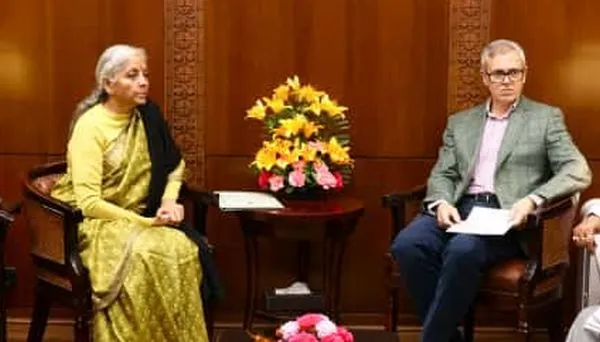
‘Show Me the Money, Ma’am; — When Praise Meets Pragmatic Politics in J&K
By: Javid Amin | 06 December 2025
How Omar Abdullah turned a compliment from Nirmala Sitharaman into a call for real resources
A Quip That Echoes a Demand
At the 2025 edition of the Hindustan Times Leadership Summit (HTLS), what began as a gracious compliment from the Union Finance Minister ended up exposing a raw, unresolved truth about J&K’s economic reality. When Finance Minister Nirmala Sitharaman acknowledged Jammu & Kashmir Government’s efforts under CM Omar Abdullah to revive the region’s battered economy, Omar’s response — “Please show me the money, ma’am” — elicited laughter. Yet, beneath the humour lay a serious demand, a public pressure point, and a tacit rebuke: praise alone won’t rebuild an economy in distress.
This article dives deep into what that line really signifies — the state of J&K’s economy, the political tightrope between elected UT government and Centre, and the structural challenges that still loom large.
The Context: Why the Compliment, and Why the Quip
Finance Minister’s Nod to “Focused” Revival
During her address at HTLS 2025, Sitharaman highlighted that the economy of the Union Territory (UT) had begun to recover under Central oversight, especially with concerted efforts to revive financial institutions and examine the region’s economic challenges in “granular detail.” She pointed out the rehabilitation of J-K Bank as a key milestone.
She also alluded to the sharp blow inflicted on J&K’s resurgence by external events — hinting at border tensions and security shocks. According to her, these jolts severely disrupted J&K’s tourism, one of the region’s most critical economic pillars. The reference to the April 22 Pahalgam attack underscored how fragile the recovery remained.
In recognition of J&K’s efforts under the Abdullah government — frequent high-level meetings with the Centre, policy pushes, and attempts at financial stabilisation — Sitharaman expressed appreciation for the “focused” and “determined” approach to revive local economy.
The Quip: Witty, But Also a Demand
When the applause subsided, Omar Abdullah accepted the compliment. Then, with a wry smile, he delivered what many saw as the real message — “Now, the next part — ma’am, please show me the money, because that’s in extremely short supply.”
Far from being mere levity, the statement underscored a harsh reality: administrative efforts and political goodwill can only go so far because actual development and reforms hinge on funding. Public infrastructure, economic revival, social welfare — all require capital flows, not just assurances.
He added that even though he may draw criticism for openly crediting the Centre, he stands by his decision to work with it. His phrasing was telling: “Good, bad, ugly… I have never shied away from taking responsibility for what I have done.”
He also clarified that a cooperative working relationship with the Centre does not imply any political alliance with the ruling party at the Centre, as his party remains politically distinct from them.
What Lies Beneath the Exchange: The Economics of J&K
A Mixed Record: Recovery Signs Amid Stubborn Challenges
Earlier this year, when Omar Abdullah presented the first full-fledged budget since the revocation of the old constitutional status of J&K, the UT government projected ambition. The budget — over ₹1.12 lakh crore for 2025–26 — included infrastructure development, welfare measures for disadvantaged groups, and schemes aimed at restoring normalcy and growth.
Further, as per the Economic Survey report tabled in 2025, J&K’s economy was estimated at around ₹2.65 lakh crore, with projections of 7.06% growth in 2024-25, even while factoring in national and regional headwinds.
For the fiscal 2023-24, J&K’s unemployment rate — according to the report — came down to 6.1% from 6.7% in 2019-20. Non-tax revenues, especially from power tariffs and related utilities, have increased. The survey also showed establishment of over 40,000 self-employment units, giving jobs to over 1.16 lakh people.
These numbers suggest that policy interventions — from promotion of small enterprises to fiscal discipline — have borne some result; the economy is not static, and there are grounds for cautious optimism.
But the Cracks Are Deep
Still, the overall per-capita income remains below the national average (J&K: ~₹1,54,703 vs all-India per capita income ~₹2,00,162 in 2024-25 estimate) as per the survey.
More worrisome: much of the revenue growth stems from taxes (vehicles, power) and non-tax sources — but the industrial base remains weak, and traditional drivers like tourism and small-scale industry are fragile.
And that is where the problem lies: many of these revenue sources — tourism, public investments, infrastructure development — require sustained capital infusion. Without substantial, continuous funding, reforms risk stalling; welfare schemes may run out of steam; promises may remain just that.
The Political Undercurrent: Centre-UT Relations and Autonomy
Governance Balance: Cooperation Without Co-option
Omar Abdullah’s quip reflects a delicate balancing act: he wants to project J&K as a functioning polity — collaborating with the Centre where needed, but retaining political independence. He emphasised that working with the Centre does not equal political alignment with the ruling party at the Centre.
In doing so, he acknowledges a practical truth: when it comes to financial muscle, the UT depends heavily on central support. But publicly asking for funds — especially in a high-profile summit — signals assertiveness. It also puts the spotlight on whether “praise” will translate into actual resources.
Risks & Rewards: Credibility, Political Standing, Public Perception
On one hand, such bluntness can earn political credibility. Citizens, especially in conflict-affected regions like J&K, often see rhetoric but not delivery. By demanding funds publicly, Omar may be reinforcing his commitment to deliver — not just talk.
On the other hand, openly acknowledging dependence on central funds can trigger criticism. Some constituents may view such dependence as compromising autonomy. Others may question why the local economy remains reliant on Centre despite years of “development efforts.”
In his remarks, Omar accepted this risk — stating that he is ready to “own the consequences” of his approach.
The Real Stakes: Why Funding Matters for J&K
Tourism: A Fragile Pillar
Tourism has long been central to J&K’s economy — providing livelihoods, generating revenue, and injecting cash into local markets. But repeated security incidents, including the April 22 Pahalgam attack referenced by Sitharaman, have damaged confidence.
Reviving tourism isn’t just about marketing or slogans — it requires infrastructure, security assurances, restoration of heritage sites, transport connectivity, hospitality investments, and sustained promotional efforts. Without money, tourism revival will remain aspirational.
Banking, Enterprise, and Local Industry
The cited “restoration” of J-K Bank is not merely symbolic. A functioning, stable bank is vital for credit flows — for entrepreneurs, small businesses, and local industries.
Similarly, efforts to generate non-tax revenue — power tariffs, water charges, vehicle taxes, GST — reflect a move toward fiscal self-reliance. But for real transformation, the region needs industries, investments, and capital-intensive sectors; that again demands funds: investment capital, infrastructure, incentives, and long-term planning.
Welfare, Infrastructure, Education — The Social Contract
J&K’s 2025-26 budget included welfare measures — support for women, pensioners, public transport, social schemes.
But social welfare and infrastructure — roads, public transport, electricity, water supply, rural development — cost money. Without central or external funding, or robust local revenue growth, these promises may remain on paper. Omar’s request is, in effect, a reminder that governance demands resources.
What the Demand Signals for the Centre — and the Audience
-
A Test of Centre’s Commitment: The public request makes it politically difficult for the Centre to merely offer rhetorical support. If the Union Government fails to deliver funds, the gap between words and action may erode trust — both in Delhi and in Srinagar/Jammu.
-
Transparency, Accountability, and Delivery Pressure: By raising the issue publicly, Omar increases pressure on all stakeholders to ensure funds are not merely sanctioned — but properly utilized. Citizens, civil society, media — all will watch.
-
Model for Other Regions: J&K is not the only region where central funds and UT/Centre dynamics matter. How this scenario plays out might influence how other Union Territories or financially weak states negotiate for support, autonomy, and collaboration.
-
Political Repercussions: Within J&K, opposition parties, voters, stakeholders may weigh in — either applauding realism or criticising dependence. National parties will watch how this affects broader federal dynamics.
Why “Symbolism vs Substance” is Not Just a Cliché Here
Public praise is easy. Speeches, accolades, media soundbites — they are inexpensive. What costs money are infrastructure projects, stimulus packages, welfare schemes, industry promotion, tourism revival.
Omar’s remark captured that essence — an open acknowledgement that until resources follow the rhetoric, economic revival remains fragile, incomplete, unstable.
In many ways, the quip “show me the money” is an insistence on grounding optimism with realism — a call not for political points, but for hard fiscal muscle.
What Needs to Follow: A Roadmap for J&K’s Economic Revival
To translate the momentum at HTLS into tangible gains for J&K, the following steps are critical:
-
Dedicated Central Assistance & Development Funds: Clear allocations to rebuild infrastructure — roads, connectivity, power, health, education — daisy-chained with accountability.
-
Support for Tourism Revival: Security, marketing, infrastructure upgrades, incentives for hospitality, heritage conservation — all requiring financial backing.
-
Credit and Banking Support: Strengthening J-K Bank, enabling credit flow to MSMEs, startups, local entrepreneurs — to diversify economic activity beyond government schemes.
-
Encouragement of Local Enterprise and Industry: Policy incentives, land allocation, subsidy — to attract businesses that can generate jobs beyond the public sector or tourism.
-
Transparent Utilisation and Monitoring Mechanisms: Given history of resource mismanagement in troubled regions, financial inflows must come with transparency, audits, and citizen oversight.
-
Balanced Federal–UT Relations: An understanding of political autonomy while accepting fiscal realities. Constructive collaboration, not coercive control.
Political and Public Perception — What Omar’s Remark Means for People
For many citizens of J&K — especially those who have seen decades of instability, false promises, and delayed development — the line resonated. It was a public acknowledgement of their frustration: of hearing about “revival” and “support,” only to find potholes, shuttered shops, sparse employment, patchy infrastructure.
For urban and rural youth seeking jobs, for entrepreneurs waiting for loans, for communities waiting for roads and hospitals — the quip signalled that their demands are being voiced at the highest levels, not casually brushed aside.
At the same time, it raised expectations. If funds arrive and delivery happens — this moment could become a turning point. If not — it might deepen cynicism.
The Bigger Picture: What This Means for India’s Federalism, Union Territories, and Governance
This exchange at HTLS 2025 between the Finance Minister and the J&K Chief Minister reflects a broader tension inherent in India’s federal structure — especially in territories such as J&K:
-
Dependence vs Autonomy: UTs and smaller states often need central support — but that dependence can erode local autonomy, or appear to. A public demand creates a new dynamic: equality-seeking rather than subservience.
-
Governance vs Politics: Development often gets overshadowed by politics (security, territorial, identity). But economic revival demands long-term governance, not short-term political wins. Publicly calling for money is politics; delivering through resources is governance.
-
Accountability & Demand-Driven Funding: When funds are tied to clear demands — infrastructure, welfare, revival — it becomes harder to justify misallocation. It shifts the focus from grants given to grants used.
Conclusion: The Money Is the Measure — Not the Praise
At a glitzy business-politics summit, amid roundtables and flashbulbs, what happened was simple — a compliment, a quip, and then a sharp, serious message.
“Please show me the money, ma’am.”
That line — delivered with poise and a half-smile — carried more weight than hours of speeches. It was not just a joke. It was a public demand for accountability, for resources, and for real progress.
For J&K, for its people, for its future: that quip is a warning, a demand, and perhaps the beginning of a turning point — only if the money follows the words.


