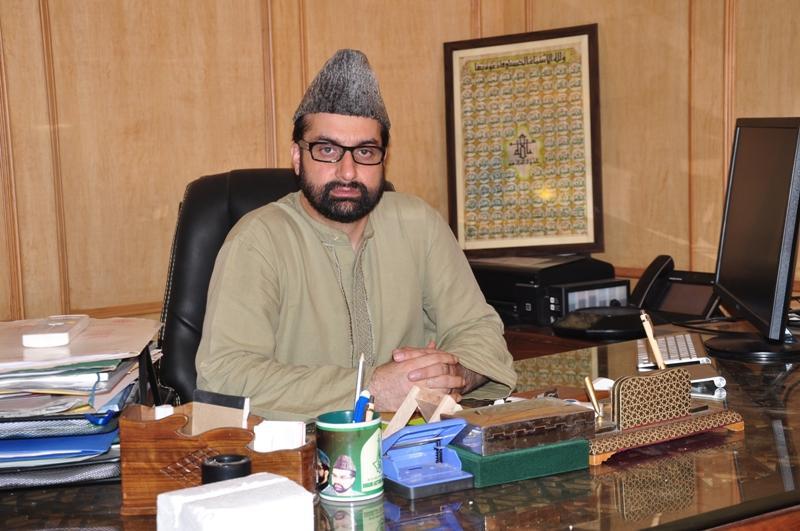
Mirwaiz Umar Farooq Drops Hurriyat Title on X, Signalling the Quiet End of an Era in Kashmir’s Separatist Politics
By: Javid Amin | Srinagar | December 25, 2025
Mirwaiz Umar Farooq, Kashmir’s chief cleric and a prominent face of moderate separatist politics, has quietly removed the designation “Chairman, All Parties Hurriyat Conference” from his verified X (formerly Twitter) profile. His bio now lists only his name and location, a subtle but significant change that has reignited debate over the relevance and future of the Hurriyat Conference.
The update, noticed on December 25, 2025, comes at a time when separatist politics in Jammu and Kashmir has been steadily losing institutional space, public traction, and organisational capacity.
A Once-Powerful Platform Reduced to Symbolism
Formed in 1993, the All Parties Hurriyat Conference (APHC) functioned for decades as the principal umbrella organisation representing separatist groups in Kashmir. At its peak, Hurriyat coordinated mass protests, shutdown calls, and international outreach, positioning itself as an alternative political authority in the Valley.
However, its influence has steadily eroded over the years due to:
-
Deep internal factionalism between moderate and hardline groups
-
Bans and legal action against constituent organisations
-
Financial probes and arrests
-
The post-2019 political and security restructuring of Jammu and Kashmir
Since the abrogation of Article 370 in August 2019, Hurriyat has effectively ceased to function as an organised political body.
Mirwaiz’s Diminished Political Space
Mirwaiz Umar Farooq, who headed the moderate faction of the Hurriyat, has himself faced sustained restrictions over the past several years. His organisation, the Awami Action Committee (AAC), has been banned under anti-terror laws, significantly curtailing his formal political activity.
While Mirwaiz continues to command religious authority as the chief cleric of Kashmir and delivers sermons at Srinagar’s Jamia Masjid when permitted, his ability to operate as a political mobiliser has been sharply limited.
Notably, Mirwaiz has not issued any public explanation for removing the Hurriyat title from his social media profile.
Why the Profile Change Matters
Though administrative in appearance, the removal of the Hurriyat designation carries strong symbolic weight.
1. Acknowledgment of Hurriyat’s Decline
By dropping the title, Mirwaiz appears to be recognising a political reality: Hurriyat no longer functions as an effective or unified platform capable of collective action.
2. Distancing Without Disowning
The move does not amount to a resignation or ideological shift, but suggests a careful distancing from a defunct institutional structure rather than separatist thought itself.
3. Public and International Signalling
With over 200,000 followers, Mirwaiz’s X profile is closely watched locally and internationally. The change subtly alters how he is perceived—more as a religious figure than an active separatist leader.
Broader Context: Separatist Politics in Retreat
Mirwaiz’s profile update comes amid a broader contraction of separatist politics in Kashmir:
-
Most Hurriyat leaders remain inactive, detained, or legally constrained
-
No coordinated separatist calls or programmes have emerged in recent years
-
Public political engagement has shifted toward mainstream or issue-based platforms
In this landscape, titles that once carried street authority now hold largely historical value.
Silence That Speaks
The absence of a statement from Mirwaiz is itself telling. Rather than publicly declaring the end of Hurriyat or issuing a political repositioning, the change reflects quiet adaptation—a recognition of transformed ground realities without formal pronouncements.
For many observers, the act underscores a larger truth: Hurriyat’s decline did not end with an announcement; it faded through silence, restrictions, and irrelevance.
TimeLine | Hurriyat Conference: Rise and Decline (1993–2025)
1993
All Parties Hurriyat Conference (APHC) formed as an umbrella of separatist groups to provide political leadership to Kashmir’s separatist movement.
Late 1990s–2000s
Hurriyat emerges as a powerful platform, coordinating protests, shutdowns, and international outreach. Internal ideological differences between moderate and hardline factions begin to surface.
2003–2004
Formal split within Hurriyat into moderate and hardline factions, weakening collective leadership.
2010–2016
Hurriyat retains symbolic influence during periods of unrest but loses organisational cohesion and public credibility.
August 2019
Abrogation of Article 370; most Hurriyat leaders, including Mirwaiz Umar Farooq, placed under detention or house arrest. Hurriyat effectively ceases organisational activity.
2020–2023
Several Hurriyat constituents banned under UAPA; financial probes and legal action further cripple the platform.
2024
Hurriyat exists largely as a symbolic entity with no visible political mobilisation.
December 25, 2025
Mirwaiz Umar Farooq removes “Chairman, Hurriyat Conference” from his X profile, marking a symbolic acknowledgement of the group’s diminished role.
Bottom-Line: A Chapter Closes Quietly
Mirwaiz Umar Farooq’s decision to remove the “Hurriyat Chairman” tag does not signal a sudden ideological shift. Instead, it marks a symbolic closure of an era in Kashmir’s separatist politics—one where organisational titles no longer reflect operational power.
Whether this step leads to a redefined public role for Mirwaiz or remains a purely symbolic adjustment remains to be seen. What is clear, however, is that the Hurriyat Conference today exists more as a historical reference than a living political force.


