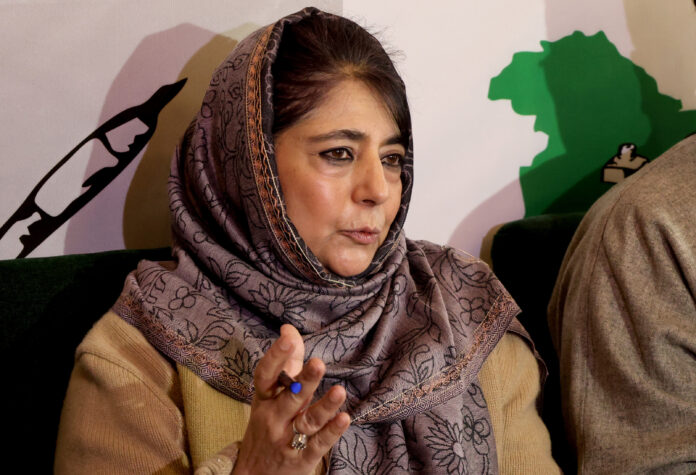
‘Send a Ministerial Team for Their Safety’: Mehbooba Mufti Urges CM to Protect Kashmiris Working Outside J&K
By: Javid Amin | 26 December 2025
A Growing Fear Beyond Borders
In recent months, Kashmiris working outside Jammu & Kashmir—particularly in northern Indian states—have increasingly voiced concerns regarding harassment, targeted assaults, and social hostility. Many of these Kashmiris are shawl sellers, small traders, seasonal workers, and traveling artisans, who leave the Valley each year to earn a livelihood in distant towns and hill states.
Against this backdrop, Peoples Democratic Party (PDP) president and former Chief Minister Mehbooba Mufti has issued a pointed and emotionally-charged appeal to the current Chief Minister of Jammu & Kashmir. She has urged the government to send a dedicated ministerial team to states like Uttarakhand, Himachal Pradesh, and Haryana—regions where a large number of Kashmiri workers live and travel for trade—to ensure their safety, monitor conditions on the ground, and build coordination with local authorities.
Her call reflects not merely political positioning, but a deepening social anxiety among Kashmiri families whose loved ones travel hundreds of kilometres away from home in search of work, often in unfamiliar and increasingly polarized environments.
Mehbooba’s Central Appeal: From Sympathy to State-Level Action
Mehbooba Mufti’s stand is clear and unambiguous: expressions of sympathy or social media statements are no longer enough. What is needed now, she argues, is visible, governmental presence and responsibility.
She emphasized that many Kashmiris working outside the Union Territory—particularly shawl sellers and small-scale traders—have been subjected to rising incidents of harassment, intimidation, and even mob-style violence in certain areas. These workers, often modest in means and with limited local support networks, remain exposed and vulnerable.
Her proposal is specific:
-
The J&K Chief Minister should dispatch a ministerial delegation
-
The team should travel to Uttarakhand, Himachal Pradesh, and Haryana
-
They should meet local administrations and police authorities
-
They must assess threats and offer reassurance to Kashmiri residents
This approach, Mehbooba argues, would signal that Kashmiris are not alone—and that their home government stands behind them.
Why These States Matter: A Trade & Migration Reality
While Kashmiris are present across India, Uttarakhand, Himachal Pradesh, and Haryana hold particular importance.
Seasonal Economy
Each winter, thousands of Kashmiris travel to hill towns and plains to sell:
-
woollen shawls
-
carpets
-
handicrafts
-
dry fruits
-
garments
These journeys sustain entire households back home.
Local Mobility & Exposure
These traders:
-
move door-to-door
-
travel late hours
-
carry inventory and cash
-
stay in rented lodges or shared rooms
This makes them highly visible—and sometimes easy targets.
The Incident That Sparked Renewed Attention
Mehbooba cited a recent assault case where a Kashmiri trader was reportedly attacked. She intervened directly on social media, even tagging the Uttarakhand Director General of Police, urging swift action.
Following her appeal, local authorities reportedly arrested an accused—demonstrating that institutional response is possible when attention is focused.
To Mehbooba, this incident reinforced one point:
Institutions respond faster when Kashmiris are backed by political voice and administrative engagement.
Silence vs Outrage: Her Criticism of Double Standards
In a sharp critique, Mehbooba Mufti contrasted the **public outrage in India over violent incidents abroad—such as those in Bangladesh—**with what she views as comparatively muted reactions to lynching-style attacks within India itself.
Her message was not rhetorical bravado. It was a moral argument:
-
If violence against minorities abroad deserves condemnation,
-
Then silence toward minority harassment at home becomes indefensible.
This framing adds ethical weight to her political appeal, placing the issue in the broader debate about pluralism, equal citizenship, and national conscience.
Comparison of Perspectives — A Policy Snapshot
| Position | Details | Implication |
|---|---|---|
| Mehbooba Mufti (PDP President) | Urges CM to send ministerial team to sensitive states | Push for proactive government intervention |
| J&K Government | Yet to announce structured measures | Faces mounting pressure to act |
| Local Administrations in Other States | Expected to coordinate with J&K officials | Must ensure law-and-order protection |
| Kashmiri Workers & Traders | Currently feel exposed and vulnerable | Seek reassurance and security guarantees |
Human Stories Behind the Anxiety
Behind every political statement lie thousands of personal stories:
-
A shawl seller traveling village-to-village in the Himalayan foothills
-
A young trader supporting elderly parents in the Valley
-
Workers far from home during peak winter
For many, the highlight of the year is returning home safely with savings.
Fear—whether justified or perceived—changes everything:
-
Business routes
-
Travel habits
-
Living arrangements
-
Mental health
Some are now considering not leaving Kashmir at all, risking livelihood collapse.
Political Sensitivity and Inter-State Dynamics
This issue sits at the crossroads of:
-
Law & Order
-
Minority Protection
-
Federal-State Coordination
-
Identity Politics
Sending a ministerial team would be unusual but not unprecedented. It would:
-
Symbolize government-to-government cooperation
-
Reduce political mistrust
-
Provide a formal communication channel
However, it also requires delicate handling so that:
-
local states do not perceive it as interference
-
rhetoric does not inflame tensions
Risks & Challenges
Political Risk
The matter could easily be politicized by rival parties, impacting both perception and response dynamics.
Community Risk
Kashmiri traders remain directly exposed on the ground.
Administrative Risk
Coordination across states is complex and time-sensitive.
Social Risk
If incidents continue, mistrust widens—on both sides.
What This Means for Kashmiris Working Outside
Mehbooba’s demand gives voice to silent anxiety.
-
It recognizes economic migration as a reality
-
It asserts that state responsibility travels with its citizens
-
It pressures the administration to move from statements to field-level engagement
For many Kashmiris, such steps would offer reassurance and psychological safety, even if incidents remain statistically limited.
Government Pressure: Why Timing Matters
The demand arrives at a moment when:
-
public discourse on intolerance is rising
-
social media amplifies every incident
-
migration-based employment is crucial for thousands
The **Chief Minister’s response—or lack of it—**will be closely observed by:
-
civil society
-
political parties
-
affected families
-
national observers
Broader Context: Kashmir’s Economic & Social Reality
With limited private sector employment at home, many Kashmiris rely on:
-
winter trade
-
inter-state retail
-
handicraft exports
Thus, economic survival is tied to physical safety beyond J&K’s borders.
Any atmosphere of fear:
-
depresses income
-
restricts movement
-
weakens family stability
This transforms a law-and-order issue into an economic development concern.
A Call for Dignity and Citizenship
At its core, Mehbooba’s appeal is about equal citizenship.
Her case is simple:
A Kashmiri trader on the road should feel as safe as any Indian citizen.
This message—delivered firmly but calmly—places responsibility on institutions rather than communities, preventing the narrative from turning divisive.
Policy Recommendations Emerging from the Debate
-
Inter-State Coordination Cells
-
Helpline Support for Traveling Workers
-
Awareness Campaigns to Counter Stereotypes
-
Police-Level Liaison Officers
-
Regular Monitoring Reports
Such mechanisms would institutionalize minority protection across regions.
Conclusion: A Test of Leadership and Compassion
Mehbooba Mufti’s demand is not simply political theatre.
It is a litmus test of governmental responsibility toward citizens who:
-
travel far
-
work hard
-
contribute to India’s social fabric
The question now before the J&K administration is straightforward:
Will concern translate into coordinated, on-ground protection?
For thousands of Kashmiri workers and their families back home, the answer matters not in theory—but in life, livelihood, and dignity.


