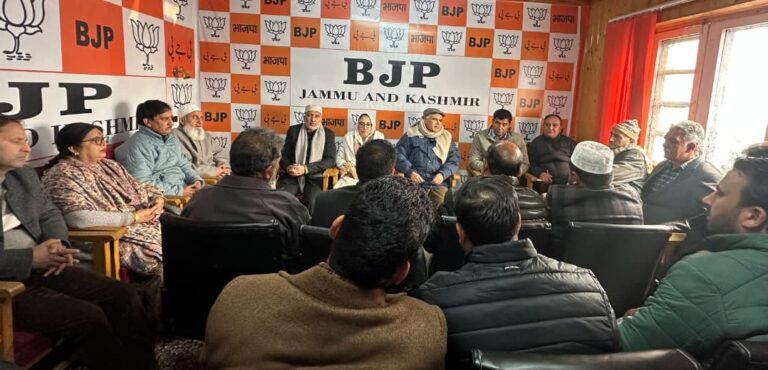
Ashok Koul Rejects Jammu–Kashmir Split: Unity, Development, and the Politics of Balance
By: Javid Amin | 08 January 2026
At a time when debates over regional identity and representation are once again surfacing in Jammu and Kashmir, BJP’s Jammu & Kashmir General Secretary (Organization) Ashok Koul has firmly rejected any proposal to divide the Union Territory. His statement, stressing unity over bifurcation, signals the Bharatiya Janata Party’s intent to hold the line against regional fragmentation while simultaneously addressing concerns of imbalance and neglect.
Koul’s remarks come amid renewed calls from sections in Jammu demanding separate statehood, citing perceived political and administrative marginalisation. On the other side, political parties in the Kashmir Valley have warned that such demands risk deepening communal and regional fault lines. Against this backdrop, the BJP leadership’s insistence on a united Jammu and Kashmir reveals both strategic calculation and ideological positioning.
“No Split, Only Unity”: Koul’s Core Message
Ashok Koul’s intervention was unambiguous. He dismissed proposals to bifurcate Jammu and Kashmir, reiterating that the BJP stands for the territorial integrity and unity of the region.
According to Koul, fragmenting Jammu and Kashmir into separate political units would not resolve grievances but would instead institutionalise divisions that have historically weakened governance and social cohesion. His tone combined firmness with reassurance, signalling that unity does not mean ignoring regional concerns.
In doing so, Koul sought to project the BJP as a stabilising force — one that acknowledges regional aspirations but rejects structural solutions that could deepen political fault lines.
Development as the Unifying Argument
A central pillar of Koul’s statement was developmental equity. He argued that the BJP’s primary focus remains balanced growth across Jammu, Kashmir, and Ladakh, ensuring that no region feels sidelined.
This emphasis reflects the BJP’s post-2019 political messaging, where development has been framed as the alternative to identity-based politics. Roads, infrastructure, healthcare, and employment generation are projected as tools to heal long-standing regional grievances.
However, critics argue that development alone cannot substitute for political representation and administrative autonomy — a concern that continues to animate Jammu-based statehood demands.
Why the Split Demand Is Resurfacing in Jammu
The renewed calls for separate statehood for Jammu stem from a combination of historical and contemporary grievances:
-
Perceptions of political under-representation
-
Allegations of administrative bias
-
Concerns that post-2019 governance structures centralise decision-making
For many pro-split voices in Jammu, the issue is not opposition to Kashmir per se, but a belief that regional interests are better protected through distinct political arrangements.
These demands have gained periodic momentum whenever political transitions occur, particularly after the reorganisation of the former state into Union Territories.
Valley Parties Push Back: Fear of Communalisation
Political parties and civil society voices in the Kashmir Valley have reacted with caution — and in some cases alarm — to renewed bifurcation debates. For them, calls to split Jammu and Kashmir risk:
-
Communalising governance
-
Reducing complex political issues into identity binaries
-
Undermining fragile social cohesion
Valley-based leaders argue that governance failures should be addressed through reforms and accountability, not territorial reconfiguration. They view unity as essential to preventing further political fragmentation in an already volatile region.
BJP’s National Narrative and Post-Article 370 Politics
Koul’s rejection of bifurcation aligns closely with the BJP’s national narrative following the abrogation of Article 370 in August 2019. Since then, the party has consistently emphasised:
-
Stronger integration with the Indian Union
-
Uniform governance structures
-
Reduced regional exceptionalism
From this perspective, endorsing a split within Jammu and Kashmir could appear contradictory to the party’s broader ideological project of consolidation and integration.
By backing unity while promising equitable development, the BJP aims to balance regional discontent without reopening debates that could complicate its national positioning.
Perspectives at a Glance
| Stakeholder | Position | Tone |
|---|---|---|
| Ashok Koul (BJP) | Rejects bifurcation, supports united J&K | Assertive, conciliatory |
| Jammu pro-split groups | Demand separate statehood | Regionalist, critical |
| Valley parties | Warn against communal and regional division | Alarmed, defensive |
The Political Tightrope for the BJP
Koul’s remarks underline the BJP’s tightrope walk in Jammu and Kashmir:
-
Appeasing Jammu’s regional aspirations
-
Reassuring the Valley against fragmentation
-
Maintaining coherence with its national integration agenda
This balancing act is particularly delicate in a Union Territory where electoral politics remain in flux and traditional political alignments have weakened.
Any misstep — perceived neglect of Jammu or disregard for Valley sensitivities — risks alienating key constituencies.
Why This Moment Matters
The significance of Ashok Koul’s statement lies not just in what it rejects, but in what it reveals:
-
Regional aspirations remain unresolved
-
Political integration is still contested on the ground
-
Development and identity continue to intersect uneasily
As Jammu and Kashmir moves toward an uncertain political future, debates over unity versus autonomy are likely to intensify — especially as electoral processes and statehood discussions re-enter the public sphere.
Conclusion: Unity as Policy, Debate as Reality
Ashok Koul’s firm rejection of a Jammu–Kashmir split underscores the BJP’s commitment to unity as both policy and principle. Yet, the persistence of statehood demands in Jammu and anxieties in the Valley suggests that unity alone, without meaningful political dialogue, may not fully address regional discontent.
The challenge ahead lies in translating the rhetoric of development and integration into governance outcomes that resonate across regions. Until then, the debate over unity versus division will remain a defining fault line in Jammu and Kashmir’s evolving political landscape.

