BJP Wants to Widen Divide Between Jammu, Kashmir, Mehbooba Mufti Says Amid Vaishno Devi Medical College Controversy
By: Javid Amin | 12 January 2026
A Political Firebrand’s Charge
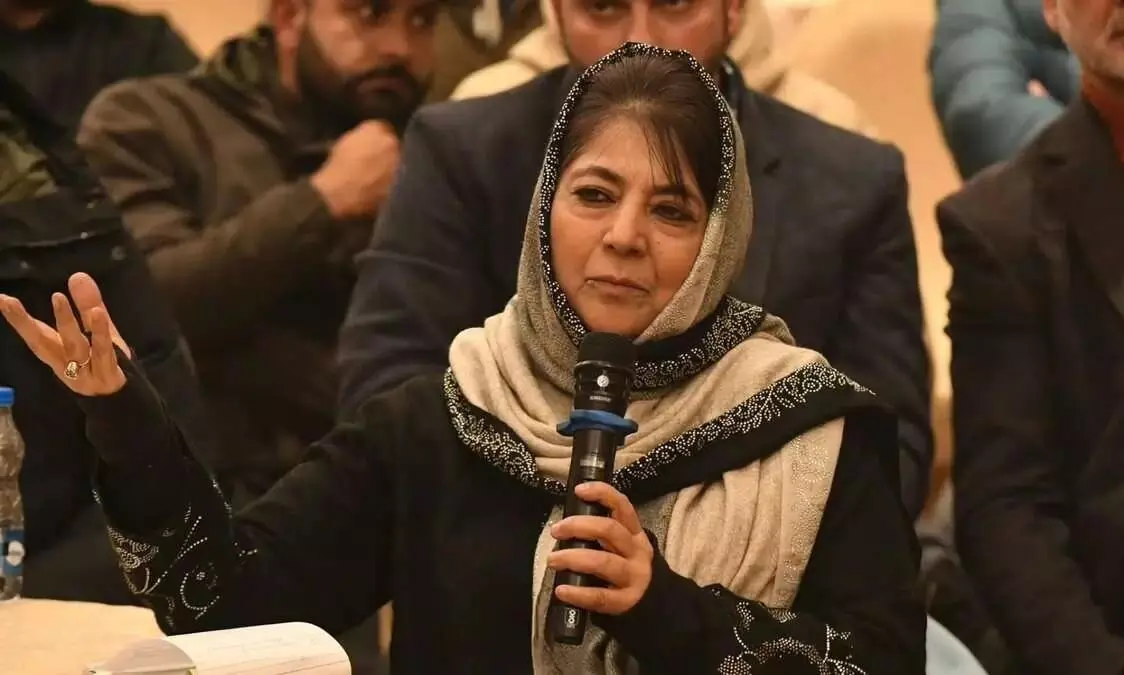
In the politically charged atmosphere of Jammu and Kashmir, People’s Democratic Party (PDP) president Mehbooba Mufti has leveled a forceful allegation against the Bharatiya Janata Party (BJP), claiming that it is deliberately trying to widen the divide between Jammu and Kashmir by pursuing divisive communal narratives and policies.
Mufti’s critique is centered on the recent Vaishno Devi Medical College controversy, but her accusations extend to what she perceives as a broader agenda of communal polarisation and regional marginalisation. She contends that these strategies threaten the secular fabric of the region and undermine unity between its diverse communities.
What Mehbooba Mufti Has Said
BJP’s “Laboratory of Division” Argument
Mehbooba Mufti has described Kashmir as the BJP’s “laboratory” to test divisive socio-political strategies, suggesting that what happens in her home region might later be exported elsewhere in India. She argues that the BJP’s approach in Jammu & Kashmir — particularly over contentious issues such as the Vaishno Devi medical college admissions — reflects a deliberate effort to pit one community or region against another.
According to Mufti, these tactics are not accidental but structured to create distrust and estrangement between Kashmiris (especially Muslims) and communities in the Jammu region.
Her remarks resonate with wider criticism from opposition leaders in the region that the Centre’s policies post-2019 have reshaped political landscapes in ways that undermine traditional secular and pluralistic balances.
On the Medical College Controversy
The spark for Mufti’s fury is the dispute over the Shri Mata Vaishno Devi Institute of Medical Excellence (SMVDIME) in Reasi, Jammu — a newly established medical college that recently had its MBBS course approval revoked by the National Medical Commission (NMC) after a row over admissions.
Initially, a majority of admitted MBBS students — 42 out of 50 — were Muslims, based on merit under the NEET system. This triggered protests from several Hindu organisations, backed politically by the BJP and allied groups, alleging that the institute — funded by donations to the Vaishno Devi Shrine Board — should prioritise admissions to Hindus or seek minority institution status.
Mufti has labelled the agitation and subsequent regulatory fallout as not merely administrative but communal in tone and impact, asserting that such pressures are meant to marginalise Kashmiri Muslim students and portray Jammu as antagonistic toward Kashmir. This, she cautions, risks deepening the divide between regions.
Her voice aligns with concerns from several Kashmiri leaders who see the controversy as more than an academic dispute — instead viewing it as a politically engineered fault line that could widen inter-regional mistrust.
On Communal Polarisation and Politics
Mufti’s critique goes beyond the medical college incident. She accuses the BJP and its ideological affiliates — including organisations such as the RSS and Bajrang Dal — of leveraging regional grievances and identity politics to consolidate support in Jammu, often at the expense of Kashmir’s Muslim majority.
According to her statements, the BJP’s strategy involves nurturing narratives that depict Kashmiri Muslims as separate or threatening to predominantly Hindu Jammu’s interests — a tactic she believes is designed to shift the political landscape in favour of the BJP’s broader ideological goals.
While not all political observers accept this framing wholesale, there is no denying that the controversy has taken on religious and regional tones, far beyond its academic origins.
Criticism of Opposition Politics Within J&K
Mufti has also taken aim at the National Conference (NC), accusing it of fearfulness when it comes to discussing key issues such as Article 370 and broader autonomy debates. She suggests that NC’s reluctance effectively assists the BJP’s agenda by failing to robustly counter polarising policies.
The Vaishno Devi Medical College Row: Core Facts
To understand the political context of Mehbooba Mufti’s accusations, it is essential to examine the medical college controversy — a flashpoint that crystallised regional and communal tensions.
Admissions and Backlash
-
The SMVDIME, located in Reasi (near Katra), began its first MBBS admissions for the 2025-26 academic year under approval from the National Medical Commission (NMC).
-
The list of selected students showed 42 Muslim students, one Sikh, and seven Hindus — all selected based on NEET merit.
-
This led to protests from Hindu groups and calls from BJP legislators demanding review or cancellation of the admission list.
-
Protesters argued the college, built on land owned by the Shri Mata Vaishno Devi Shrine Board and funded through devotee contributions, should prioritise students aligned with the religious ethos.
Officials and regulators emphasised that the admissions were entirely merit-based and compliant with national norms, and pointed out that the institution does not have minority status that would allow religion-based quotas.
Regulatory Reversal and Fallout
In early January 2026, the NMC revoked the MBBS programme approval, citing non-compliance with minimum standards and structural deficiencies — though critics note the withdrawal came amid intense political pressure.
Government officials, security agencies, and political leaders are currently navigating the fallout, as the move affects students enrolled in the first batch and raises fears about educational opportunities and trust in institutional fairness.
Political Implications of Mehbooba’s Accusations
Regional Sentiments and Alienation
Mehbooba Mufti’s narrative of a deliberate Jammu-Kashmir divide is tapping into longstanding regional sensitivities:
-
Kashmiris often perceive policy debates to be shaped by external political agendas after the abrogation of Article 370 in 2019, which significantly altered the region’s constitutional status.
-
Rising communal undercurrents — whether in education, public policy, or social discourse — feed into perceptions of marginalisation among certain communities.
Mufti’s charges, therefore, resonate with those who feel the post-2019 political reality has shifted against the secular and plural character historically associated with Jammu & Kashmir.
BJP’s Position and Signalling
While the BJP has welcomed the NMC action — framing it as a commitment to quality education — party leaders have also backed protests over perceived imbalances and advocated for reforms to local institutional practices.
Importantly, the party has not formally declared a policy to institutionalise regional divides, and this ambiguity allows for political framing by opponents who argue that ground politics is being shaped indirectly by ideology.
Opposition Unity and Vulnerabilities
Mehbooba’s critique of the National Conference points to another trend: political fragmentation among J&K’s regional parties. Her charges suggest that opposition parties are not only divided against the Centre but also competing among themselves for credibility and relevance in addressing communal and regional concerns.
Risks and Broader Challenges
Risk of Deepened Communal Polarisation
The medical college row and the accompanying rhetoric risk deepening socio-religious divides:
-
Communities may feel targeted or sidelined based on religion or region, igniting further protests or political agitation.
-
Students and families affected by the institutional closure face uncertainty, which can fuel frustration and mistrust.
Vulnerability of Regional Unity
Mufti’s warnings about a widened regional divide underscore the fragility of Jammu & Kashmir’s social cohesion. Political narratives that emphasise differences rather than common interests may lead to enduring mistrust between regions, complicating governance and unity.
Impact on Future Political Alignments
Persistent accusations from regional leaders like Mehbooba Mufti contribute to shifting political alignments. They may:
-
Undermine confidence in mainstream parties perceived as ineffective in resisting polarising influences,
-
Empower fringe voices advocating stronger identity-based politics, and
-
Influence electoral narratives in upcoming elections.
Conclusion: A Critical Moment in J&K Politics
Mehbooba Mufti’s accusation that the BJP wants to widen the divide between Jammu and Kashmir encapsulates deep political anxieties in the region — where identity, education, governance, and communal relations intersect.
While interpretations vary, the Vaishno Devi Medical College controversy has undeniably become a focal point for debates about merit, community, and regional equity. Whether this episode evolves into lasting political change or temporary discord will depend on how leaders address root grievances and restore confidence in democratic and administrative processes.