Demand for New Administrative Division Rekindles Fault Lines in Jammu & Kashmir
By: Javid Amin | 21 January 2026
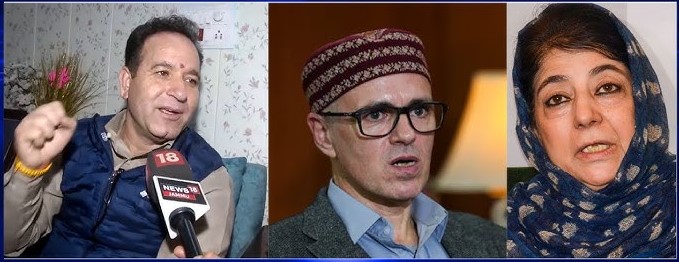
Mehbooba Mufti’s Pir Panjal–Chenab Valley proposal sparks rare convergence of opposition from NC and BJP, reopening old debates on governance, identity, and regional balance
An Administrative Proposal That Turned Politically Explosive
In Jammu & Kashmir, administrative ideas rarely remain administrative. Geography, demography, history, and identity are so deeply intertwined that even proposals framed around governance efficiency quickly acquire political and communal overtones.
That reality was once again underlined after People’s Democratic Party (PDP) president and former Chief Minister Mehbooba Mufti demanded the creation of a new administrative division for the Pir Panjal and Chenab Valley regions—a move that immediately drew sharp opposition from both the National Conference (NC) and the Bharatiya Janata Party (BJP).
What makes the controversy particularly striking is that NC and BJP—otherwise bitter political rivals—found themselves united in rejecting Mehbooba Mufti’s proposal, though for very different reasons. The episode has reopened old wounds about regional neglect, communal suspicion, and the future political architecture of Jammu & Kashmir.
What Mehbooba Mufti Proposed: The Case for a New Division
At the heart of the debate lies Mehbooba Mufti’s demand for a separate administrative division encompassing Pir Panjal and Chenab Valley, two mountainous sub-regions within the Jammu province.
1. Geography and Remoteness
Mufti argued that the regions:
-
Are geographically isolated
-
Have difficult terrain and fragile ecology
-
Remain cut off during winters and extreme weather
According to her, administrative decisions taken from distant divisional headquarters fail to account for the ground realities of high-altitude districts.
2. Development and Access to Services
She cited:
-
Long travel distances to access courts, hospitals, and government offices
-
Poor connectivity and infrastructure gaps
-
Administrative neglect compared to Jammu plains and the Kashmir Valley
Her argument framed the new division as a tool for decentralisation, not political fragmentation.
3. “Absolutely Genuine Demand”
Mehbooba Mufti stressed that the proposal was:
-
Non-communal
-
Non-separatist
-
Entirely focused on equitable governance
She described it as a long-pending grassroots demand from residents who feel sandwiched between Jammu and Kashmir without adequate representation.
Which Areas Are Involved? Understanding Pir Panjal and Chenab Valley
The proposed division would broadly cover five districts in Jammu province, including:
-
Rajouri
-
Poonch
-
Doda
-
Kishtwar
-
Ramban
These districts share:
-
Mountainous terrain
-
Mixed ethnic and religious populations
-
Chronic development deficits
Historically, they have often complained of being peripheral to both Jammu city-centric administration and Kashmir-centric politics.
National Conference Pushback: “A Dixon Plan Echo”
The sharpest ideological resistance came from the National Conference, particularly its patriarch Farooq Abdullah.
1. The Dixon Plan Reference
NC leaders likened Mehbooba Mufti’s proposal to the Dixon Plan, a 1950 UN-backed proposal that suggested dividing Jammu & Kashmir along communal and regional lines as part of a plebiscite formula.
For the NC:
-
Any new division based on geography that overlaps with religious demography is politically dangerous
-
Such ideas revive historically toxic frameworks that threaten unity
2. NC’s Core Argument
The NC maintains that:
-
Administrative restructuring should not mirror identity fault lines
-
J&K has already suffered fragmentation with the 2019 bifurcation and Ladakh’s separation
-
Further internal divisions weaken the case for full statehood restoration
To NC, Mehbooba’s proposal risks legitimising narratives that J&K is ungovernable as a single political entity.
BJP’s Response: “Divisive and Dangerous”
The BJP’s opposition came from an entirely different ideological angle.
1. Strong Language, Strong Rejection
BJP leaders dismissed the proposal as:
-
“Divisive”
-
“Destabilising”
-
Even “ISI-scripted”
They argued that raising such demands:
-
Fuels regional and communal suspicion
-
Distracts from development
-
Undermines national integration
2. BJP’s Strategic Concern
For the BJP:
-
The Jammu region is a core political base
-
Any sub-regional reorganisation could dilute its narrative of Jammu unity
-
Administrative fragmentation may complicate security and governance
Ironically, while BJP leaders in the past have supported separate Jammu statehood, they rejected Mehbooba’s proposal because it originates from a Kashmir-based party and involves Muslim-majority districts.
Mehbooba Mufti’s Counter: “Don’t Weaponise History”
Responding to criticism, Mehbooba Mufti:
-
Rejected comparisons with the Dixon Plan
-
Accused rivals of deliberately communalising an administrative demand
-
Pointed out that administrative divisions already exist within J&K without threatening unity
She argued that:
“If governance can be decentralised elsewhere, why is it seen as sedition or conspiracy here?”
Mufti positioned her demand as part of a broader debate on inclusive governance, not territorial politics.
Why This Debate Resonates: Deeper Regional Anxieties
The controversy resonates because it taps into long-standing grievances.
1. Feeling of Neglect
Residents of Pir Panjal and Chenab Valley have often complained of:
-
Poor road and tunnel connectivity
-
Limited higher education and healthcare facilities
-
Administrative invisibility
2. Identity Complexity
These regions:
-
Are religiously mixed
-
Do not fit neatly into Jammu-Kashmir binaries
-
Often feel politically orphaned
The demand for a new division reflects a desire for recognition rather than separation.
Administrative Reality Check: What Creating a New Division Means
Creating a new administrative division is not symbolic—it involves:
-
Separate divisional commissionerate
-
New budgetary allocations
-
Restructuring of police, judiciary, and revenue administration
-
Central government approval
Critics argue the UT’s financial constraints make such restructuring impractical, while supporters say governance costs are justified if services improve.
Political Fallout: A Rare PDP vs NC vs BJP Triangle
The episode has:
-
Pitted PDP against both NC and BJP
-
Exposed fractures within opposition politics
-
Reaffirmed that regional questions can override ideological alliances
For Mehbooba Mufti, the demand positions PDP as:
-
A voice for neglected sub-regions
-
Willing to challenge both regional and national parties
Risks Ahead: Polarisation or Policy Debate?
1. Communal Overtones
Critics fear:
-
The debate may harden religious identities
-
Administrative logic could be drowned in suspicion
2. Opportunity for Genuine Reform
Supporters argue:
-
The controversy could force a serious discussion on decentralisation
-
Ignoring these regions risks deeper alienation
Conclusion: Governance Question or Political Red Line?
Mehbooba Mufti’s demand for a Pir Panjal–Chenab Valley administrative division has once again demonstrated that in Jammu & Kashmir, governance reforms cannot be divorced from history and identity.
While NC fears historical repetition and BJP sees political danger, Mufti frames her proposal as a developmental necessity. Whether the demand evolves into a policy discussion or collapses under political hostility will depend on whether leaders can separate administrative logic from ideological reflexes.
What is clear, however, is that voices from the margins are growing louder—and ignoring them may carry its own political cost.


