J&K Government Rules Out Liquor Ban: A Deep Dive into Economics, Society, and Policy Impact
By: Javid Amin | 11 February 2026
J&K Says ‘No’ to a Liquor Ban: What’s at Stake?
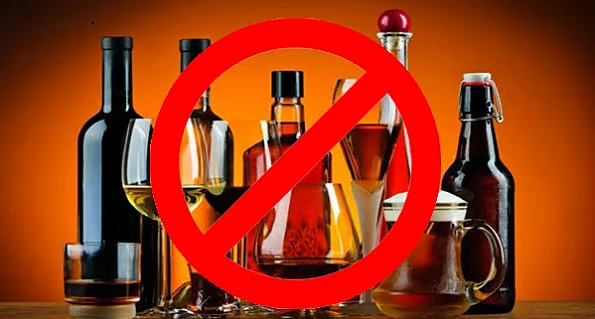
In a decisive policy clarification on February 10, 2026, the Jammu & Kashmir Government formally dismissed proposals to impose a complete ban on the sale and consumption of alcohol in the Union Territory’s legislative assembly. Chief Minister Omar Abdullah, also the Finance Minister, outlined a detailed rationale, emphasizing economic stability, security challenges, tourism interests, and practical governance hurdles as reasons why prohibition — while a topic of recurring debate — is impractical and potentially harmful.
This announcement arrives amid increasing calls from religious leaders and civil society in parts of the Union Territory for a total ban on alcohol — particularly in regions where sobriety is seen as a moral or cultural necessity. At the same time, the government continues to update and strengthen its excise policy framework to regulate alcohol responsibly, cushion social harm, and mitigate illicit trade.
This feature article goes beyond headlines to explore why J&K has chosen regulation over prohibition, the economic and social trade-offs involved, and what this means for communities, businesses, and the region’s future.
Government Position: Why There Will Be No Liquor Ban in J&K
Policy Clarification in the Assembly
In a written reply to a question from BJP MLA Balwant Singh Mankotia, the government clarified that there is no proposal under consideration to make J&K a “dry” Union Territory. Prohibition — in other words, a total ban on alcohol sales and consumption — is not part of current or planned policy.
The government’s official position reflects several key concerns:
01. Smuggling and Illicit Supply Risks
Officials highlighted that prohibition often fails to reduce consumption and instead pushes demand to black markets. They cited the legitimate risk that a ban would prompt large-scale smuggling of liquor from neighbouring states and Union Territories — an outcome that could strain law enforcement, destabilize local markets, and fuel criminal networks.
Recent excise data reflect the existing challenge of illegal liquor circulation; authorities have seized 13.65 lakh kilograms of locally fermented “lahan” and 16.3 thousand litres of illicit liquor in operations spanning 2022–23 and into 2025–26 — a stark indicator of the dangers posed by unregulated alcoholic substances.
02. Public Health & Safety vs. Prohibition Danger
The government noted that illicit liquor production and underground distillation — risks exacerbated by prohibition — pose significant public health hazards. Spurious alcohol often contains toxic substances that can cause serious injury or death, a pattern seen in other Indian states that have implemented strict bans.
Officials warned that prohibition could inadvertently fortify the influence of liquor mafias and underground networks, heightening concerns about money laundering, hawala transactions, and broader criminal activity.
03. Employment and Economic Stability
From production to retail, transport to hospitality, thousands of livelihoods depend on the liquor supply chain:
-
Manufacturing units and distilleries
-
Wholesale distributors and trucking sectors
-
Retail shop owners and bar staff
-
Hospitality and tourism workers
A ban, the government argued, would jeopardize these jobs and destabilize household incomes for many workers — particularly youth engaged in service and logistics sectors linked to alcohol distribution.
04. Revenue Generation and Fiscal Balance
Excise duty on liquor is a major revenue source for the J&K exchequer. Official figures show that liquor revenue has topped ₹3,450 crore over the last three financial years, underscoring how alcohol sales support government finances and public services.
A sudden loss of this revenue stream — without adequate alternative funding — would further strain the Union Territory’s budget and limit its capacity to deliver essential services.
05. Tourism and Hospitality Impacts
Tourism, a lifeline for J&K’s economy, thrives on hospitality services that meet visitor expectations — including access to licensed alcohol. Government representatives warned that prohibition could drive tourists to neighbouring states where bars and restaurants operate freely, dampening hotel bookings and revenue flows.
What’s Driving the Demand for a Liquor Ban?
Despite official resistance, calls for prohibition continue to surface, rooted in moral, cultural, and public health concerns.
01. Religious and Cultural Advocacy
Prominent religious figures — including J&K Grand Mufti Nasir-ul-Islam — have publicly urged the government to impose a liquor ban, citing increasing alcohol consumption in predominantly Muslim districts and the social harm they associate with it.
For many advocates, alcohol is viewed not only as a personal choice but as a social risk that undermines family structures and community values.
02. Political Pressures and Legislative Initiatives
Political leaders from diverse backgrounds — including former Chief Minister and PDP chief Mehbooba Mufti — have supported proposals for stricter alcohol controls, framing the issue as a matter of social welfare and ethical governance.
In some corners of the legislative assembly, private member bills have surfaced seeking comprehensive bans on the advertisement, sale, and consumption of alcohol — though these measures have not gained traction in government policy.
03. Community Voices and Local Advocacy
Public sentiment varies across regions:
-
In urban centres, many residents view alcohol consumption as part of modern lifestyle choices.
-
In rural and conservative districts, community leaders and families express concern over alcohol-related domestic issues, youth vulnerability, and social instability.
Local advocacy groups often organize meetings and petitions reflecting these grassroots concerns, though there is no unified stance across the Union Territory.
Economic Realities: Jobs, Revenue, and Industry in J&K
One of the most contentious aspects of the liquor policy debate is the economic equation — how liquor sales contribute to jobs and government finances.
01. Excise Revenue: A Pillar of the Budget
Liquor excise revenue has become an important pillar of the J&K government’s fiscal framework. Official legislative responses indicate that excise collections in recent years have exceeded ₹3,450 crore, with consistent year-on-year growth.
In the financial year 2024–25 alone, the government reported sizeable revenue — with Jammu region contributing most of the excise collections, while Kashmir Valley’s contribution also increased notably.
02. Employment Across the Supply Chain
The liquor industry supports employment in multiple segments:
-
Distillery workers handling production processes
-
Warehouse and logistics personnel
-
Retail shop staff operating licensed outlets
-
Hospitality and tourism roles tied to bars, restaurants, and hotels
-
Transport drivers and supply contractors
Government and industry estimates suggest that outright prohibition could eliminate a significant number of these jobs — a concern magnified by persistently high youth unemployment in J&K.
03. Broader Industrial Linkages
Liquor sales also drive demand in packaging, bottling, trucking, advertising, and ancillary manufacturing sectors — creating indirect economic benefits that extend beyond direct excise income.
The bottle manufacturing industry, for example, has voiced concerns that a ban could lead to reduced demand and factory closures.
04. Tourism Sector Considerations
For many hotels and resorts, liquor sales comprise a meaningful revenue share, enhancing profitability and guest satisfaction. Government representatives argue that removing this amenity could make J&K less competitive with neighbouring destinations.
Tour operators have indicated that international and domestic tourists — particularly those from metropolitan areas — often expect structured access to alcoholic beverages as part of their travel experience.
Social Impact: The Real Costs of Alcohol Consumption
While economics matters, it is only one side of the story. Alcohol consumption has deep social implications — many of which are cited by those advocating for stricter controls.
01. Family Stress and Domestic Instability
Studies and community reports suggest alcohol abuse can correlate with:
-
Domestic conflicts and violence
-
Financial strain within households
-
Neglect of educational or caregiving responsibilities
Families occasionally attribute chronic discord and stress to problematic drinking patterns.
02. Youth Vulnerability and Addiction Risks
Easy availability of alcohol — even under regulated markets — raises concerns about:
-
Early initiation of drinking among teens and young adults
-
Interference with education and workforce readiness
-
Increased susceptibility to addiction and mental health issues
Local educators and health professionals have voiced concerns about alcohol normalization among youth.
03. Public Health Burden
Healthcare systems in J&K — already managing diverse pressures — absorb costs related to:
-
Alcohol-related illnesses
-
Liver diseases and detox treatments
-
Accident and injury care linked to intoxication
Public hospitals and clinics report that alcohol plays a role in a notable portion of emergency cases.
04. Cultural Erosion and Community Well-being
For parts of J&K that prioritize traditional values, alcohol use is seen as a potential threat to community harmony and cultural continuity.
This perspective often aligns with religious teachings discouraging intoxicants and is supported by civic organizations advocating for sobriety.
Lessons from Other Regions: Prohibition in Practice
While J&K has opted against prohibition, other Indian states provide useful comparisons:
01. Bihar’s Ban: Revenue Drop and Illicit Markets
The prolonged liquor ban in Bihar — often cited by policy analysts — has been criticized for:
-
Lower than expected social improvement
-
Emergence of black markets
-
Loss of legitimate excise revenue
Critics argue that alcohol still flows underground, often increasing risks to consumers.
02. Mixed Models in Other States
Several states adopt partial restrictions rather than total prohibition:
-
Limited hours of sale
-
Higher taxes to disincentivize excessive use
-
Zoning restrictions near schools and places of worship
These regulated markets attempt to balance social concerns with economic realities.
What’s Next for J&K’s Liquor Policy?
01. Excise Policy 2026–27: Regulation Over Prohibition
The government’s Excise Policy for 2026–27 (effective April 1, 2026) provides a structured approach focused on:
-
Responsible consumption awareness
-
Revenue optimization
-
Illicit trade prevention
-
Digital tracking across the supply chain
Penalties for unauthorized sales, stricter licensing requirements, and transparent e-auctioning processes seek to enhance accountability and enforcement.
02. Enforcement and Monitoring Enhancements
Plans include:
-
Enhanced excise enforcement teams
-
Digital inventory and sales monitoring
-
Public campaigns on alcohol risks
-
Collaboration with law enforcement to curb smuggling
Voices From the Ground: Perspectives Across Society
01. Industry Stakeholders
Liquor producers, transporters, and retailers emphasize stability and predictability in policy, warning that prohibition would destabilize established business ecosystems.
02. Residents and Families
Opinions vary widely — from outright opposition to alcohol consumption, to calls for sensible regulation that addresses youth usage and public health without economic disruption.
03. Youth and Educators
Schools and youth groups stress education and preventive initiatives rather than simple bans, advocating for awareness programs and community engagement.
Conclusion — Beyond the Ban: Building a Balanced Future
The J&K government’s decision to rule out a liquor ban is rooted in a complex matrix of economic imperatives, social realities, enforcement practicality, and regional aspirations. While the concerns raised by religious and civic groups echo deep societal values, policymakers have prioritized regulated consumption, revenue sustainability, and economic stability over outright prohibition.
The debate in J&K reflects broader questions about social responsibility versus individual liberties, economic needs versus cultural ethos, and regulation versus prohibition. As the Union Territory continues to refine its approach — balancing community well-being with viable economic policies — the liquor policy conversation will remain a significant public discourse.