Vikram Randhawa Retracts ‘Land Grabbers’ Remark | Political Uproar in J&K Assembly Over Kashmiri Muslims Comment
By: Javid Amin | 17 February 2026
Amid Uproar, BJP’s Vikram Randhawa Retracts ‘Land Grabbers’ Remark — A Fresh Flashpoint in J&K’s Sensitive Political Climate
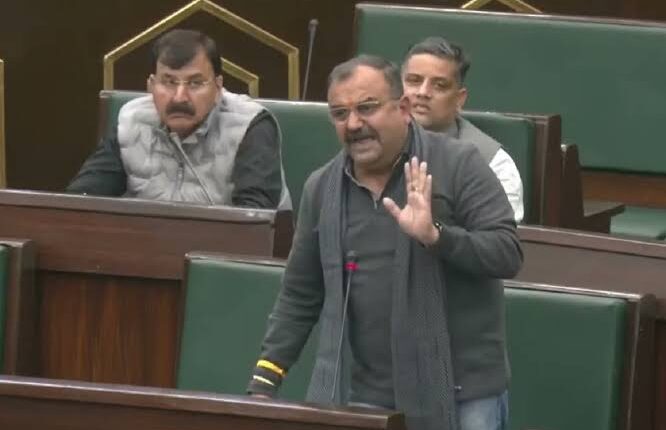
In yet another episode underscoring the fragility of political discourse in Jammu & Kashmir, senior BJP leader and MLA Vikram Randhawa has withdrawn his controversial remarks in which he allegedly dubbed Kashmiri Muslims as “land grabbers.”
The statement, made during a politically charged moment, triggered immediate outrage across party lines and civil society, setting off sharp exchanges inside and outside the Jammu and Kashmir Assembly.
Though Randhawa later clarified that his words were “not intended to hurt sentiments” and had been misinterpreted, the damage had already rippled through the Valley and Jammu regions alike, reigniting debates about responsible political speech in one of India’s most politically sensitive territories.
The Controversial Remark: What Sparked the Uproar?
The controversy began when Randhawa made comments perceived as derogatory towards Kashmiri Muslims, allegedly referring to them as “land grabbers.” In the socio-political context of J&K — where land, identity, and demography remain deeply sensitive issues — such terminology carries explosive implications.
In a region still navigating post-Article 370 realities, administrative transitions, and political re-alignments, rhetoric surrounding land ownership is not merely political — it touches historical grievances, demographic anxieties, and community relations.
Opposition parties swiftly seized upon the remark, accusing the BJP MLA of fueling divisive narratives.
Opposition Reaction: NC and PDP Condemn Remarks
The Jammu & Kashmir National Conference (NC) and the People’s Democratic Party (PDP) condemned the statement in strong terms, calling it “derogatory,” “divisive,” and “irresponsible.”
NC leaders argued that elected representatives must exercise caution when addressing sensitive identity-linked issues. PDP leaders went a step further, stating that such rhetoric risks deepening mistrust at a time when political reconciliation is crucial.
In statements issued to the media, opposition lawmakers said:
-
Public figures must avoid language that stigmatizes communities.
-
Political disagreements should not devolve into identity-based targeting.
-
Legislative forums must uphold dignity and constitutional values.
The controversy quickly escalated into heated exchanges in the Assembly, forcing procedural interventions to restore order.
Echoes Inside the J&K Assembly
Inside the Jammu and Kashmir Legislative Assembly, the issue dominated proceedings.
Opposition legislators demanded:
-
A formal apology on the floor of the House
-
Clarification on intent
-
Assurance against recurrence of such rhetoric
Several members argued that statements like these undermine the spirit of representation in a diverse region where communal harmony is a fragile but essential foundation.
The uproar led to disruptions, adjournments, and pointed debates about political accountability.
Randhawa’s Clarification and Retraction
Facing mounting criticism, Randhawa issued a clarification stating:
-
His remarks were not meant to target any specific community.
-
The comments had been “taken out of context.”
-
He respects the people of Jammu and Kashmir.
Subsequently, he withdrew the statement.
The retraction, however, did little to immediately calm political tensions. Critics argued that the initial remark reflected deeper issues in political communication strategies.
Why Rhetoric Matters More in Jammu & Kashmir
Political discourse in J&K operates within a uniquely sensitive framework shaped by:
-
Decades of conflict
-
Identity-based political mobilization
-
Constitutional changes post-2019
-
Ongoing debates over land rights and domicile rules
Since the abrogation of Article 370 in August 2019, land laws and ownership policies have undergone significant changes. This has intensified public scrutiny over statements related to land and demographic issues.
Therefore, when an elected representative uses language perceived as targeting a specific community, it resonates far beyond standard political debate.
In J&K, words are rarely “just words.”
Land, Identity, and Post-2019 Political Realities
Land ownership in Jammu & Kashmir is historically intertwined with:
-
Special constitutional protections (prior to 2019)
-
Agrarian reforms
-
Demographic concerns
-
Political autonomy debates
After the reorganization of the former state into two Union Territories — Jammu & Kashmir and Ladakh — several legal changes altered land and domicile frameworks.
This transformed land into a politically sensitive subject, particularly in the Valley, where anxieties around demographic shifts remain pronounced.
Thus, labeling a community as “land grabbers” intersects with ongoing debates about ownership, migration, and identity — making the controversy far more than a passing political misstep.
Civil Society Reaction: Concern Over Polarizing Language
Beyond party politics, civil society voices expressed concern over escalating rhetoric.
Community leaders and academics emphasized:
-
Political leaders must act as stabilizing forces.
-
Polarizing statements can widen communal fault lines.
-
Responsible communication is essential in transitional political phases.
Several commentators pointed out that while democratic politics thrives on disagreement, identity-based generalizations weaken institutional credibility.
The BJP’s Balancing Act in J&K
The BJP’s political positioning in J&K remains complex.
While the party holds influence in Jammu, it faces a distinct political landscape in Kashmir. Maintaining regional balance requires calibrated messaging.
The Randhawa episode presents a challenge:
-
It risks alienating sections of the Valley electorate.
-
It fuels opposition narratives of divisive politics.
-
It puts pressure on party leadership to reaffirm inclusive messaging.
Party insiders suggest that leadership prefers de-escalation rather than prolonging controversy.
A Pattern or Isolated Incident?
Political observers note that rhetorical controversies in J&K often follow a familiar trajectory:
-
Provocative remark
-
Public backlash
-
Assembly uproar
-
Clarification or apology
-
Lingering political narrative
Whether this incident becomes a sustained political issue depends on:
-
Opposition strategy
-
Media amplification
-
Upcoming electoral timelines
As of now, the matter remains a talking point rather than a legislative action trigger.
Assembly Accountability and Democratic Norms
Legislative bodies are not merely debating platforms — they are institutional guardians of democratic conduct.
Opposition leaders argue that stronger mechanisms may be required to:
-
Enforce decorum
-
Prevent communal polarization
-
Encourage evidence-based debate
However, procedural tools such as privilege motions or censure require broader consensus.
Political Communication in the Social Media Age
Another dimension amplifying the controversy is digital media.
Clips of the remarks circulated rapidly across social platforms, often stripped of broader context. In today’s environment:
-
Political soundbites travel instantly.
-
Clarifications struggle to match initial outrage.
-
Narratives solidify quickly.
This dynamic makes disciplined communication even more critical for public representatives.
The Broader Lesson: Restraint in a Fragile Landscape
Jammu & Kashmir’s socio-political environment demands heightened sensitivity.
Statements touching upon:
-
Religion
-
Identity
-
Land
-
Demography
carry disproportionate weight.
The Randhawa controversy reinforces a broader truth: leadership in J&K requires rhetorical caution as much as policy clarity.
What Happens Next?
While Randhawa’s retraction may close the immediate procedural issue, political fallout could persist.
Key questions include:
-
Will opposition parties pursue formal Assembly action?
-
Will BJP leadership issue broader guidance on communication discipline?
-
Will the episode influence upcoming political negotiations or electoral dynamics?
For now, the controversy stands as another reminder of the delicate balance between assertive politics and communal harmony in Jammu & Kashmir.
Conclusion: Words, Responsibility, and the J&K Political Equation
The controversy surrounding Vikram Randhawa’s “land grabbers” remark is more than a fleeting headline. It reflects the ongoing tension between political mobilization and social cohesion in a region navigating profound change.
His withdrawal may signal de-escalation, but it also underlines the necessity for calibrated language in public life.
In Jammu & Kashmir — where history, identity, and politics intersect intensely — responsible discourse is not optional. It is foundational.
As the Assembly session continues and political narratives evolve, one principle remains clear: in J&K’s complex political theatre, every word carries weight.