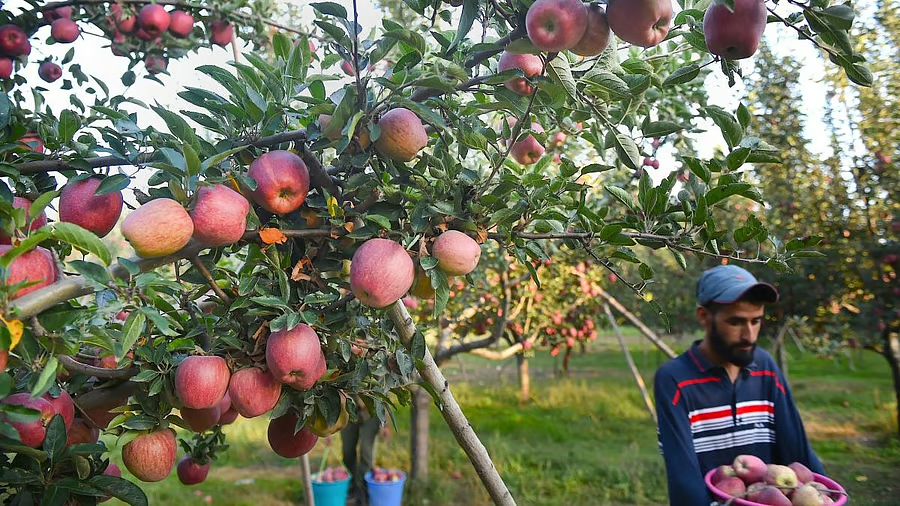
PDP Demands All-Party Meet Over Trade Deal Impact on Kashmir’s Apple Sector
By: Javid Amin | 16 February 2026
Political concern is mounting in Jammu & Kashmir over the potential fallout of emerging free trade arrangements with the United States and New Zealand, with the People’s Democratic Party calling for an urgent all-party meeting to assess risks to the region’s apple economy.
PDP leader Waheed Para warned that tariff relaxation and increased access for foreign apples could destabilize the Valley’s horticulture backbone, threatening the livelihoods of thousands of growers who depend on apple cultivation as their primary income source.
The demand reflects rising anxiety within Kashmir’s farming community, where apples are not merely a crop but the foundation of rural economic stability.
Why the Trade Debate Matters to Kashmir
Kashmir’s apple belt is one of the most economically sensitive agricultural zones in India. Any shift in trade policy affecting pricing or market access reverberates far beyond orchards.
According to horticulture estimates, apples dominate temperate fruit production in the region and anchor a supply chain involving growers, packers, transporters, cold storage operators, traders, and seasonal laborers.
The PDP argues that cheaper imported apples from highly mechanized agricultural economies could undercut domestic prices, compress farmer margins, and push small orchard owners toward financial distress.
The concern is not abstract. It is rooted in price competition.
Global producers benefit from scale, subsidies, and advanced logistics. Kashmiri farmers operate within a fragile ecosystem marked by climate unpredictability, rising input costs, and infrastructure gaps.
Trade liberalization introduces competition that is not symmetrical.
Kashmir’s Apple Economy: More Than Agriculture
Often referred to as India’s apple heartland, Kashmir contributes the largest share of the country’s apple output. The horticulture sector generates an estimated ₹5,000 crore annually and supports hundreds of thousands of livelihoods directly and indirectly.
Apples influence:
-
rural household income
-
seasonal employment cycles
-
transport networks
-
storage infrastructure
-
local credit markets
-
export trade channels
A shock to this sector would ripple across the broader economy, affecting consumption, debt repayment, and social stability in orchard-dependent districts.
In economic terms, the apple industry functions as a regional anchor sector — one whose performance stabilizes entire rural ecosystems.
Farmers Already Under Pressure
Even before trade anxieties, growers have been navigating mounting challenges:
-
climate variability affecting yield patterns
-
pest and disease outbreaks
-
rising fertilizer and labor costs
-
inadequate cold chain infrastructure
-
market volatility
-
competition from other Indian states
Imported apples add a new layer of pressure to an already stretched system.
Farmers fear a race to the bottom in pricing — one they are structurally ill-equipped to win.
Without intervention, orchard profitability could erode quickly.
The Policy Dilemma: Free Trade vs. Protection
The debate exposes a familiar economic tension.
Free trade encourages consumer choice, competitive pricing, and international cooperation. Protectionist measures defend domestic industries, employment, and regional stability.
For policymakers, the challenge lies in sequencing.
Should trade liberalization proceed without buffers for vulnerable sectors?
Or should domestic industries be fortified before exposure to global competition?
The PDP’s position is clear: Kashmir’s horticulture sector requires safeguards.
The party has called for protective tariffs, targeted subsidies, and logistical support to maintain competitiveness. It argues that rural economies cannot absorb abrupt market shocks without social consequences.
Industry Voices: A Call for Cushioning, Not Isolation
Even some non-political stakeholders agree that the issue is not trade itself, but preparedness.
Economists suggest that exposure to global markets can benefit local producers if accompanied by modernization investments:
-
advanced grading and packaging
-
export-quality certification
-
storage upgrades
-
branding initiatives
-
value-added processing
-
crop insurance expansion
Without these upgrades, liberalization becomes disruption.
With them, it becomes opportunity.
The apple sector’s future may depend less on blocking imports and more on elevating domestic competitiveness.
Why an All-Party Meeting Matters
The PDP’s demand for a cross-party discussion reflects recognition that horticulture policy transcends party lines.
Apple farming intersects with employment, migration, rural credit, and social cohesion. Decisions affecting the sector cannot be treated as narrow trade technicalities.
An all-party meet could serve as a unified negotiating platform with the Centre, signaling that safeguarding the apple economy is a shared regional priority.
Political consensus reduces policy uncertainty.
Farmers need assurance that their industry is not entering a policy vacuum.
The Rural Stability Factor
In Kashmir, agriculture is inseparable from social structure.
Stable orchard incomes support education, healthcare, and generational continuity. When agricultural sectors collapse, migration accelerates and rural debt rises.
Economic insecurity rarely remains confined to economics.
Regions dependent on a single anchor industry are particularly vulnerable to external shocks. The apple sector’s centrality means that trade decisions carry amplified social consequences.
Protecting rural livelihoods is not anti-growth. It is risk management.
Consumer Perspective: The Other Side of the Debate
Trade liberalization also introduces a consumer argument: cheaper imports reduce prices for buyers.
Urban consumers may welcome lower fruit costs. But policymakers must weigh immediate consumer gains against long-term producer viability.
If domestic production declines, dependence on imports increases. Price stability then shifts from local farmers to international markets — a trade-off with strategic implications.
Food security and price control are long-term considerations.
Short-term affordability should not undermine production capacity.
A Sector at a Crossroads
Kashmir’s apple industry stands at a critical juncture. Trade openness could either modernize the sector or marginalize it, depending on policy design.
Experts emphasize that transitional safeguards are common in global trade frameworks. Sensitive industries often receive phased exposure, adjustment funds, or competitiveness grants.
The question is not whether Kashmir should engage with global markets.
The question is how.
Conclusion: Beyond Politics, Toward Economic Strategy
The PDP’s call has transformed a trade clause into a regional conversation about economic resilience.
Kashmir’s apple industry represents employment, identity, and stability. Protecting it does not require rejecting globalization — it requires entering globalization strategically.
If policymakers balance openness with preparation, the sector could expand into export leadership.
If exposure arrives without support, farmers may bear disproportionate risk.
The proposed all-party meeting is less about politics and more about planning.
Because for Kashmir, apples are not just fruit.
They are infrastructure disguised as agriculture.


