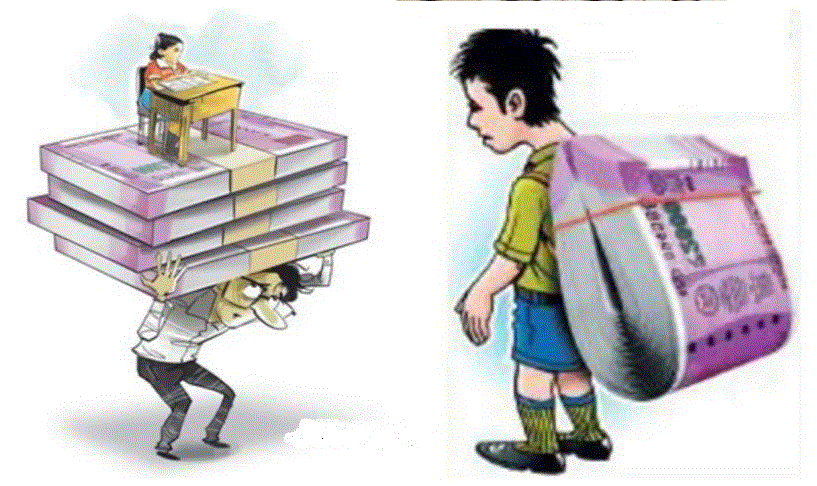
Education for Sale in Kashmir: “This mafi(a) is looting parents — fees, books, uniforms, activities — everything except studies”
By: Javid Amin | 15 November 2025
A deeply researched, sourced investigation into private-school profiteering in Jammu & Kashmir — and a loud call to authorities: stop the hollow promises and show results.
A new academic session in Kashmir has once again exposed a pattern parents know too well: private schools increasing fees, forcing expensive textbook kits and stationery, insisting on purchases from preferred vendors, mandating new uniforms that render last year’s unusable, and layering “activity”, transport and “miscellaneous” charges — often without clear bills or oversight. The result: parents face sudden, unaffordable bills; Economically Weaker Section (EWS) families are squeezed out; pedagogy is sidelined while retail margins rise.
This report pulls together ground reporting from multiple Kashmir outlets, administrative directives, legal context, and parents’ testimonies to show the scale and mechanisms of the problem — and to demand that the Directorate of School Education, Kashmir (DSEK), the Fee Fixation & Regulation Committee (FFRC), and the UT administration stop issuing circulars that aren’t enforced, and start producing visible results: audits, refunds, prosecutions where warranted, and binding regulations.
Why this matters (human & legal stakes)
-
Financial pain for families: Fee hikes and forced purchases are not just an annoyance — they’re a measurable economic shock for thousands of households across Srinagar and the Valley. Many parents report fee increases of 25–40% across the last two years and surprise “balance” demands from prior sessions.
-
EWS exclusion: When schools prescribe kits that cost far more than state reimbursements, students from EWS categories risk dropping out or being effectively excluded—contradicting the spirit (and sometimes the letter) of the RTE.
-
Pedagogical harm: Schools are increasingly emphasizing “branded kits”, activity fees and extra commercial modules — sometimes at the cost of classroom teaching time and curricular alignment. Parents say everything but studies is being delivered.
-
Rule-of-law crisis: Repeated directives by DSEK and the UT administration have failed to end the practice: promises have been made, circulars issued, but enforcement has been partial or absent. That gap between promise and action is the central grievance.
How the “mafia” works — mechanics of extraction
From reporting and documented circulars we can see recurring tactics:
-
Vendor lock-in (books, stationery, uniforms)
Schools tie up with preferred shops/publishers — sometimes on-premises or immediately adjacent — and make those the only place parents can buy “mandatory” kits. These vendors charge higher markups; bills may be informal; and schools benefit through commissions or reciprocal financial arrangements. DSEK directives have repeatedly warned schools not to force purchases from a particular shop — but enforcement is inconsistent. -
Inflated ‘prescribed’ kits vs. board books
Parents report that board-prescribed (JKBOSE/NCERT) books cost modestly (a few hundred to a thousand rupees per set), whereas school-mandated kits with supplementary workbooks, branded notebooks and activity books sell for several thousands. These extra books are frequently unnecessary for the official curriculum. Recent local reporting documents multiple cases in Srinagar where parents were billed for kits far higher than government-prescribed materials. -
Surprise fee hikes, retroactive bills, miscellaneous charges
Aside from tuition, schools apply charges for transport, “annual charges”, smart-class subscriptions, co-curricular “project fees”, and vague “miscellaneous” items. In the post-2023 period many private schools in Kashmir reportedly applied retroactive “balance” demands, leaving parents with unexpected dues. Multiple local outlets have covered protests and complaints. -
Curriculum tinkering to justify extra materials
Some institutions adopt parallel workbooks or their own “in-house” modules that they claim supplement the board syllabus — allowing them to prescribe additional titles they sell or promote. This “double-curriculum” phenomenon increases parents’ bills and weakens adherence to state/board-prescribed texts. -
Administrative opacity & weak receipts
Parents often report not receiving itemised invoices. When complaints are made, schools issue circulars promising action. But without transparent accounting or external audits, the system stays opaque. When the UT directed schools to upload book lists and vendor details, many complied partially; some didn’t.
Voices from Kashmir (what parents and local reporting say)
We synthesized multiple Kashmir media reports and interviews to surface recurring narratives:
-
“They told us old uniforms were ‘out of stock’ — and gave a new design. Old ones are not accepted now.” — common parental complaint in Srinagar, reported in local outlets. Forced uniform changes are used to sell new uniforms and pad vendor sales.
-
“Books cost four times the JKBOSE set. They add workbooks and activity books we never know are used.” — parents report oversized kits with low classroom utility. Several Kashmiri outlets have documented such instances.
-
“We paid for transport during months our children were not attending — the school kept charging and then blocked online classes.” — a family dispute reported around DPS Srinagar highlighted how schools sought utility/transport fees even during lockdowns. This points to broader issues of charging for services not delivered.
-
Protests and parent associations: Kashmir has a history of parents’ protests against fee hikes. Visual records and video clips from prior years (and as recently as 2025) show organised parent demonstrations in Srinagar demanding transparency and restraint on fee increases.
What the administration has said — and why statements haven’t changed realities
Officials have issued orders and circulars. Notable actions:
-
DSEK circulars and warnings: DSEK has repeatedly warned private schools against imposing purchases from specific bookshops and has instructed schools to upload class-wise book lists on their websites. These directives are necessary but not sufficient when enforcement is weak.
-
FFRC and fee regulation: The Fee Fixation & Regulation Committee (FFRC) exists to regulate fees in J&K and has set frameworks. However, despite committees and standardized structures, numerous reports show non-compliance by hundreds of schools across the UT. A 2025 report described that regulatory efforts had not fully resolved fee inflation and opaque charges.
-
UT ministerial statements: Education ministers (including public statements from ministers like Sakina Itoo in 2025) asked parents to report overpriced textbooks and indicated administrative action would follow. But parents say action has been slow and localized, not systemic.
Why these measures fail:
-
Enforcement gap: Circulars and warnings do not substitute for regular, surprise inspections, audits, and credible penalties.
-
Scale of non-compliance: When hundreds of schools flout norms, a patchwork response (notably a few show-cause notices or fines) won’t deter the rest.
-
Information asymmetry: Parents lack easy, accessible price-lists and alternative vendor options; they are often coerced in school premises.
Cases & incidents (illustrative, verified examples)
Below are documented instances that illustrate how the problem operates on the ground in Kashmir and similar Indian contexts:
-
DPS Srinagar — service charges & online-class exclusion
A family filed a complaint alleging DPS Srinagar charged fees for services not delivered during lockdown and barred a Class-2 student from online classes over unpaid amounts. The dispute highlighted how schools sometimes bill retroactively and withhold academic access. -
Repeated DSEK warnings (2023 onward)
DSEK’s 2023 circular explicitly barred schools from forcing parents to buy books from a particular shop. Yet, as late as 2025 parents reported continued forced purchases — indicating enforcement weaknesses. -
FFRC action reports (2025)
Local reports in 2025 indicate FFRC barred hundreds of schools from collecting fees for non-compliance in certain districts — an important enforcement step that nevertheless requires follow-up audits to ensure refunds and behavioral change. -
Wide media coverage & parent protests
Multiple Kashmir outlets and social video channels have photographed and recorded parents protesting fee hikes. Visual evidence of protests (placards, banners demanding “Stop fee hike”) supports the scale of dissent.
Socioeconomic analysis: who pays and who loses
-
Middle-class families: They absorb shocks but respond by cutting discretionary spending, delaying other investments, or borrowing; this erodes household resilience. Reports suggest many families in Srinagar faced two-year cumulative fee increases between 2023–25 that were unsustainable.
-
Low-income/EWS families: They are hit hardest. When mandatory kits and fees exceed reimbursements, EWS students may be forced to leave private schools or be de-facto excluded, undermining inclusion goals under RTE.
-
Educational outcomes: When schools prioritize revenue channels (kits, branded workshops, activity fees) over classroom investment, the net educational quality may stagnate — long-term human capital loss for the UT.
What should real enforcement look like? (a concrete action plan)
The problem is not lack of guidelines — it’s lack of durable, visible enforcement and accountability. Below is a prioritized set of actions the UT administration, DSEK, FFRC, and the Directorate can (and must) take — now.
1) Immediate (within 7–14 days)
-
Massive transparency order: Require every private school in J&K to upload, publicly and in machine-readable format, a class-wise book list (with ISBNs), vendor names, itemized fees and sample invoices for kits sold in the last 3 years. Non-compliance triggers immediate show-cause notices. (DSEK already asked schools to upload details once — make it binding and auditable).
-
Prohibit vendor exclusivity: Clarify and enforce that schools cannot force purchases from a single vendor; parents must be allowed to buy equivalent items from any source and submit bills. Enforce through spot checks at school premises during kit distribution periods.
-
Emergency helpline & digital complaint tracker: Create a public web portal where parents lodge complaints about forced purchases, overcharging, or withholding services — each complaint gets a visible ticket and status. The portal should require a formal response within 7 days.
2) Short term (1–3 months)
-
Conduct random audits: District-level officers and FFRC must perform randomized inspections of schools across all districts — verifying invoices, cross-checking vendor connections (ownerships, commissions). Schools failing audits must be fined and required to refund overcharged parents. (Example: other states fined schools and the fines led to refunds.)
-
Freeze collection powers for flagrant offenders: Where evidence shows systemic exploitation, temporarily bar those schools from collecting further fees until audits/rectifications are complete. Reports show FFRC has used a similar measure in some districts; scale it up transparently.
3) Medium term (3–12 months)
-
Mandatory external financial audits: Require unaided private schools to undergo annual independent financial audits focusing on non-tuition revenues (books, uniforms, vendor commissions). Audit reports should be public.
-
Standardized book-price schedule: In consultation with JKBOSE, NCERT, and consumer-protection bodies, prepare a price-guideline for textbooks and standardized lists for state-specified syllabus. Consider “fixed rate by page-count” for supplementary books (as suggested in other PILs) to prevent egregious markups.
-
Strengthen punitive mechanisms: Raise fines, enable revocation of recognition for repeat offenders, and empower district commissioners to take decisive action where exploitative practices continue.
4) Long term (12–36 months)
-
Legal backing: Convert critical guidelines into enforceable rules under the J&K School Education Act, including penalties and appeal mechanisms. Don’t rely on advisory circulars alone.
-
Capacity-building for parents: Fund NGOs and parent associations to educate families on rights (ability to buy from any vendor, demand bills, challenge kits), and to form collective negotiation mechanisms.
-
Curriculum integrity panels: Ensure JKBOSE reviews and approves any non-board textbooks. Prohibit “extra” sets that duplicate board content unless proven pedagogically necessary.
Accountability checklist for DSEK & UT authorities (what we expect to see within 30/60/90 days)
-
Within 7 days: Publish a list of the top 200 complaints received over the last 12 months and their status (open/closed), and the contact for the grievance cell.
-
Within 30 days: Announce results of random inspections for at least three districts and list schools found in violation and the penalties imposed.
-
Within 60 days: Present a timeline for mandatory audits of top-earning private schools and commit to public audit reports.
-
Within 90 days: Demonstrate measurable refunds issued to parents where overcharging is proven, and publish the names of repeat offenders whose recognition has been suspended or penalties amplified.
If these steps are not completed transparently, parents and civil society should escalate — judicially and politically.
Call to action — a loud, public appeal
To the Directorate of School Education, Kashmir (DSEK), the Committee for Fixation & Regulation of Fees (FFRC), the UT Government, and the District Magistrates:
-
Your circulars and warnings are visible — now show proportionate action. Make uploaded lists auditable, carry out surprise inspections, publish audit reports, and enforce penalties without fear or favor. Stop the cycle of “circulars and lip service.”
To parents:
-
Organize: form school-level parent groups; demand itemised receipts; keep copies; file complaints on the DSEK portal; pool evidence and use collective bargaining power. Legal aid clinics and local NGOs in Srinagar can help file PILs if administration fails.
To media and civil society:
-
Investigate supply chains — who owns the vendor shops linked to schools? Are trustees or relatives involved? Publish clear exposés. Push for FOI-style access to school procurement records.
To judiciary and oversight bodies:
-
If the administration stalls, courts must step in as they have in other states — use PILs to compel systemic transparency and to create enforceable remedies for affected parents.
What successful enforcement looks like (a short scenario)
Imagine: DSEK publishes a searchable database of every private school’s classwise booklists and standard prices. Parents buy identical items from local markets with confidence. Audits show a cluster of schools had vendor-commission linkages; those schools are fined, required to refund excesses, and a few managers face administrative sanctions. The judiciary upholds the right of parents to choose vendors and demands annual audits. Schools revert to focusing on classroom quality rather than building retail pipelines. That outcome is achievable — but only with political will and visible enforcement.
Final note — this is not about demonising private schools
Many private-school teachers and some managements are dedicated and sincere. This investigation is about systems: opaque procurement chains, incentives for commercialisation, and a governance gap that lets exploitative practices persist. The solution is systemic: enforceable rules, audits, and empowered parents. Until then, Kashmir’s families will continue to be billed for everything except the one thing they most desperately need — quality, accountable education.


