Kashmir Paddy Land Protest: Farmers, PDP, NC and BJP Unite Against Land Conversion
By: Javid Amin | 11 June 2026
Iltija Mufti Leads Symbolic Resistance as Farmers, NC, BJP and Civil Society Rally to Protect Agricultural Land in South Kashmir
A Protest That Goes Beyond Politics
In Kashmir’s deeply polarized political landscape, moments of unity across party lines are rare.
Yet in the muddy paddy fields of Bijbehara and Pulwama, an unusual scene unfolded this week.
Farmers planting rice saplings were joined not only by PDP leaders but also by representatives from rival political parties, civil society activists, and local residents concerned about the future of Kashmir’s shrinking agricultural land.
What began as resistance to restrictions on cultivation has rapidly evolved into a broader debate over land rights, food security, rural livelihoods, and the future of Kashmir’s agricultural identity.
At the center of the controversy are thousands of kanals of fertile paddy land in South Kashmir, where cultivators claim they have farmed for generations but now face uncertainty over their continued access.
Why Farmers Took to the Fields
The immediate trigger was the issuance of notices and administrative restrictions on cultivation in parts of Anantnag and Pulwama districts.
According to farmers, revenue authorities informed cultivators that certain parcels of land are recorded as state land and cannot continue to be used in the manner they have traditionally been cultivated.
Many affected families reject that interpretation.
They argue that while ownership records may classify the land differently, their families have cultivated these fields continuously for decades—some claiming 60 to 80 years of uninterrupted farming.
For these households, the dispute is not merely legal.
It is existential.
The land provides:
- Rice cultivation.
- Fodder for livestock.
- Seasonal employment.
- Household income.
- Food security for entire families.
For many villagers, losing access to cultivation would mean losing their primary economic foundation.
Iltija Mufti Turns the Issue Into a Political Campaign
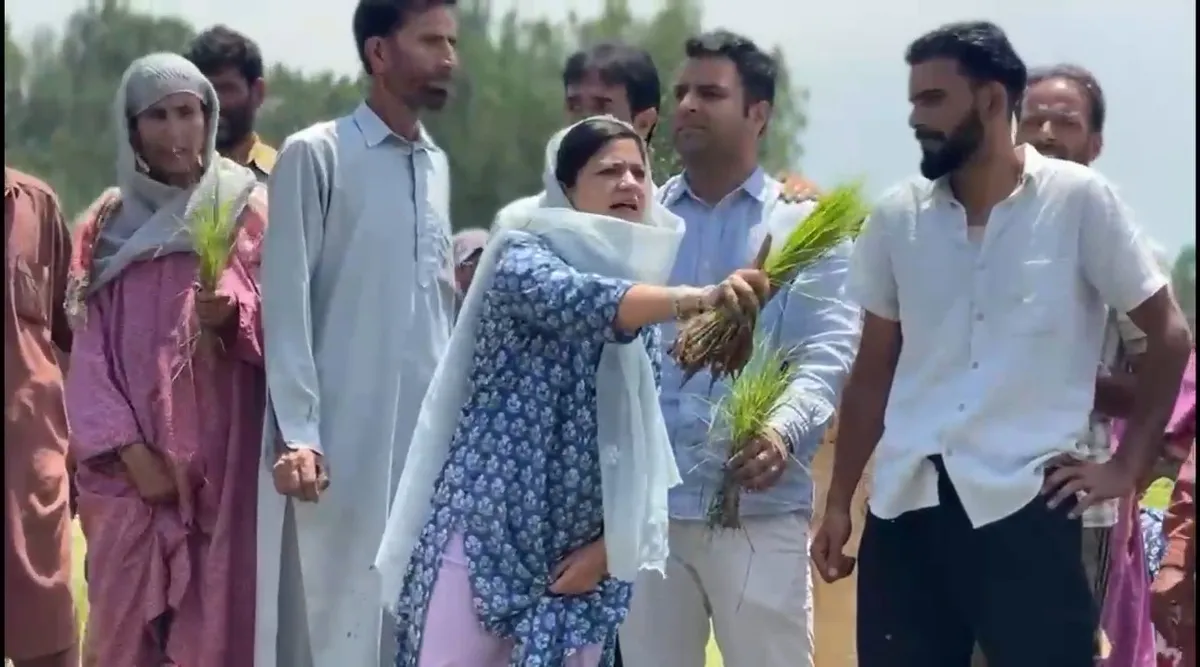
The issue gained Valley-wide attention when PDP leader Iltija Mufti entered the fields alongside local farmers and participated in symbolic rice transplantation.
The image was powerful.
Rather than holding a press conference or political rally, she chose to stand ankle-deep in water with cultivators, planting saplings in land whose future remains contested.
The message was straightforward:
Agricultural land should remain agricultural land.
By physically participating in cultivation, Iltija sought to frame the issue not as a bureaucratic dispute but as a question of livelihood and dignity.
The symbolism resonated strongly on social media and among rural communities.
Waheed Para Expands the Campaign
The movement gained further momentum when PDP leader Waheed Ur Rehman Para joined farmers in Pulwama.
Para went beyond statements, reportedly ploughing fields alongside cultivators to demonstrate solidarity.
The visual messaging was deliberate.
PDP leaders sought to portray themselves as standing with farmers confronting administrative uncertainty.
The strategy also helped shift political attention away from conventional constitutional debates and toward everyday economic concerns affecting rural Kashmir.
The Rare Cross-Party Moment
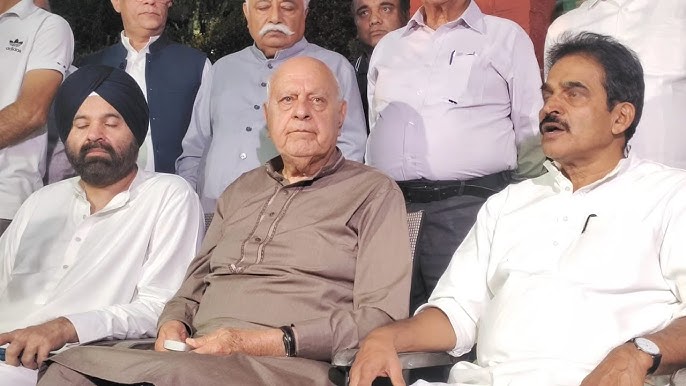
Perhaps the most remarkable aspect of the protest has been the participation of leaders from rival political camps.
Among those expressing support or joining farmers were leaders associated with:
- National Conference.
- Bharatiya Janata Party.
- Civil society organizations.
- Local advocacy groups.
Such convergence is unusual in Jammu and Kashmir’s political environment.
Despite deep ideological differences on issues such as Article 370, statehood, and governance, many leaders appeared willing to unite around the protection of agricultural land.
Political observers describe this as one of the few issues capable of cutting across traditional party divides.
Food security and farming remain concerns that affect communities regardless of political affiliation.
Why Kashmir’s Agricultural Land Is Becoming a Sensitive Issue
The controversy reflects a much larger challenge facing Kashmir.
Over the past two decades, agricultural land across the Valley has steadily declined due to:
Urban Expansion
Growing towns and cities have expanded into agricultural zones.
Commercial Development
Residential colonies, markets, and commercial projects increasingly occupy former farmland.
Infrastructure Growth
Roads, institutions, and public projects require land acquisition.
Land Conversion
Agricultural plots are gradually being converted for non-farming purposes.
Agricultural experts have repeatedly warned that continued loss of paddy land could threaten long-term food security.
Kashmir already imports substantial quantities of rice despite being historically known for paddy cultivation.
Any further reduction in cultivated land could increase dependence on outside supplies.
Farmers Fear More Than Economic Loss
For many villagers, the issue is also cultural.
Rice cultivation is deeply woven into Kashmir’s rural identity.
Entire communities organize their lives around agricultural cycles.
Planting and harvesting seasons are linked to family traditions, local customs, and village economies.
Many farmers argue that the loss of cultivation rights would not only affect income but also erode a way of life passed down through generations.
This emotional dimension explains why the protests have generated strong local participation.
Government’s Position
Authorities maintain that the disputed land falls under state ownership and that land-use regulations must be respected.
Officials argue that public land cannot automatically become private property through prolonged cultivation.
From the government’s perspective, the issue concerns:
- Revenue records.
- Legal land classification.
- Regulatory compliance.
- Future land-use planning.
Officials also insist that development and public projects require adherence to legal frameworks.
However, critics argue that legal classifications alone cannot ignore decades of cultivation and dependence.
The dispute therefore sits at the intersection of law, livelihood, and governance.
Opposition Accuses Government of Heavy-Handed Approach
Opposition leaders have alleged that authorities used intimidation to discourage farmers from cultivating the disputed land.
Some politicians have claimed that warnings, police intervention, and legal threats created fear among villagers.
These allegations have intensified the political dimension of the controversy.
If the issue continues to escalate, it may become one of the most significant rural governance debates in Kashmir this year.
Why This Issue Could Grow Bigger
Several factors suggest the dispute is unlikely to fade quickly.
Large Number of Families Affected
Thousands of kanals involve hundreds of households.
Cross-Party Support
The issue has attracted backing from leaders across political divides.
Strong Rural Sentiment
Agricultural land remains emotionally and economically important.
Food Security Concerns
The debate touches on broader questions about Kashmir’s future self-sufficiency.
Symbolic Value
The image of farmers planting saplings in defiance of restrictions has already become a powerful political symbol.
The Bigger Question: Development vs Agriculture
At its core, the controversy raises a difficult question facing Kashmir’s policymakers:
How can development proceed without undermining agriculture?
Economic growth requires infrastructure, institutions, and investment.
At the same time, protecting fertile agricultural land remains essential for:
- Food security.
- Rural employment.
- Environmental sustainability.
- Cultural continuity.
Finding a balance between these competing priorities will be one of the major governance challenges in the coming years.
Conclusion
The Bijbehara paddy land protest is about far more than a few disputed fields.
It reflects growing anxiety over the future of agriculture in Kashmir, fears about shrinking farmland, and frustration among communities that feel disconnected from decisions affecting their livelihoods.
What makes the movement particularly significant is the rare political consensus emerging around it.
When farmers, opposition leaders, ruling-party representatives, and civil society voices stand in the same paddy fields, governments are forced to pay attention.
The immediate dispute may concern a few thousand kanals of land.
But the larger debate concerns something much bigger:
Who controls Kashmir’s land, how it should be used, and what kind of rural future the Valley wants to build.