Outsiders Buying Land in Srinagar? Altaf Bukhari Questions Government, Says NC Must Be Held Accountable for Any Demographic Change
By: News Desk | 27 September 2026
Apni Party chief seeks clarification over alleged land deals in Syedpora and Hazratbal, urges Centre-J&K dialogue
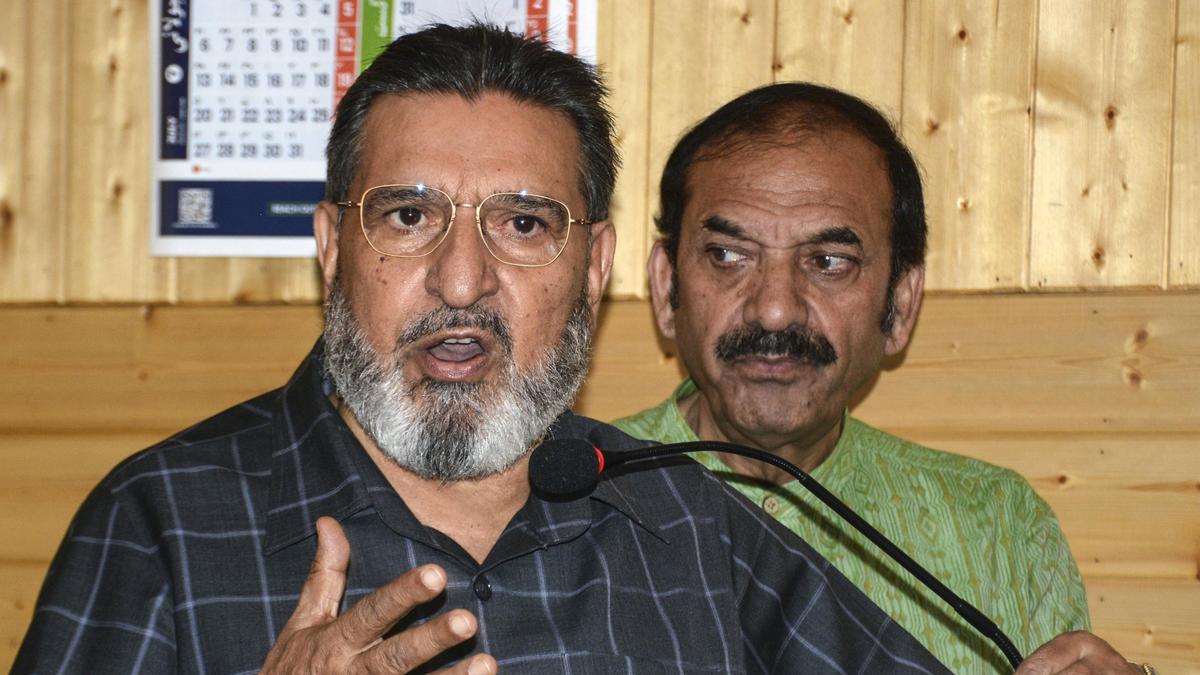
Srinagar: Jammu and Kashmir Apni Party president Syed Mohammad Altaf Bukhari has stepped up his criticism of the Omar Abdullah-led government, questioning alleged land transactions involving people and companies from outside Jammu and Kashmir and warning that the ruling National Conference (NC) would have to answer for any demographic changes resulting from such activity.
Addressing a public meeting at Natipora in Srinagar’s Chanapora constituency, Bukhari specifically questioned how a Mumbai-based businessman was allegedly able to acquire land for a hotel project in Syedpora and how a Delhi-based company allegedly acquired 150 kanals of land in the Chatterhama-Hazratbal area.
The allegations have added a fresh dimension to an already intense political debate in Jammu and Kashmir over land ownership, statehood, governance and the long-term consequences of the changes introduced to the region’s legal and constitutional framework after 2019.
But the legal position surrounding land purchases is more complicated than a simple local-versus-outsider distinction.
Bukhari Demands to Know Who Approved the Transactions
Bukhari directly questioned the government over the alleged transactions, asking who had permitted the purchase of land for the hotel project in Syedpora and the acquisition of 150 kanals in Chatterhama.
He argued that it was the government’s responsibility to prevent any attempt to alter Jammu and Kashmir’s demographic character and said the NC would be held accountable if such a change took place.
“If this robbery is taking place, it is taking place due to the NC government,” Bukhari said, according to reports, while warning that the ruling party would be responsible if anyone was attempting to bring about demographic change.
The Apni Party leader’s intervention was not accompanied, in the reports reviewed, by documentary evidence establishing that the two alleged transactions violated the applicable land laws.
That distinction is important because the legality of a land transaction depends on the nature and classification of the land, the purpose of acquisition, the ownership structure and the permissions obtained, rather than simply on whether the buyer is from outside J&K.
What J&K’s Current Land Law Actually Says
The legal framework changed substantially after the constitutional changes of 2019.
In October 2020, the Centre notified changes allowing people without a J&K domicile or Permanent Resident Certificate to purchase non-agricultural land in the Union Territory. The change removed the earlier requirement that a purchaser be a permanent resident of J&K for such land.
That means the assertion that an outsider cannot legally purchase land in J&K merely because they do not have a domicile certificate is too broad.
The position is different for agricultural land.
Under Section 133-H of the J&K Land Revenue Act, transfer of agricultural land to a non-agriculturist is restricted. The J&K government’s current legal-aid and revenue information says such a transfer can take place only after permission from the Deputy Commissioner and subject to prescribed conditions. Those conditions include using the land for the purpose for which permission was granted and ensuring that the transaction does not render the transferor landless.
Consequently, the crucial question in the cases cited by Bukhari is not simply “Are the buyers outsiders?”
It is:
What category of land was involved, under what legal provision was it transferred, for what purpose, and what permissions or approvals were issued?
Those are questions that can be answered through official revenue and registration records.
Why the Syedpora and Chatterhama Claims Matter
The two transactions mentioned by Bukhari are politically sensitive because they concern areas around Srinagar where land, urban expansion and commercial development are already subjects of public debate.
According to the reports, Bukhari referred to a Mumbai-based businessman whom he identified as “Chawla Sahib” in connection with a hotel project at Syedpora.
He also alleged that a Delhi-based company had acquired 150 kanals in Chatterhama, in the Hazratbal area.
At present, these should remain treated as allegations requiring official verification, rather than established evidence of unlawful acquisition or demographic engineering.
No official government clarification confirming the legality, ownership structure or precise land classification of the cited properties was identified in the sources reviewed.
That leaves a clear factual gap.
If the transactions were legally approved, the government can establish that through the relevant records. If there were violations of land-use, transfer or permission requirements, those records could similarly identify where the irregularity occurred.
The Larger Demographic Question
Bukhari’s intervention reflects a much broader political concern in Jammu and Kashmir: whether changes in land laws and increased investment from outside the Union Territory could eventually affect the region’s demographic and economic character.
That concern has existed since the post-2019 restructuring of the legal framework.
Before the constitutional changes of August 2019, property rights in Jammu and Kashmir were governed by a framework that restricted ownership by people who were not permanent residents. The subsequent changes removed those restrictions for non-agricultural land.
The 2020 changes were presented by the government as part of bringing J&K’s land laws closer to the broader Indian legal framework and facilitating investment and development. At the same time, the administration said safeguards for agricultural land would remain in place.
The resulting debate has therefore never been only about individual property transactions.
It is also about the balance between investment, development, local land rights and demographic concerns.
Bukhari’s Criticism Extends Beyond Land
The Apni Party chief’s latest attack was broader than the land issue.
He accused the National Conference government of failing to deliver on several electoral and political commitments, including its positions on Article 370, Article 35A and statehood.
Bukhari also criticised the government’s handling of the Assembly, arguing that elected representatives should be concentrating on employment, detainees and other issues affecting ordinary people instead of repeated disruptions.
He has similarly criticised the NC’s statehood resolution, questioning whether the party has genuinely pursued the objectives on which it sought votes.
The criticism comes at a particularly politically charged moment, with the Assembly debating statehood and the National Conference government attempting to build political pressure around the restoration of J&K’s full statehood.
For Bukhari, however, statehood cannot be separated from questions about governance and the region’s future political and demographic character.
NC Under Pressure Over Its Electoral Promises
Bukhari accused the NC of seeking votes by promising the restoration of Article 370 and Article 35A, statehood and other measures, but failing to deliver on those commitments after assuming power.
UNI reported that he also cited promises involving 200 units of free electricity and free gas cylinders while questioning the government’s record nearly two years into its tenure.
These are political claims from the Apni Party and should be understood within the wider opposition campaign against the NC government.
The National Conference, meanwhile, has continued to make restoration of statehood a major political demand. Chief Minister Omar Abdullah recently moved a resolution in the Assembly seeking the immediate and urgent restoration of full statehood.
The resulting confrontation with BJP legislators has become one of the defining political episodes of the current Assembly session.
Bukhari’s criticism therefore lands at the intersection of two separate debates: what the NC promised before the election and what it has been able to achieve within the present constitutional and administrative framework.
Bukhari Also Seeks Direct Dialogue With Centre
Alongside his criticism of the NC government, Bukhari appealed to Prime Minister Narendra Modi to initiate direct dialogue with the people of Jammu and Kashmir, particularly young people.
He argued that the “trust deficit” between the Centre and the people of J&K would not disappear without meaningful engagement.
“The prevailing trust deficit will not end until direct talks are held between the Centre and the people, particularly the youth of J&K,” he said, according to reports.
The appeal is significant because Bukhari’s political positioning has often attempted to distinguish the Apni Party from both the mainstream regional parties and the BJP-led central establishment.
His latest remarks combine criticism of the NC government with a demand for greater engagement from New Delhi.
Youth, Police Verification and Unemployment
Bukhari also raised issues affecting young people, including unemployment, police verification and the difficulties some individuals face in obtaining clearances for passports and jobs.
He alleged that some young people remained in detention or were repeatedly called to police stations, while questioning whether the government was doing enough to address their concerns.
These allegations, too, require case-specific verification.
But they form part of a broader political argument being made by Bukhari: that the government’s attention should move beyond political symbolism and towards issues that directly affect people’s livelihoods and interaction with the state.
Employment is particularly important in this context because J&K’s political debate increasingly intersects with concerns over recruitment, verification procedures and opportunities for young people.
A Debate Already Growing Around Srinagar’s Development
Bukhari’s latest comments also follow an earlier intervention by him on September 20, when he called for an inquiry into alleged changes to Srinagar’s Master Plan.
He claimed that areas originally designated for commercial activity had been converted into residential zones and vice versa, and questioned whether such changes had harmed the city’s character and interests of residents.
At the same meeting, he also raised allegations that land was being purchased in the names of local residents to facilitate the settlement of outsiders and demanded a probe.
Kashmir Reader separately reported that Bukhari had called for an investigation into allegations that local individuals were facilitating land purchases on behalf of outsiders.
These earlier statements show that the land issue is becoming a recurring component of his political messaging rather than a one-off allegation.
Development Versus Land Protection
At the centre of the controversy is a difficult policy question.
Jammu and Kashmir needs investment, tourism infrastructure, commercial activity and employment-generating projects. At the same time, land is an especially sensitive resource in a region where questions of ownership, displacement and demographic change have long been politically charged.
The current legal framework permits outsiders to acquire non-agricultural property, while retaining restrictions and permission requirements concerning agricultural land.
The debate therefore is not necessarily about whether outside investment should exist at all.
It is about how such investment is regulated, where it is permitted, who benefits, how land-use changes are approved, and whether local residents are adequately protected from unlawful transfers or displacement.
Those questions can be addressed through transparent land records, planning permissions, revenue orders and public disclosure.
What the Government Would Need to Clarify
Bukhari’s allegations have created several questions that the administration could answer through documentary evidence.
Among them are:
- What is the exact classification of the land cited in Syedpora?
- Who currently owns the property and through what transaction was ownership transferred?
- What permissions were granted for the proposed hotel project?
- What is the legal status and land classification of the 150-kanal property in Chatterhama-Hazratbal?
- Was the land agricultural or non-agricultural at the time of transfer?
- If agricultural land was transferred to a non-agriculturist, was the required Deputy Commissioner permission obtained?
- Were the transactions consistent with the applicable Master Plan and land-use regulations?
- Were any government agencies involved in granting approvals or changing land use?
Answering these questions would move the debate from political allegation to verifiable documentation.
The Political Stakes Are Larger Than Two Land Deals
The dispute over the alleged transactions comes at a time when almost every major political question in Jammu and Kashmir is being viewed through the larger lens of post-2019 governance.
Statehood remains a major demand of the elected government. Land ownership remains a sensitive issue among political parties and sections of civil society. Investment and tourism are being promoted as avenues for economic growth. At the same time, questions about local employment, land-use planning and demographic change continue to generate political anxiety.
Bukhari is seeking to connect all of these issues into a single political argument: that development should not come at the cost of local interests and that the government must remain accountable for decisions involving land.
Whether the specific transactions he cited violate any law, however, is a matter for official records and competent authorities to establish.
A Political Debate Moving From Statehood to Land
The latest controversy shows how quickly Jammu and Kashmir’s political debate can move from constitutional questions to highly localised issues of property and development.
The National Conference is pressing the Centre on statehood.
The BJP is challenging elements of the government’s political messaging.
The Apni Party is questioning both the NC’s electoral record and the government’s handling of land and governance.
For residents, however, these larger political arguments increasingly intersect with tangible questions: who owns land, what can be built on it, whether local people benefit from investment, how young people find employment and whether government decisions are transparent.
Bukhari’s latest remarks have put those questions back at the centre of the political conversation.
The immediate issue now is whether the government responds with political counterarguments or with the records that can establish precisely what happened in the land transactions cited by the Apni Party chief.
For a debate as sensitive as land and demographic change in Jammu and Kashmir, the distinction between allegation, legal permission and proven violation will remain crucial.