Omar Abdullah’s Statehood Resolution Sparks BJP Protest Over 2000 Autonomy Reference; LoP Meets Amit Shah Next Day
By: Javid Amin | 26 September 2026
Srinagar/New Delhi: Jammu and Kashmir’s demand for restoration of full statehood returned to the centre of the political stage this week after Chief Minister Omar Abdullah moved a resolution in the Legislative Assembly seeking the “immediate and urgent” restoration of statehood, triggering a sharp confrontation with BJP legislators.
The resolution itself called for statehood. But the political flashpoint inside the House was its reference to two earlier Assembly resolutions — the June 26, 2000 autonomy resolution and the November 6, 2024 resolution seeking restoration of special status and constitutional guarantees.
BJP legislators, led by Leader of Opposition Sunil Sharma, objected to the references and said the party was prepared to discuss statehood but would not permit the House to reopen questions concerning autonomy or Article 370.
The confrontation escalated into slogan-shouting, protests in the Well of the House, tearing of copies of the resolution and heated exchanges between treasury and Opposition benches. The Speaker eventually adjourned the House after repeated attempts to restore order failed.
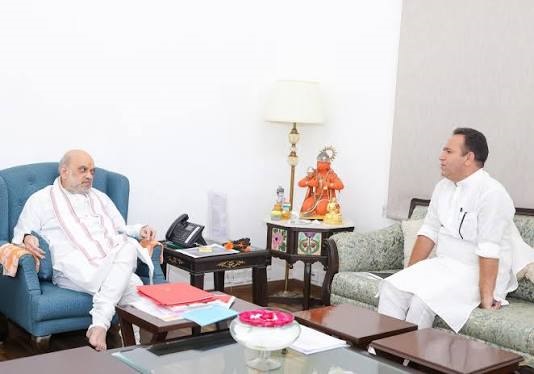
The following day, Sharma travelled to New Delhi and met Union Home Minister Amit Shah, where the two discussed security, law and order, development, governance and matters connected with the ongoing Assembly session, according to a statement issued after the meeting.
The sequence has given the statehood debate a fresh political dimension: a resolution promoted by the ruling National Conference government, a BJP objection to its historical references, and a subsequent meeting between the J&K Opposition leader and the Union Home Minister.
What exactly did Omar Abdullah’s resolution say?
Chief Minister Omar Abdullah moved the resolution after Question Hour during the Assembly’s autumn session.
The operative portion called upon the Government of India for the “immediate and urgent restoration of full statehood to Jammu and Kashmir” and proposed forwarding the resolution to the Centre.
But the resolution did not stand alone.
Its opening language stated that it was being moved “in addition to” resolutions passed by the Assembly on June 26, 2000, and November 6, 2024.
That wording became the central source of disagreement.
The 2000 resolution, passed when Jammu and Kashmir was still a state and Farooq Abdullah was Chief Minister, sought restoration of greater autonomy to the erstwhile state.
The November 2024 resolution passed by the newly elected Assembly had called for dialogue on restoring special status and constitutional guarantees to Jammu and Kashmir.
For the National Conference, the references form part of its longer political record on Jammu and Kashmir.
For the BJP, the inclusion of those earlier resolutions changed the political character of what it regarded as a straightforward statehood question.
That disagreement ultimately produced the Assembly confrontation.
BJP: Statehood can be debated, autonomy cannot
Leader of Opposition Sunil Sharma made the BJP’s position clear after the resolution was tabled.
He said the BJP was prepared to debate restoration of statehood but opposed any attempt to reopen the autonomy question or bring Article 370-related issues back into the Assembly’s proceedings.
The party’s objection centred particularly on the 2000 autonomy resolution.
BJP legislators argued that the autonomy resolution had already been rejected and questioned why it was being referenced in a fresh resolution concerning statehood.
The protest escalated as BJP MLAs entered the Well of the House, raised slogans and tore copies of the resolution. Reports also described heated exchanges between members of the treasury benches and the Opposition, with the disruption eventually forcing adjournment.
The BJP’s argument therefore rests on a distinction:
statehood is one issue; autonomy and Article 370 are another.
The party says it is willing to discuss the former while rejecting the reopening of the latter.
Why the 2000 autonomy resolution matters
The historical reference is not incidental.
On June 26, 2000, the then Jammu and Kashmir Assembly passed a resolution seeking restoration of greater autonomy to the state.
The resolution sought a return to the constitutional position that existed before August 9, 1953. It was subsequently rejected by the Union government.
The issue remains politically significant because the National Conference has historically advocated greater autonomy for Jammu and Kashmir.
The party’s 2024 Assembly election manifesto also included implementation of the 2000 autonomy resolution among its political commitments, according to contemporary reporting.
That background helps explain why the BJP reacted so strongly to its inclusion in the new statehood resolution.
For the BJP, the reference was evidence that the resolution could not be viewed solely as a statehood demand.
For the NC, the reference was part of the political and legislative history of Jammu and Kashmir.
The two interpretations collided inside the House.
Omar Abdullah’s argument: the statehood promise remains incomplete
While moving the resolution, Omar Abdullah argued that the Centre had previously indicated a sequence involving delimitation, elections and restoration of statehood.
He said delimitation and elections had taken place and argued that restoration of statehood was the remaining step.
The Chief Minister said the people of Jammu and Kashmir participated in the 2024 Assembly elections with an expectation that statehood would follow. He also referred to statements made by the Union government and Prime Minister Narendra Modi regarding restoration of statehood.
This has become a recurring argument of the NC government.
The party has maintained that the elected Assembly and government should operate with the full constitutional status that existed before the 2019 reorganisation.
The Centre, however, has not restored statehood as of September 2026.
The question therefore remains a major unresolved issue between the J&K government and the Union government.
The political contradiction at the heart of the debate
The Assembly confrontation also exposed an interesting political overlap.
The BJP has publicly opposed the inclusion of autonomy and Article 370-related references, but the party’s position on restoration of statehood is more nuanced than outright rejection of statehood itself.
Sunil Sharma has explicitly said the BJP is ready for a debate on statehood.
The dispute is therefore not simply:
Statehood versus no statehood.
It is increasingly:
Statehood on its own versus statehood linked to the wider political history of autonomy and special constitutional status.
That distinction is central to understanding the latest Assembly confrontation.
The 2024 resolution adds another layer
The November 6, 2024 resolution is also significant.
The first Assembly elected after Jammu and Kashmir’s reorganisation in 2019 passed a resolution seeking dialogue on restoring special status and constitutional guarantees.
The BJP had opposed that move.
The 2026 statehood resolution’s reference to the 2024 resolution therefore brought an already contested political issue back into the Assembly debate.
For the NC, the reference connects the latest demand with the Assembly’s previous position.
For the BJP, it raises the question of whether the ruling party is attempting to combine a statehood demand with issues that were politically and constitutionally altered after August 2019.
Neither interpretation should be confused with the legal effect of the Assembly resolution itself.
A legislative resolution calling upon the Centre to restore statehood does not, by itself, alter Jammu and Kashmir’s constitutional status.
It is a political expression of the Assembly’s position and a request to the Union government.
Congress and other parties back the statehood demand
The resolution received support from the treasury benches and Congress legislators in the House.
PDP members and the lone AAP member also supported the statehood resolution, according to reporting from the proceedings.
The support reflects the broader political significance of statehood in Jammu and Kashmir.
Although parties differ sharply over Article 370, autonomy, constitutional arrangements and the timing of restoration, several political formations have publicly supported restoration of full statehood.
The differences lie in how the demand should be pursued and what other issues should accompany it.
That distinction became particularly visible during Friday’s proceedings.
Congress’s position becomes part of the BJP’s challenge
Sunil Sharma also questioned the Congress’s position on the resolution’s references to autonomy and Article 370.
He called upon Congress leaders to clarify whether the party supported the 2000 autonomy resolution and the broader political framework referred to in the resolution.
This turned the Assembly confrontation into more than an NC-BJP dispute.
It also placed the Congress, which supports the restoration of statehood, in the middle of a wider argument over whether supporting statehood also implies support for the political resolutions referenced by the NC government.
For the Congress, those questions are politically separate.
For the BJP, the references provide grounds to demand clarification.
The disagreement illustrates how a single legislative resolution can bring several unresolved questions from different periods of J&K’s political history back into the same debate.
The Assembly protests and the question of procedure
The confrontation was not confined to slogans.
BJP members also questioned whether the prescribed Assembly procedure had been followed when the resolution was introduced.
Sharma alleged that the government and the Speaker had not followed the appropriate procedure and questioned whether the Chief Minister could introduce the resolution in the manner adopted.
These are procedural allegations by the Opposition rather than established findings.
The Speaker’s handling of the proceedings became another source of disagreement as members refused to return to their seats.
Eventually, the House was adjourned, with reports indicating that proceedings were suspended until Monday.
The episode demonstrated how the substantive statehood debate was overtaken by disagreement over the wording and procedure surrounding the resolution.
From Assembly confrontation to Amit Shah meeting
The political significance of the episode increased the next day.
On September 26, BJP Leader of Opposition Sunil Sharma met Union Home Minister Amit Shah in New Delhi.
According to the statement released after the meeting, the discussions covered:
- security in Jammu and Kashmir;
- law and order;
- development;
- governance;
- issues concerning the people of the Union Territory; and
- matters linked to the ongoing Assembly session.
The meeting came only a day after Sharma had led the BJP’s opposition to the statehood resolution inside the Assembly.
However, the publicly reported account of the meeting does not establish that the two discussed the Assembly resolution exclusively or that a specific decision on statehood was taken.
The meeting should therefore be understood as a broader discussion on J&K issues, with the statehood confrontation providing important political context.
What did Amit Shah communicate?
According to the account released after the meeting, the Union government’s commitment to peace, development and prosperity in Jammu and Kashmir was reiterated, along with an assurance of continued support in addressing public concerns.
There was no publicly reported announcement following the meeting that the Centre had agreed to immediately restore statehood.
This is an important distinction.
The political demand remains active, but the meeting did not itself change the constitutional status of Jammu and Kashmir.
For now, statehood remains a matter of political negotiations and decisions at the Union level.
Why the timing of the meeting matters
The timing is nevertheless politically significant.
On Friday:
The NC-led government pressed the Centre for immediate statehood.
The BJP objected to the resolution’s references to autonomy and special status.
The Assembly descended into disorder and was adjourned.
On Saturday:
The BJP’s Leader of Opposition met the Union Home Minister in Delhi to discuss J&K issues.
That sequence ensures that the Assembly confrontation will continue to have political consequences beyond the House itself.
It also places the BJP’s J&K leadership directly in communication with the Union government at a moment when the statehood question has returned to the forefront.
Statehood has become the central constitutional demand of the elected government
Since the formation of the elected government after the 2024 Assembly polls, restoration of statehood has remained one of the National Conference-led administration’s principal political demands.
The government has repeatedly argued that an elected government should not continue to function under the Union Territory framework indefinitely.
Omar Abdullah has also previously said that the decision to restore statehood rests with the Union government, specifically the Prime Minister and Home Minister.
That political reality is important.
The J&K Assembly can pass resolutions urging restoration.
The final decision on changing the Union Territory’s constitutional status lies with Parliament and the Union government through the applicable constitutional and statutory process.
Consequently, the Assembly resolution is principally a political instrument intended to reinforce the elected government’s demand.
Why the BJP sees a larger issue in the resolution
The BJP’s objection is rooted in the historical references rather than simply the demand for statehood.
The party has argued that the 2000 autonomy resolution and Article 370 represent issues that should not be reopened.
Sunil Sharma has repeatedly said the BJP will not permit a debate on those matters, while maintaining that it is prepared to discuss statehood.
This creates a clear line of political disagreement.
The NC is attempting to frame statehood within Jammu and Kashmir’s longer constitutional and political history.
The BJP is attempting to separate restoration of statehood from the pre-2019 constitutional debate.
The Assembly’s latest confrontation is a direct expression of that difference.
The wider governance backdrop
The statehood dispute is unfolding against a broader Assembly session dominated by governance concerns.
Before the latest confrontation, BJP legislators had raised issues including daily-wage workers, NHM employees and electricity tariffs, while the Opposition had prepared to question the government over unemployment, recruitment, outsourcing, local-body elections and other public issues.
That background matters because the BJP has accused the NC government of using politically emotive questions to divert attention from governance.
The NC, in turn, argues that restoration of statehood is itself a fundamental governance issue because it would change the institutional framework within which the elected government functions.
Thus, the disagreement is not simply over political symbolism.
It involves competing definitions of what should be the priority for the Assembly: immediate administrative and public-service issues, or the constitutional status of the Union Territory.
What happens to the resolution now?
The immediate question is whether the Assembly will resume discussion on the resolution and whether it will eventually be put to a vote.
Friday’s proceedings were disrupted before the House could complete a normal debate on the measure.
The Speaker adjourned proceedings following the protests.
If debate resumes, members will have to address two separate questions:
First: whether they support restoration of full statehood.
Second: whether they accept the wording linking the new resolution to the 2000 and 2024 Assembly resolutions.
Those are not necessarily identical questions.
A legislator could support restoration of statehood while disagreeing with the inclusion of the autonomy resolution.
That distinction could become important if the Assembly attempts to move the resolution toward a formal vote.
The unresolved question: when will statehood return?
The latest political developments have once again brought the statehood question into the national spotlight, but they have not produced a timeline for restoration.
The elected J&K government continues to press for an early decision.
The BJP says it supports discussion of statehood but rejects any attempt to reopen autonomy or Article 370.
The Union government has not announced a restoration date in the wake of the latest Assembly proceedings.
That leaves the central political question unanswered:
When will Jammu and Kashmir return to full statehood?
For the NC government, the answer should follow the completion of delimitation and elections, which it says fulfilled the sequence previously outlined by the Centre.
For the BJP, the current controversy demonstrates why the statehood question should be considered separately from the autonomy and Article 370 debate.
And for the Union government, the final decision remains pending.
The significance of Sunil Sharma’s Amit Shah meeting
The Sharma-Shah meeting therefore carries importance primarily because of its timing.
It followed the most contentious Assembly confrontation of the current session and brought the J&K BJP’s senior legislative leader directly into discussions with the Union Home Minister.
Yet the publicly disclosed agenda was broader than statehood alone.
Security, law and order, development, governance and public concerns were all reportedly discussed.
Whether the meeting produces any change in the Centre’s position on statehood remains to be seen.
For now, the political positions remain distinct.
The J&K government is demanding immediate restoration of full statehood.
The BJP says it is ready to discuss statehood but rejects any accompanying discussion on autonomy or Article 370.
The Union government has not announced a fresh timeline.
And the Assembly is preparing to resume amid a dispute that has once again brought Jammu and Kashmir’s constitutional future to the centre of political debate.
What Friday’s confrontation revealed
The latest episode demonstrates that the statehood question is no longer merely a slogan outside the Assembly.
It has become a direct legislative issue.
But the debate has also exposed how deeply intertwined statehood remains with the larger political history of Jammu and Kashmir.
For the National Conference, the 2000 autonomy resolution and the 2024 special-status resolution are part of the political record through which it frames its demands.
For the BJP, reopening those references crosses a political line even if the immediate subject is statehood.
The next phase of the Assembly session will determine whether the House can separate those disagreements sufficiently to debate the actual question of statehood.
The resolution’s fate, meanwhile, will be watched beyond Srinagar — particularly in New Delhi, where the final constitutional and legislative decisions concerning J&K’s status ultimately rest.

