Khamenei Killing: Protests, Shutdown in J&K as Internet Curbs Tighten on Second Day
By: Javid Amin | 02 March 2026
The reported assassination of Ayatollah Ali Khamenei in a US–Israel strike has ignited widespread protests across India, with Jammu and Kashmir emerging as the epicenter of unrest.
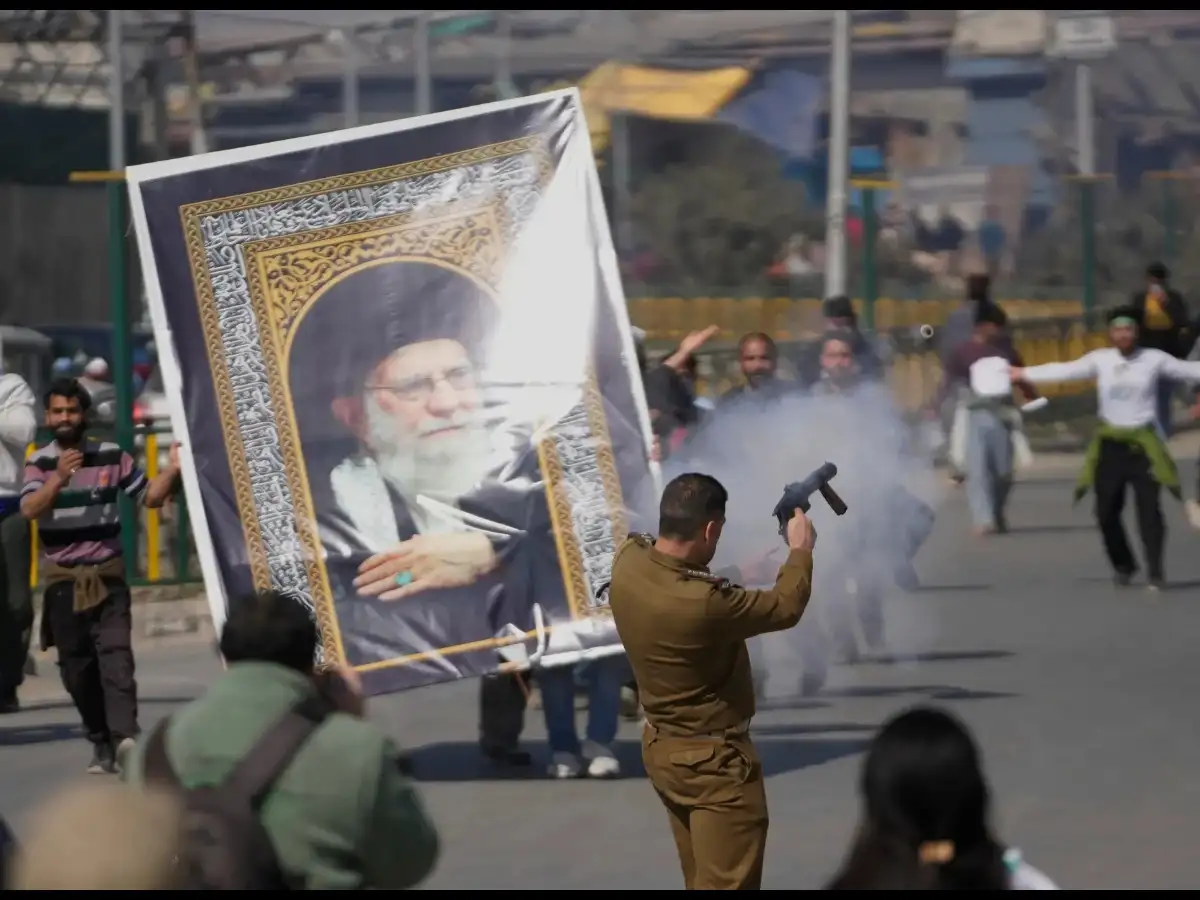
For the second consecutive day, large sections of the Kashmir Valley witnessed demonstrations, shutdowns, and heightened security measures. Authorities imposed restrictions on movement, temporarily shut educational institutions, and slowed mobile internet speeds in an attempt to prevent escalation.
The mood across Kashmir is tense but controlled — a delicate balance between public mourning and state-imposed curbs.
Second Day of Protests in Kashmir
Lal Chowk and Ghanta Ghar Turn Flashpoints
In Srinagar, thousands gathered near Lal Chowk and the iconic Ghanta Ghar, chanting anti-US and anti-Israel slogans. Protesters carried black flags and banners condemning what they described as an unjust killing.
Security forces had already barricaded roads leading to Lal Chowk early in the morning. Concertina wires, checkpoints, and riot-control vehicles were deployed to prevent mass congregation in the square, historically a symbolic and politically sensitive location.
Despite heavy deployment, scattered demonstrations were reported in interior neighborhoods.
Valley-Wide Demonstrations
Protests were not limited to Srinagar. Similar gatherings were reported from:
-
Budgam
-
Anantnag
-
Pulwama
-
Baramulla
While most protests remained peaceful, officials said stone-pelting incidents were reported in isolated pockets.
Shutdown Call by Mutahida Majlis-e-Ulema
The influential religious coalition Mutahida Majlis-e-Ulema (MMU) called for a Valley-wide strike to protest Khamenei’s assassination.
The impact was visible across major towns:
-
Shops and commercial establishments remained closed.
-
Public transport was largely off the roads.
-
Private schools and coaching centers suspended classes.
In several areas, mosque loudspeakers were used to announce mourning gatherings and prayer meetings.
The MMU described the killing as a “grave injustice” and urged the international community to hold those responsible accountable.
Mobile Internet Speeds Restricted
Authorities confirmed that mobile internet speeds were restricted across parts of the Kashmir Valley as a preventive measure.
Officials stated the move was intended to:
-
Prevent the spread of misinformation
-
Curb mobilization calls through social media
-
Maintain public order
Internet throttling has historically been used in the region during periods of unrest. While broadband services remained functional in some districts, mobile data speeds were significantly slowed.
Residents reported difficulty accessing messaging apps and uploading videos, though voice calls continued uninterrupted.
Educational Institutions Closed
As tensions mounted, the administration ordered:
-
Closure of schools and colleges for two days
-
Suspension of classes in government and private institutions
Officials described the shutdown as precautionary, aimed at ensuring student safety and preventing campus mobilization.
Parents expressed mixed reactions — some supporting the decision as necessary for safety, others worried about academic disruption.
Political and Religious Leaders React
Leaders across party lines in Jammu & Kashmir issued statements condemning the assassination of Khamenei.
Prominent political figures called it:
-
A violation of international norms
-
A destabilizing action in an already volatile region
-
An act that could inflame sectarian tensions
Religious leaders held condolence meetings, urging restraint while expressing solidarity with Iran’s Shia community.
Notably, there was rare unity among diverse political and religious groups in condemning the strike, even as they appealed to citizens to maintain peace.
Kargil Observes Mourning
In Kargil, part of Ladakh, large mourning processions were organized. Kargil, a Shia-majority district, announced seven days of mourning.
Key developments in Kargil:
-
Black flags hoisted in several neighborhoods
-
Community-led condolence gatherings
-
Partial market shutdowns
Unlike spontaneous protests in Srinagar, events in Kargil were more structured and coordinated by religious bodies.
The emotional intensity in Kargil remains particularly high, given the region’s strong religious ties with Iran.
Protests Beyond Kashmir
The impact of Khamenei’s reported killing extended beyond Jammu & Kashmir.
Demonstrations were reported in:
-
Hyderabad
-
Lucknow
Shiite organizations in several Indian cities announced multiple days of mourning, organizing prayer gatherings and peaceful marches.
However, unlike Kashmir, these protests remained largely symbolic and did not prompt major security restrictions.
Security Strategy: Preventive, Not Reactive
Authorities in Jammu & Kashmir appear focused on containment rather than confrontation.
Measures include:
-
Sealing sensitive intersections
-
Imposing restrictions on public gatherings
-
Increasing police and paramilitary patrols
-
Monitoring social media activity
Officials privately describe the situation as “emotionally charged but manageable.”
Compared to reports of violent unrest in Pakistan, where attempts to storm diplomatic missions led to fatalities, Kashmir’s protests — though intense — have so far been largely non-lethal.
Why Kashmir Reacted So Strongly
The depth of response in Kashmir can be traced to multiple factors:
-
Religious Affinity: Many in Kashmir, particularly in Shia-majority pockets, view Khamenei as a significant religious authority.
-
Political Sensitivity: The region has a history of reacting strongly to international developments affecting Muslim-majority countries.
-
Symbolic Solidarity: Public expressions of solidarity often serve as both religious mourning and political messaging.
The convergence of these elements has made Kashmir one of the focal points of reaction within India.
Ground Reality: Tense but Under Control
As of the second day:
-
Lal Chowk remains heavily barricaded.
-
Internet restrictions continue in many districts.
-
Schools remain closed temporarily.
-
Protests are ongoing but under close surveillance.
Security forces maintain visible presence, particularly in downtown Srinagar and sensitive neighborhoods.
Residents describe the atmosphere as “somber but watchful.”
Key Takeaway
The assassination of Ayatollah Ali Khamenei has resonated deeply in Jammu & Kashmir, triggering two days of sustained protests, shutdowns, and preventive restrictions.
While authorities have imposed internet curbs and movement restrictions to prevent escalation, the emotional response — especially in Srinagar and Kargil — remains strong.
Kashmir once again finds itself at the intersection of global geopolitics and local sentiment — a reminder of how events thousands of kilometers away can profoundly shape realities on the ground in the Valley.


