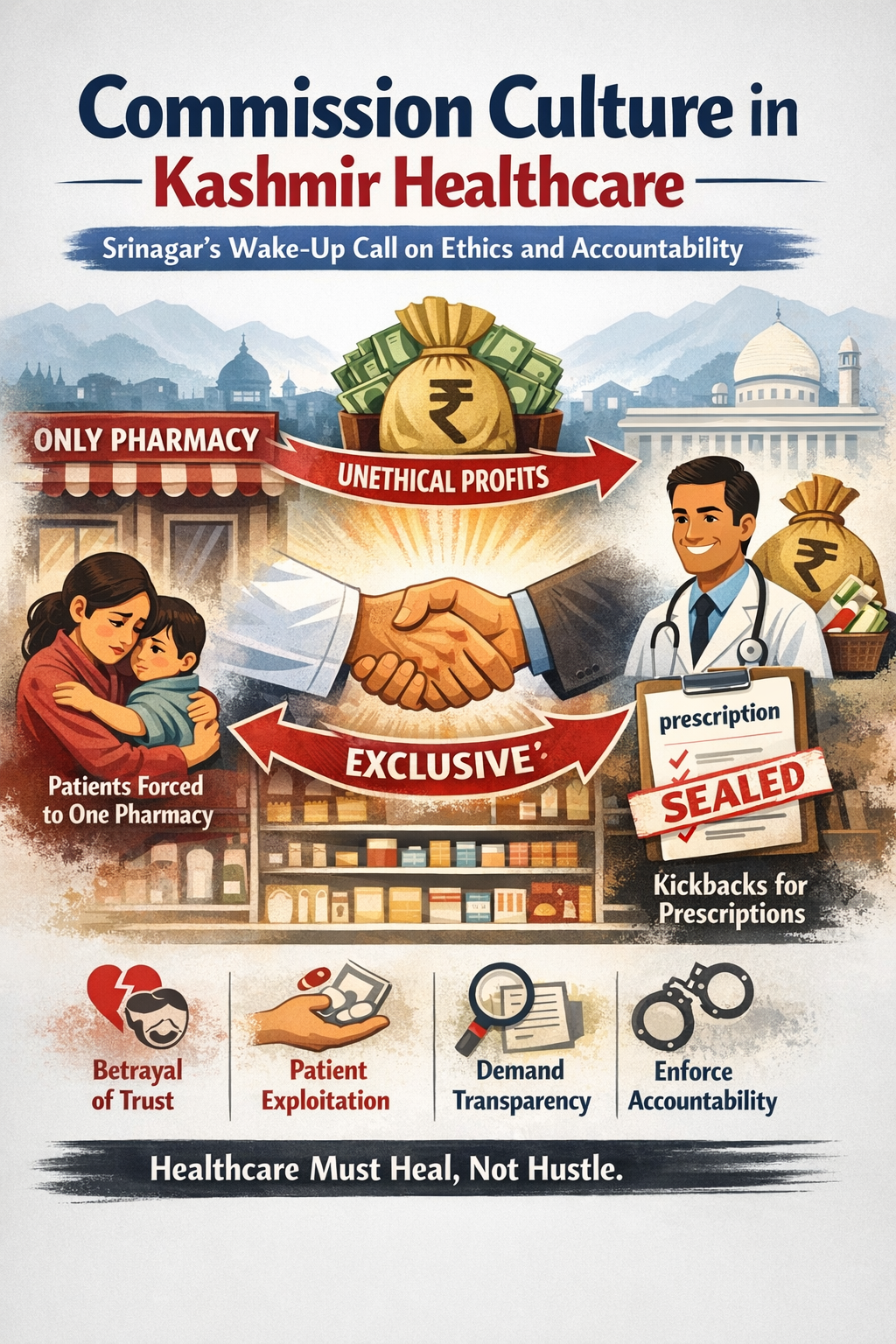
Srinagar Healthcare Scandal: Commission Culture, Pharmacy Nexus & Patient Rights Crisis
By: Javid Amin | 03 May 2026
A Disturbing Case from Srinagar’s Downtown
A recent incident in Srinagar has sparked serious concern about ethical practices in healthcare. Patients in Downtown localities reported that a specific prescribed medicine was unavailable across multiple pharmacies—except one allegedly linked to the consulting doctor.
For families already under stress, this meant having no real choice but to purchase from a single outlet—often at higher cost and under pressure. What appears on the surface as inconvenience points to a deeper, more troubling pattern: commission-driven healthcare practices.
Allegations of a Pharmacy–Doctor Nexus
Patients and local observers allege:
- Prescriptions being directed toward specific pharmacies
- Limited or artificial availability of certain medicines
- Financial incentives or kickbacks influencing prescribing behavior
If proven, such practices fall squarely under unethical profiteering, where patient care is compromised for monetary gain.
This is not merely a regulatory lapse—it is a breach of medical ethics and public trust.
Regulatory Action: A Strong Start, But Not Enough
Authorities have responded with visible enforcement:
- Multiple medical shops sealed under the Drugs and Cosmetics Act, 1940
- Surprise inspections intensified across Downtown and adjoining areas
- Signals from officials that further action may follow
These steps indicate administrative intent. However, crackdowns alone cannot dismantle a system if its incentives remain intact.
Why Commission Culture Persists
The Downtown case is not an isolated anomaly—it reflects structural weaknesses:
1. Profit Over Patients
In some instances, prescriptions may be influenced by financial arrangements rather than purely clinical need.
2. Weak and Irregular Oversight
Regulation exists, but enforcement is often:
- Sporadic
- Reactive rather than preventive
- Limited in tracking patterns over time
3. Normalization of Kickbacks
In parts of the healthcare supply chain, commissions have become an open secret—rarely acknowledged, rarely penalized consistently.
4. Information Asymmetry
Patients often lack:
- Awareness of their rights
- Knowledge of alternative medicine options
- Confidence to question prescriptions
This imbalance allows coercive practices to go unchallenged.
The Real Cost: Erosion of Trust
When healthcare becomes transactional:
- Patients lose faith in doctors
- Financial burden increases for families
- Clinical decisions come under suspicion
Trust—once broken in healthcare—is difficult to restore. And without trust, even legitimate medical advice faces skepticism.
Broader Implications for Kashmir’s Healthcare System
This issue goes beyond one locality or one prescription:
Patient Rights at Risk
Every patient has the right to:
- Choose where to purchase medicines
- Seek second opinions
- Receive prescriptions based solely on medical need
Credibility of Medical Practice
If even a fraction of prescriptions are influenced by commissions, it casts a shadow over the entire profession.
Need for Systemic Reform
Experts increasingly argue that isolated enforcement cannot fix systemic incentives.
What Must Change: From Crackdown to Reform
1. Digital Prescription Tracking
Introduce systems to:
- Monitor prescribing patterns
- Flag repeated pharmacy linkages
- Detect anomalies in drug availability
2. Accountability Across the Chain
- Strict penalties for proven collusion
- Equal scrutiny of doctors and pharmacies
- Transparent disciplinary processes
3. Protect Whistleblowers
- Encourage patients and pharmacists to report coercion
- Ensure legal protection and anonymity
4. Public Awareness Campaigns
Citizens must know:
- They are free to buy medicines from any licensed pharmacy
- They can question prescriptions
- They can report unethical practices
5. Strengthen Regulatory Oversight
Move from reactive raids to:
- Continuous monitoring
- Data-driven inspections
- Independent audits
A Turning Point or a Missed Opportunity?
The Downtown Srinagar case has done something important—it has exposed a hidden but widely suspected practice.
The administration now faces a choice:
- Treat it as a one-off violation
- Or recognize it as a systemic issue requiring structural reform
Conclusion: Healthcare Must Heal, Not Hustle
Healthcare operates on a simple moral foundation: the patient comes first.
When prescriptions become pathways to profit, that foundation cracks.
Srinagar’s recent crackdown is a necessary step—but not a sufficient one.
Real change will come only when:
- Incentives are corrected
- Transparency is enforced
- Accountability becomes non-negotiable
Anything less risks turning a wake-up call into just another missed warning.


