Jammu & Kashmir Weather Crisis: 7th Consecutive Dry Winter, 65% Rainfall Deficit Pushes J&K to Brink
By: Javid Amin | 02 March 2026
Snow Likely This Week, But Is It Enough? A Ground Report on the Deepening Dry Winter Crisis in Jammu & Kashmir
A Winter Without Snow: Why Jammu & Kashmir Is Facing an Alarming Weather Crisis
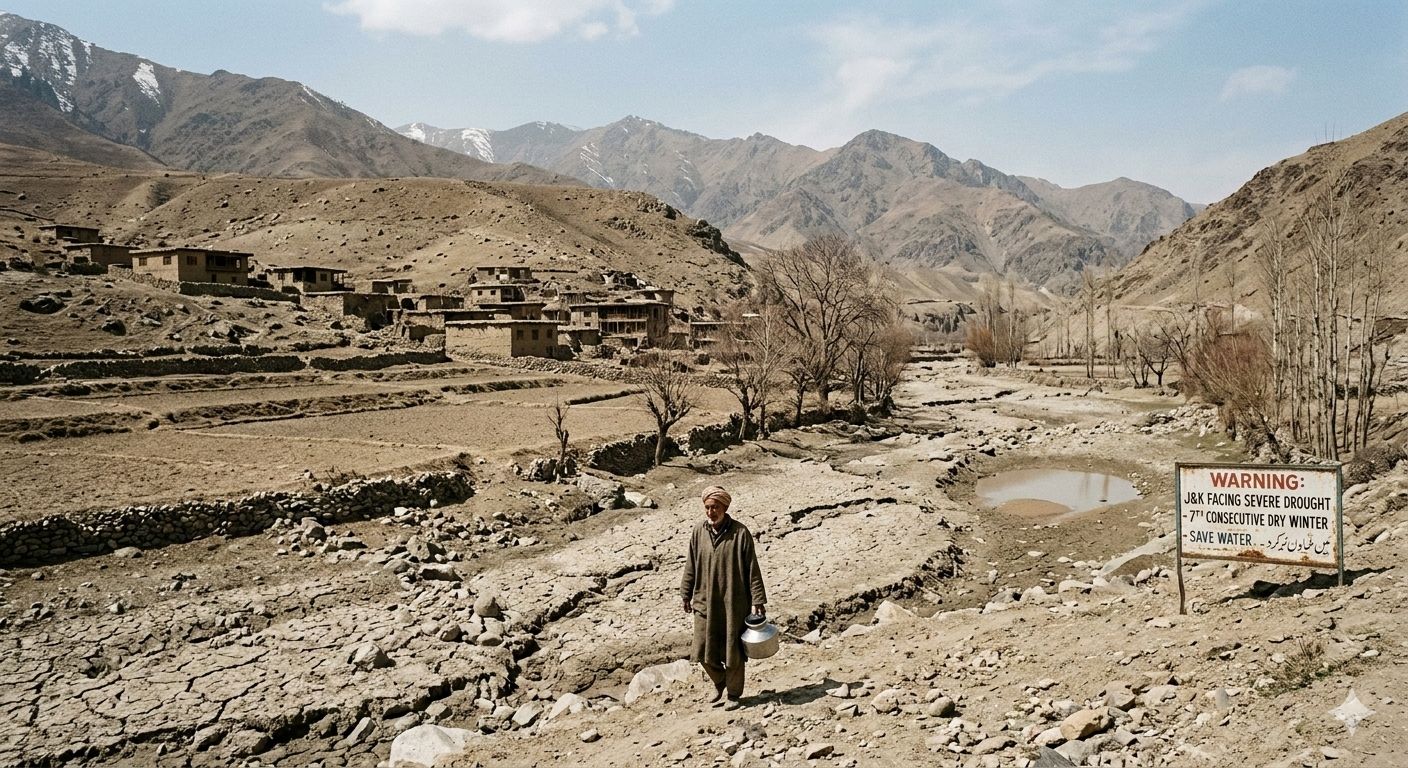
For the seventh consecutive year, Jammu & Kashmir has closed its winter season with a significant rainfall and snowfall deficit. What was once considered an occasional dry spell has now turned into a persistent climatic pattern.
Between December 2025 and February 2026, the Union Territory received only 100.6 mm of precipitation against a normal of 284.9 mm — a 65% deficit. February 2026 was particularly alarming, recording just 14.2 mm of rainfall against a normal of 130.4 mm, marking an 89% shortfall.
These figures are not isolated anomalies. They reflect a structural shift in winter weather patterns across the Himalayan region.
As meteorologists predict snowfall in higher reaches on Tuesday, with humidity expected to prevail over southern districts, a larger question remains: Will one spell of snow reverse seven years of deficit?
Ground reports suggest the answer is far more complex.
Understanding the Pattern: Seven Consecutive Dry Winters in J&K
The Numbers Behind the Crisis
According to seasonal meteorological data compiled from regional weather observatories:
-
Total Winter Precipitation (Dec 2025–Feb 2026): 100.6 mm
-
Seasonal Normal: 284.9 mm
-
Deficit: 65%
-
February 2026 Rainfall: 14.2 mm
-
February Normal: 130.4 mm
-
Deficit: 89%
This marks the seventh straight winter where precipitation has remained below normal.
Meteorologists point to weakening and irregular Western Disturbances — the primary drivers of winter snowfall in North India — as a major factor.
Western Disturbances, which originate in the Mediterranean region and move eastwards, historically bring heavy snowfall to Kashmir’s higher reaches. However, in recent years, these systems have either weakened before reaching the Himalayas or shifted their trajectory northwards.
The result? Less snow, shorter winter spells, and prolonged dry intervals.
Ground Reality: What Dry Winters Mean for Jammu & Kashmir
Numbers tell one part of the story. The lived experience on the ground reveals the rest.
01. Agriculture Under Stress: Rabi Crops at Risk
In rural districts of both Kashmir Valley and Jammu division, farmers are increasingly anxious.
Rabi crops such as:
-
Wheat
-
Mustard
-
Barley
depend heavily on winter moisture — both rainfall and snowmelt.
Traditionally, snow cover acts as a natural reservoir. As it melts gradually in spring, it replenishes soil moisture and irrigation channels. With reduced snowfall:
-
Soil moisture declines.
-
Irrigation demand rises.
-
Groundwater stress increases.
-
Crop yield risks escalate.
Agricultural experts warn that repeated winter deficits weaken soil health over time, making farming more input-intensive and less sustainable.
In rain-fed belts, especially in South Kashmir and parts of Jammu division, farmers are already reporting stunted growth in wheat crops due to moisture stress.
02. Hydropower Concerns: A Silent Energy Threat
Jammu & Kashmir is heavily dependent on hydropower generation from its river systems fed by snowmelt.
Reduced snowpack means:
-
Lower spring discharge in rivers.
-
Reduced reservoir storage.
-
Declining power generation capacity.
If snow accumulation remains low, the ripple effect may be felt in summer through:
-
Energy shortages.
-
Increased dependence on power imports.
-
Higher fiscal burden on the administration.
Hydropower engineers emphasize that winter snowfall acts as a “natural bank deposit” for summer electricity generation. A deficit year reduces that deposit significantly.
03. Tourism Sector Hit: Dry Slopes in Gulmarg and Pahalgam
Winter tourism has long been a cornerstone of Kashmir’s economy.
Two major destinations illustrate the impact:
-
Gulmarg
-
Pahalgam
Both are known for snow-based tourism, skiing, and winter sports.
This year:
-
Snowfall was delayed.
-
Snow depth remained below average.
-
Ski slopes required artificial management in some stretches.
-
Tourist bookings fluctuated due to uncertainty.
Local hotel owners report that while footfall did not collapse entirely, the duration of winter tourism shortened. Skiing windows became unpredictable.
For daily wage workers — pony handlers, ski instructors, snowmobile operators — even a two-week reduction in peak snow season means major income loss.
04. Ecological Impact: Glaciers and Forests Under Pressure
Environmental scientists warn that repeated low-snow winters accelerate glacier retreat.
In the Himalayan ecosystem:
-
Snow replenishes glaciers.
-
Snow cover regulates ground temperature.
-
Snow reduces early spring evaporation.
When snowfall declines:
-
Glaciers shrink faster.
-
River flow becomes erratic.
-
Biodiversity patterns shift.
-
Forest fire risk increases in late spring due to dry undergrowth.
Kashmir has already seen rising incidents of forest fires in recent pre-summer seasons — a phenomenon once rare in snow-heavy years.
The ecological stress is cumulative. Seven dry winters in a row magnify long-term risk.
The Role of Western Disturbances: A Changing Atmospheric Pattern
Winter weather in Jammu & Kashmir depends largely on Western Disturbances (WDs).
In January 2026:
-
A few weak Western Disturbances passed over the region.
-
They brought scattered precipitation.
-
However, intensity remained below seasonal average.
Meteorologists suggest three emerging trends:
-
Western Disturbances are becoming more erratic.
-
Some systems are tracking north of Kashmir.
-
Rising temperatures may be altering precipitation type — rain instead of snow.
Even slight warming can change snow into rainfall, reducing long-term snowpack.
Short-Term Forecast: Snowfall Likely, Humidity to Prevail
Weather reports indicate:
-
Snowfall likely in higher reaches on Tuesday.
-
Cloud cover over the Valley.
-
Humidity levels to remain high in southern districts.
While this may provide temporary relief, experts caution that isolated snowfall cannot compensate for a season-long deficit of 65%.
What matters is sustained snow accumulation — not scattered episodes.
Is This Climate Change? Or Cyclical Variability?
The key question emerging across scientific forums is whether this pattern is cyclical or structural.
Climate researchers studying Himalayan trends observe:
-
Rising average winter temperatures.
-
Reduced snow duration.
-
Increased frequency of extreme weather events.
-
Shifts in precipitation timing.
Seven consecutive deficit winters strongly suggest a structural shift rather than coincidence.
While natural variability plays a role, climate change appears to be intensifying the pattern.
Water Security: The Emerging Crisis
Water scarcity is the underlying threat tying together agriculture, hydropower, and ecology.
Reduced snow means:
-
Lower spring recharge.
-
Reduced streamflow.
-
Pressure on irrigation canals.
-
Stress on drinking water supplies in rural belts.
Urban centers may manage through storage and infrastructure, but remote villages dependent on natural springs are more vulnerable.
Several springs in Kashmir have reportedly shown declining discharge over recent years — a worrying trend.
Socio-Economic Ripple Effects
When winters remain dry repeatedly, the impact is layered:
-
Farmers face income instability.
-
Tourism workers face seasonal job losses.
-
Energy deficits strain public finances.
-
Ecosystem degradation increases disaster risk.
The convergence of these factors can create what experts term a “compound climate risk scenario.”
Policy Gaps and the Way Forward
Despite recurring deficits, climate adaptation measures remain limited.
Experts recommend:
-
Improved snow monitoring systems.
-
Glacier mapping and hydrological forecasting.
-
Diversified crop patterns.
-
Micro-irrigation systems.
-
Artificial snow infrastructure for tourism sustainability.
-
Spring rejuvenation programs.
-
Strengthened water storage mechanisms.
Long-term climate resilience planning is now essential.
Voices from the Valley
Local farmers express growing anxiety over uncertainty. Tourism operators speak of unpredictable seasons. Environmental activists warn that glacier retreat may cross irreversible thresholds if warming continues.
The lived experience is consistent: winters are not what they used to be.
Conclusion: A Region at a Turning Point
Jammu & Kashmir’s seventh consecutive dry winter is not just a weather statistic. It is a warning.
A 65% seasonal deficit and 89% February shortfall represent more than numbers — they signal structural climate stress.
While snowfall may arrive this week, it cannot erase seven years of declining winter precipitation.
If current patterns persist:
-
Agriculture could weaken.
-
Hydropower may face instability.
-
Tourism could become volatile.
-
Water scarcity risks may intensify.
The region stands at a climatic crossroads.
The coming years will determine whether adaptive planning, scientific forecasting, and policy reform can stabilize the situation — or whether dry winters become the new normal in the Himalayan landscape.
For now, the sky over Jammu & Kashmir carries both snow clouds and uncertainty.
And the Valley waits.