Jammu Bridge Collapse Kills 3 Workers: Safety Lapses Under Scrutiny in Bantalab Tragedy
By: Javid Amin | 02 May 2026
A tragic infrastructure failure on the outskirts of Jammu city has once again exposed serious concerns over construction safety and oversight in Jammu & Kashmir.
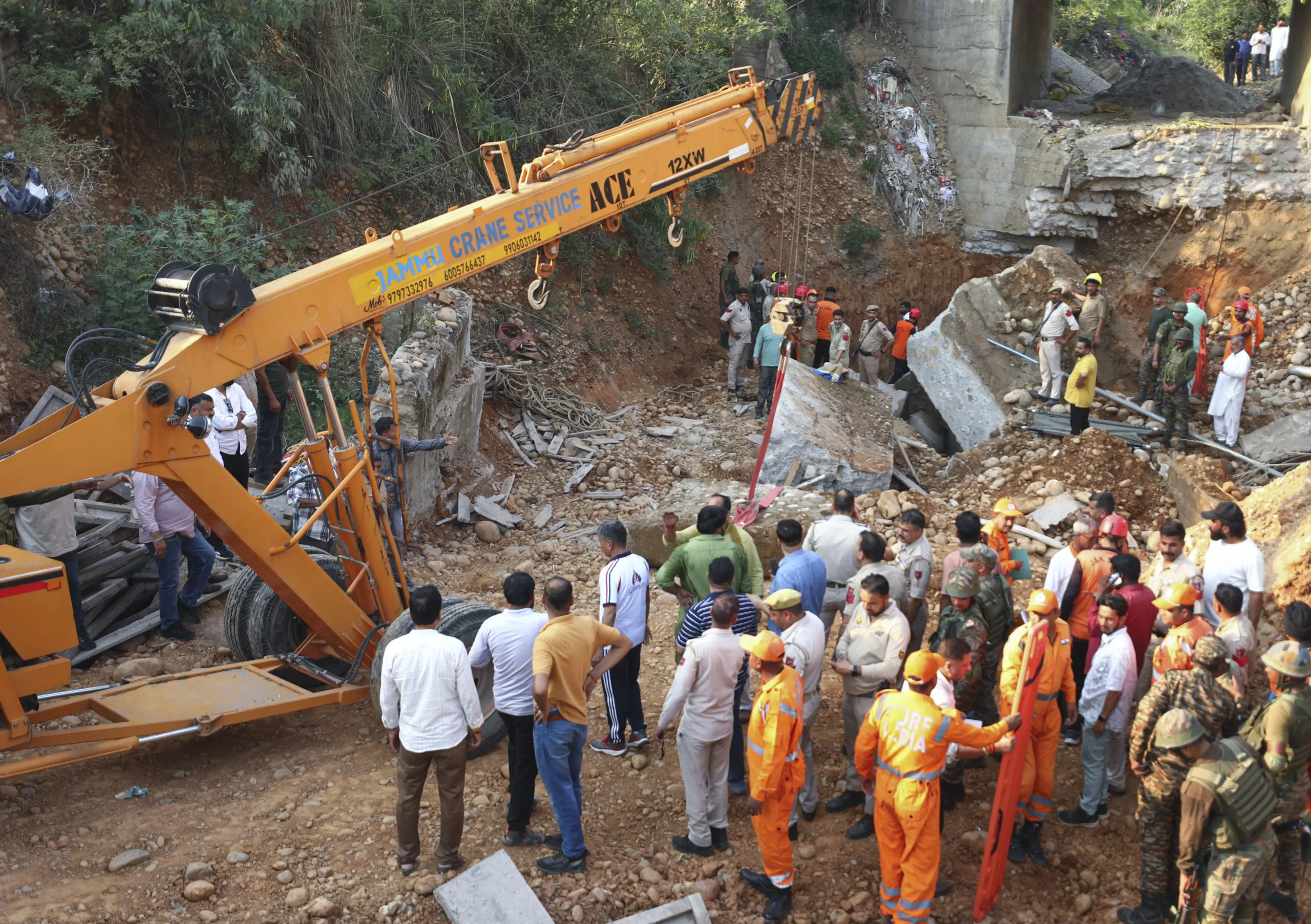
On May 1, 2026, a portion of an under-repair bridge collapsed in Thuther locality of the Bantalab area, killing three workers and injuring two others during active construction work. The incident has triggered swift administrative action, including suspensions and a high-level probe.
What Happened: Collapse During Repair Work
The accident occurred at a bridge site in Thuther, part of the Bantalab belt, where repair and reinforcement work was underway following damage caused by flash floods last year.
According to initial reports:
- The collapse took place during retaining wall and foundation work
- A section of the structure gave way अचानक, trapping workers under debris
- Large stones and construction material fell into the work zone
The bridge had already been structurally weakened by earlier flood damage, raising immediate concerns about the quality of restoration work and on-site safety protocols.
Casualties: Workers From Outside States Among Victims
Authorities have confirmed the deaths of three workers:
- Panchu Sethi (50), from Odisha
- Harish Kumar (28), from Chhattisgarh
- Raj Kumar (30), from Chhattisgarh
Two others were injured, including a senior rescue official:
- Divisional Fire Officer Mohammad Jaffar, who sustained injuries after being struck by a boulder during the rescue operation
The injured were shifted to nearby hospitals, where they are undergoing treatment.
Rescue Operation: 12-Hour Overnight Effort
The rescue operation was extensive and continued for nearly 12 hours under challenging conditions.
Agencies Involved
- Police
- Indian Army
- NDRF and SDRF teams
- Fire & Emergency Services
Equipment Deployed
- JCB machines
- Cranes
- Hydraulic cutters
- Floodlights for night operation
Rescuers worked through the night to:
- Clear heavy debris
- Retrieve trapped workers
- Stabilize the site to prevent further collapse
Despite the scale of the operation, three lives could not be saved.
Government Action: Suspensions and High-Level Probe
In the immediate aftermath, the administration moved quickly to initiate accountability measures.
Officials Suspended
- Assistant Executive Engineer Sahil Verma
- Junior Engineer Sajad Mir
Administrative Action
- Executive Engineer attached to headquarters pending inquiry
Probe Committee
A three-member investigation panel has been constituted under:
- Purshotam Kumar, Engineer-in-Chief, PWD
The committee has been tasked to:
- Determine the exact cause of the collapse
- Fix responsibility for lapses
- Recommend safety and structural reforms
The report is expected within 5 to 15 days, depending on directives.
Political Response: Condolences and Call for Accountability
Chief Minister Omar Abdullah expressed deep grief over the loss of lives and ordered a thorough investigation into the incident.
Lieutenant Governor Manoj Sinha also conveyed condolences and emphasized the need for strict accountability and corrective action.
The tragedy has sparked wider concern across political and administrative circles, with calls for stronger monitoring of infrastructure projects.
Key Questions: Could This Have Been Prevented?
The incident raises several critical questions:
1. Structural Integrity
Was the bridge adequately assessed before repair work began, especially after flood damage?
2. Safety Protocols
Were workers provided with proper safety gear and structural safeguards?
3. Contractor Oversight
Was there sufficient supervision of contractors and adherence to engineering standards?
Initial local reports suggest possible lapses in site risk assessment and execution quality.
Worker Safety: The Invisible Crisis
This tragedy also highlights a deeper issue—the vulnerability of construction workers, many of whom are migrant labourers.
Common concerns include:
- Lack of safety training
- Minimal protective equipment
- Limited insurance or compensation mechanisms
Despite being central to infrastructure development, worker safety often remains reactive rather than preventive.
Infrastructure Risks in J&K: A Pattern Emerging
Jammu & Kashmir’s terrain and weather conditions make infrastructure projects inherently complex:
- Flash floods weaken existing structures
- Soil instability affects foundations
- Rapid repairs often prioritize speed over safety
Without rigorous audits and monitoring, such projects can become high-risk zones.
What Needs to Change: Beyond Immediate Action
Experts suggest that preventing such tragedies requires systemic reform:
Immediate Measures
- Mandatory on-site safety audits before repair work begins
- Deployment of independent structural engineers
- Strict compliance with labour safety standards
Long-Term Reforms
- Transparent contractor accountability systems
- Blacklisting of negligent firms
- Real-time monitoring of major infrastructure projects
Conclusion: Development Without Safety Comes at a Cost
The Bantalab bridge collapse is more than an isolated accident—it is a reminder of the human cost of infrastructural negligence.
As investigations proceed, the focus must shift from temporary action to lasting reform. Because for the workers who lost their lives, accountability after the fact is not enough.
Safety must become foundational—not optional—in every development project across Jammu & Kashmir.


